
Carpenter Ants Are Destroying Homes Right Now — Here’s What to Do
How to get rid of carpenter ants starts with one critical step: find the nest and eliminate it. Surface sprays alone won’t solve the problem. Here’s a quick overview of what works:
- Locate the nest – Follow ant trails at night with a flashlight; look for sawdust-like frass near wood
- Treat the nest directly – Apply insecticidal dust, boric acid, or borax bait into nest galleries
- Eliminate moisture sources – Fix leaks and replace decaying wood that attracts and sustains colonies
- Seal entry points – Caulk cracks, trim tree branches touching your home, store firewood away from the structure
- Monitor and repeat – Baits can take several weeks to fully collapse a colony; re-inspect regularly
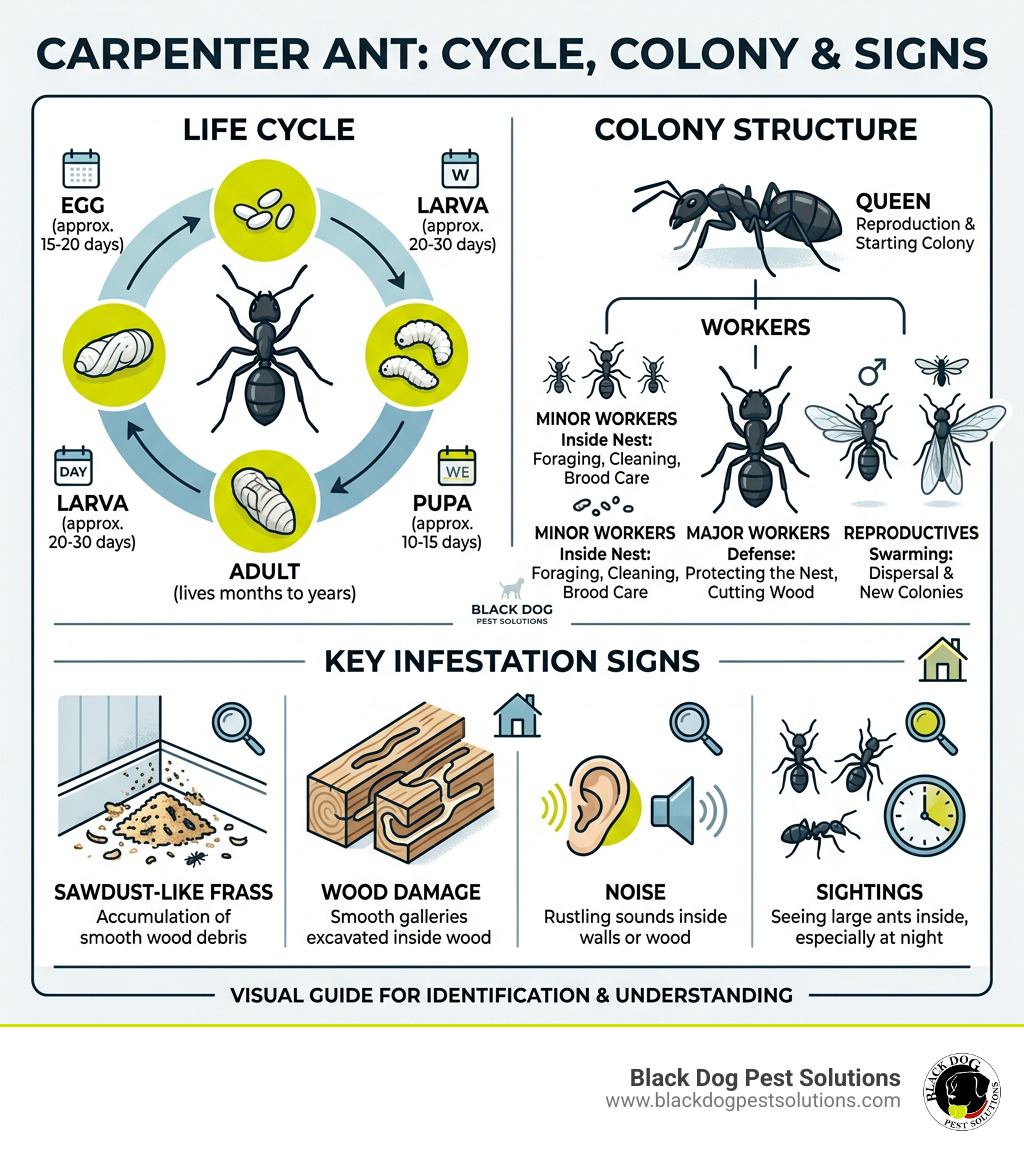
These ants don’t eat wood — they excavated it. They hollow out galleries inside your walls, floors, and structural beams to build their nests. A mature colony can reach up to 10,000 individuals, and by the time you spot them, the damage may already be significant.
In Northern Ohio, carpenter ants are an especially common problem. Wet winters, aging wood, and tree-heavy neighborhoods give them plenty of opportunity to move in — often without homeowners noticing until the infestation is well established.
I’m Mat Ledyard, owner of Black Dog Pest Solutions in Avon, Ohio, and I’ve been in the pest control industry since 2005 — helping homeowners across Northeast Ohio figure out exactly how to get rid of carpenter ants before they cause serious structural damage. In this guide, I’ll walk you through everything you need to know, from identifying the pest to eliminating it for good.
Identifying the Culprit: Carpenter Ants vs. Termites
Before you start your eviction process, you need to make sure you’re fighting the right enemy. In Northern Ohio—from Cleveland to Sandusky—homeowners often confuse carpenter ants with termites. While both can compromise your home’s structural integrity, they are very different biological “beasts.”
The most important distinction is their diet. Termites actually eat the cellulose in wood. Carpenter Ants, on the other hand, are like tiny, uninvited contractors; they chew through the wood to create galleries for their nests but don’t actually consume it.
To tell them apart, look closely at their physical features. You can use this Carpenter ant identification key for a deep dive, but here are the highlights:
| Feature | Carpenter Ants | Termites |
|---|---|---|
| Antennae | Elbowed (bent) | Straight (like a string of beads) |
| Waist | Pinched, narrow “wasp” waist | Thick, straight waist |
| Wings | Front wings longer than back wings | All four wings are equal length |
| Thorax | Smooth, evenly rounded top | Flat or lumpy |
| Debris | Leave “frass” (sawdust mixed with insect parts) | Leave mud tubes or tiny pellets |
Carpenter ants in our region, like the Camponotus pennsylvanicus (Black Carpenter Ant), are among the largest ants you’ll see. Workers range from 1/4 to 1/2 inch, while a queen can reach a full inch in length. If you see large, dark ants with a single node (hump) between their thorax and abdomen, you’ve likely found your culprit. For more details on local species, check out our page on Ants.
How to Get Rid of Carpenter Ants: Locating the Nest
If you want to know how to get rid of carpenter ants permanently, you have to find the “heart” of the operation. Treating a few foragers in your kitchen with a supermarket spray is like trying to put out a forest fire with a squirt gun—it might look like you’re doing something, but the source remains untouched.
The Parent and Satellite Connection
Carpenter ants often operate with a “hub and spoke” system. The parent colony is usually located outdoors in a high-moisture environment like a rotting tree stump, a firewood pile, or an old fence post. This is where the queen lives and where the eggs are laid.
Satellite nests are what we usually find inside Ohio homes. These are established when the parent colony gets too large. They don’t require the same high moisture levels as the parent nest, which is why you might find them in dry wall voids, insulation, or even hollow-core doors.
Detective Work: Tracking the Trails
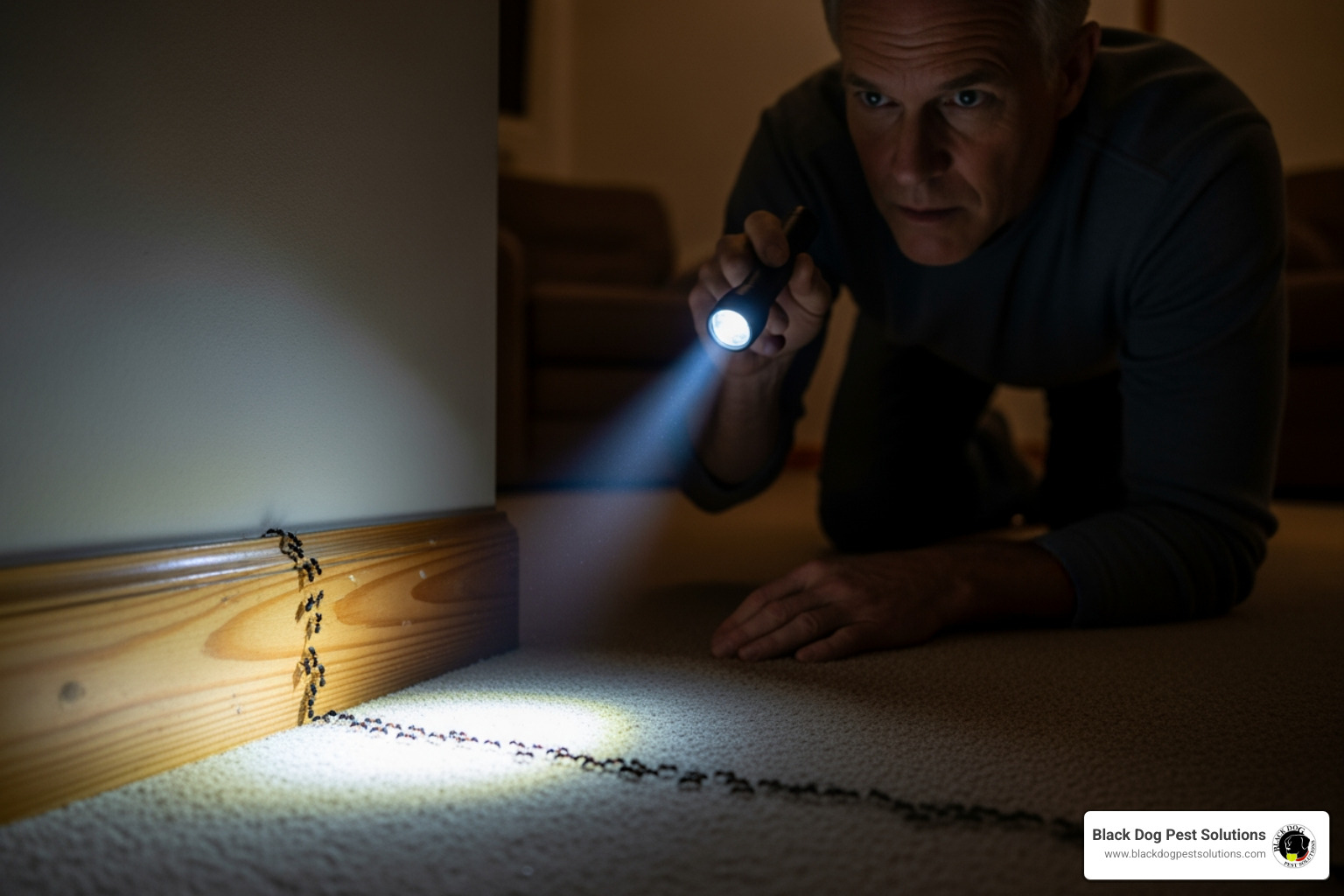
Because carpenter ants are primarily nocturnal, your best tool is a flashlight and a little bit of patience.
- Nighttime Inspection: Peak activity usually happens between 10 PM and 2 AM. Walk the perimeter of your home and check interior walls.
- Follow the Scent Trails: These ants use pheromone “highways” to travel between nests and food sources. They often follow structural edges like baseboards, carpet edges, or even utility wires.
- Listen for Rustling: If the infestation is large, you can actually hear them! Tap on a suspect wall; if you hear a sound like crinkling cellophane, you’ve likely hit a nest.
- Look for Frass: Since they don’t eat wood, they have to “kick out” the debris. Look for small piles of coarse sawdust mixed with dead ant parts. This is a “smoking gun” for a nearby nest.
For more expert tips on finding these hidden invaders, read about our professional ant removal methods.
Effective DIY Strategies for Carpenter Ant Removal
Once you’ve located the general area of the nest, it’s time to take action. Successful DIY removal requires a multi-pronged approach using baits, dusts, and sometimes direct injections.
Using Baits to Get Rid of Carpenter Ants
Baiting is often the most effective DIY method because it utilizes the ants’ own social behavior against them.
- The Trojan Horse Effect: Ants find the bait, eat it, and—crucially—carry it back to share with the rest of the colony, including the queen.
- Sugar vs. Protein: Carpenter ants change their preferences seasonally. In the spring, they often crave protein (like tuna or cat food). In the summer, they switch to sweets (like honey or sugar water).
- Borax Recipe: A common home remedy involves mixing 1/2 cup of sugar, 1.5 tablespoons of Borax, and 1.5 cups of warm water. Soak cotton balls in the mixture and place them in shallow containers near ant trails.
Pro Tip: Be patient! Baits are designed to be slow-acting. If the ant dies immediately, it can’t take the poison back to the nest. You might see more ants initially—don’t spray them! Let them finish their “last meal.”
Applying Dusts and Sprays to Get Rid of Carpenter Ants
If you can pinpoint the nest location in a wall void, “drill-and-fill” is a powerful technique.
- Desiccant Dusts: Products like Diatomaceous Earth or Silica Gel work by drying out the ant’s exoskeleton. They are non-toxic to humans and pets but lethal to ants.
- Boric Acid: This can be puffed into wall voids using a bulb duster. It acts as a stomach poison when the ants groom themselves.
- Pyrethrins: Derived from chrysanthemum flowers, these are natural neurotoxins. You can learn more about Pyrethrins safety and usage to ensure you’re using them correctly.
When applying these, focus on “voids”—the empty spaces behind electrical outlets, under sinks, and inside walls where pipes enter. Always wear a mask when working with dusts to avoid inhalation. If you’re unsure about chemical applications, explore our residential pest control options.
Long-Term Prevention: Keeping the Ants Away
Eliminating the current colony is only half the battle. In Northern Ohio, if your home is attractive to one colony, it will be attractive to the next one. Prevention is about making your home a “fortress” against future invaders.
Moisture Control is Key
Carpenter ants are “moisture-seeking missiles.” They rarely nest in perfectly dry, sound wood.
- Fix Leaks: Check under sinks, around chimneys, and near window frames. Even a small, slow leak can soften wood enough to invite a colony.
- Improve Ventilation: Ensure crawl spaces and attics are well-ventilated to prevent condensation.
- Gutter Maintenance: Clogged gutters cause water to back up against the fascia boards—a prime real estate spot for carpenter ants.
Exterior Maintenance
- Trim the “Bridges”: Tree branches and shrubs touching your house act as bridges for ants. Keep vegetation at least 2 feet away from your siding.
- Firewood Storage: Never store firewood against your house or inside your garage. Keep it elevated and at least 20 feet away from the foundation.
- Seal the Gaps: Use silicone caulk to seal cracks in the foundation and gaps around utility pipes.
For a seasonal checklist tailored to our local climate, see our summer ant prevention strategies.
Frequently Asked Questions about Carpenter Ants
Are carpenter ants dangerous to humans or pets?
Generally, no. They are not known to carry diseases like cockroaches or ticks. While they can bite if their nest is disturbed, they don’t have a stinger, and the bite is more of a sharp pinch than a medical emergency. The real “danger” is to your wallet—unmanaged infestations can lead to thousands of dollars in structural repairs. Regarding baits, while Borax is low-toxicity, it should always be kept out of reach of curious pets and toddlers.
How long does it take to fully eliminate a colony?
It’s not an overnight process. If you are using baits, it can take anywhere from two weeks to a month to see a total collapse of the colony. If you are treating the nest directly with dusts, you might see results in a few days. However, because of the satellite nest system, we usually recommend a 30-day monitoring period to ensure no “stragglers” are rebuilding.
What is the most common mistake in treating carpenter ants?
The #1 mistake is “repelling” instead of “eliminating.” When homeowners see ants and immediately spray a heavy-duty repellent across the baseboards, they often “lock” the ants inside the walls. The ants simply find a new route, and the homeowner thinks the problem is solved because they don’t see them on the floor anymore. Meanwhile, the ants continue to chew through the structural beams. Another mistake is ignoring the moisture issue; if you don’t fix the wet wood, new ants will eventually find it.
Conclusion
Knowing how to get rid of carpenter ants is about more than just a quick spray; it’s about understanding their biology and outsmarting their colony structure. From the historic homes in Lakewood to the newer builds in Avon Lake, no house is completely immune to these wood-excavating pests.
A mature colony is a formidable opponent. With over 90% of colonies failing in their early stages, the ones that actually make it into your home are the “survivors”—they are resilient and industrious. While DIY methods can work for small, localized issues, larger infestations often require professional-grade tools and non-repellent transfer insecticides that simply aren’t available at the local hardware store.
At Black Dog Pest Solutions, we pride ourselves on being the local experts in Northern Ohio. Whether you’re in Bay Village, Westlake, or North Ridgeville, we understand the local pest pressures. We don’t just spray and leave; we conduct a thorough investigation to find the parent nest and the moisture sources that started the trouble in the first place.
Don’t let these tiny carpenters renovate your home without a permit. If you’ve seen the signs—the frass, the nocturnal foragers, or the winged swarmers—it’s time to act. Schedule your carpenter ant eviction today and let us help you protect your biggest investment with our 4.9-star rated professional service.