
Small flies in the kitchen peak with the garden harvest around here. Tomatoes come in off the vine and a few squash sit on the counter. Someone brings over a bag of grapes. Within a week, small flies circle the sink.
The frustrating part is how fast they come back. You wipe down the counter, throw out the bananas, spray the ones you can see, and two days later they’re back at the same spot. That pattern usually means the breeding site is still there.
Why late summer and fall bring the worst of it
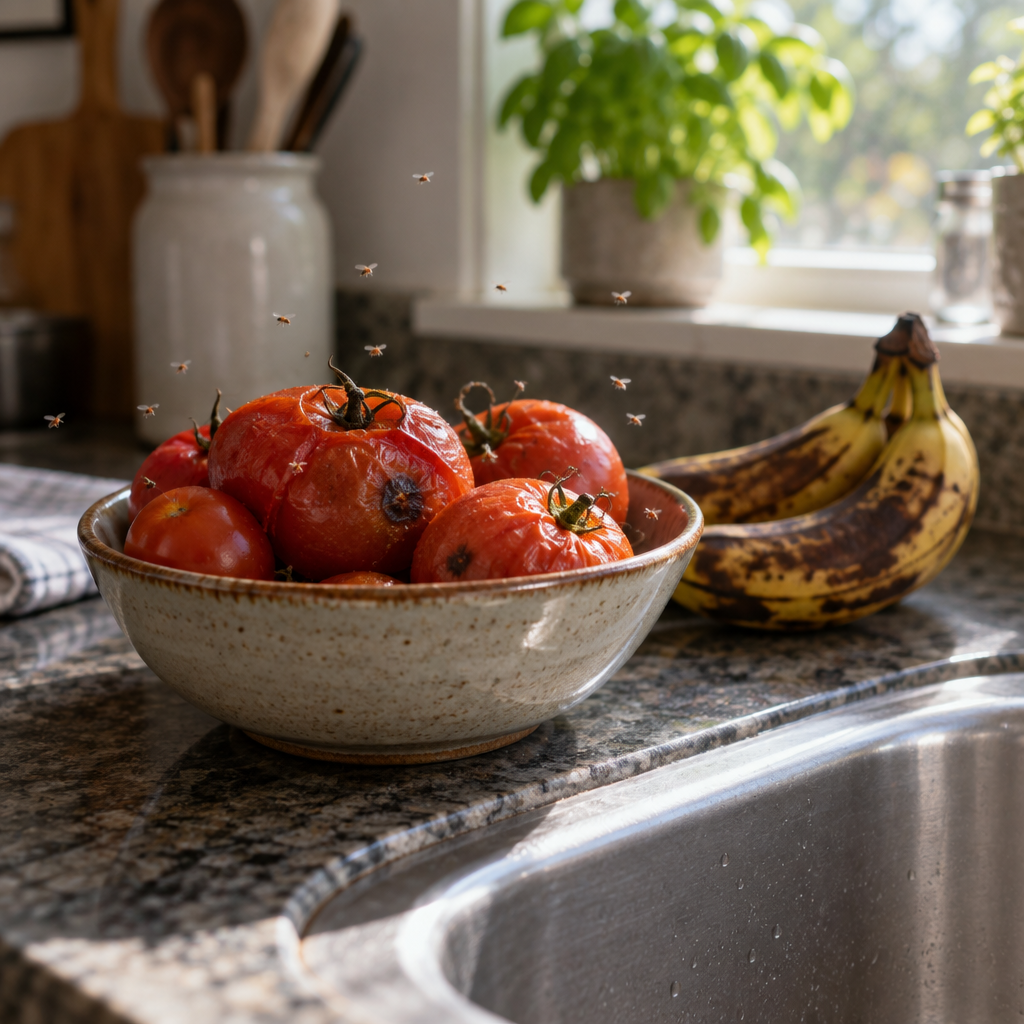
These insects are a year-round possibility that gets much worse on this schedule. University of Kentucky Extension’s fruit fly publication says they’re especially common in late summer and fall, when ripened and fermenting fruits and vegetables draw them in. It names the usual carriers. Tomatoes, melons, squash and grapes come in from the garden, and rotting bananas, potatoes and onions come from the store.
The adults are about 1/8 inch long, usually with red eyes, a tan front half and a black rear. Females lay eggs near the surface of fermenting food, and the larvae feed near that surface. That habit has a useful consequence. A damaged or over-ripe section can be cut away without discarding the rest of the fruit.
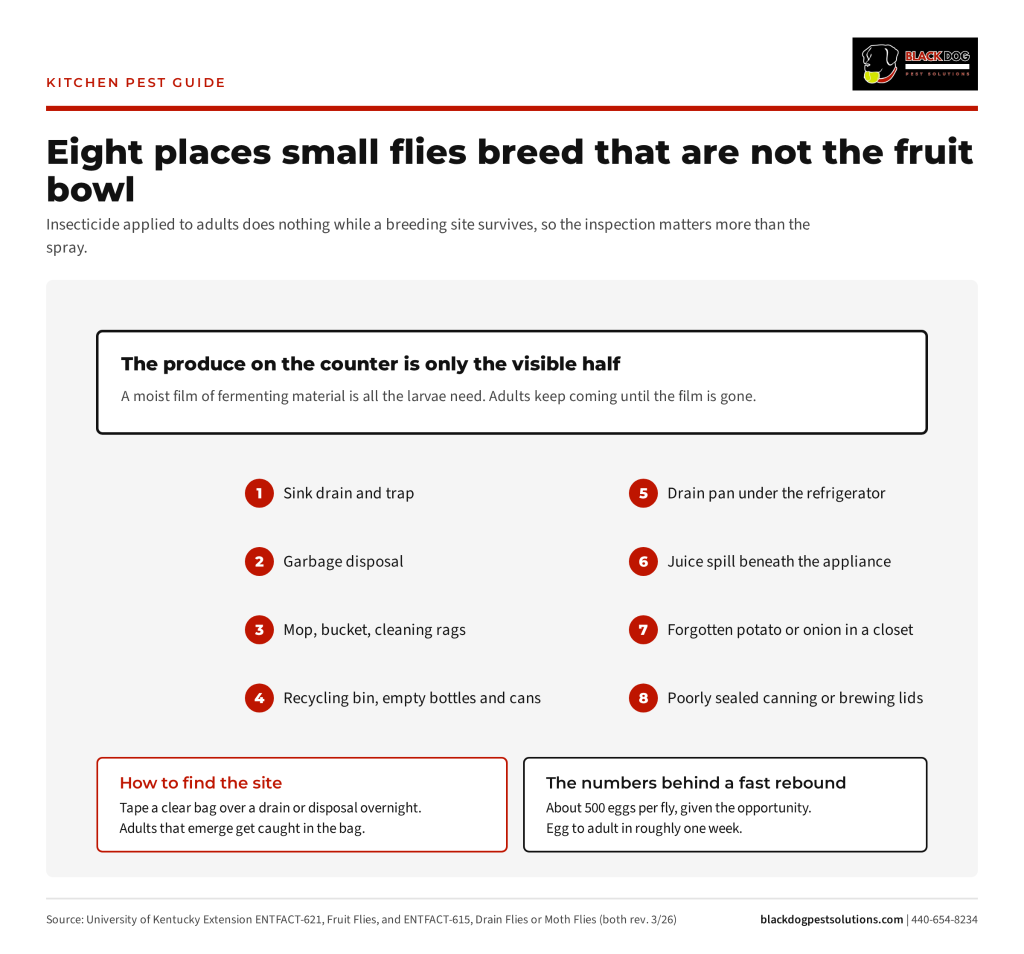
Reproduction is what makes a small oversight expensive. Given the opportunity, a fruit fly will lay about 500 eggs, and the entire cycle from egg to adult can finish in about a week. Kentucky Extension gives the examples that catch people out. One forgotten potato or onion at the back of a closet can breed thousands of flies. So can juice spilled under the refrigerator, or a recycling bin in the basement that sits unwashed.
They also breed in places you would not think to check for fruit. Drains, garbage disposals, empty bottles and cans, trash containers, mops and cleaning rags all qualify. A moist film of fermenting material is all the larvae need.
Two very different small flies, one kitchen
| Small fly | How to recognize it | Where it breeds | Source |
| Fruit fly, also called vinegar fly | About 1/8 in. Red eyes. Tan front, black rear. It hovers near produce. | Fermenting fruit and vegetables. Also drains, bottles, mops and rags. | UK ENTFACT-621. |
| Drain fly, also called moth fly | Small and dark. Fuzzy wings leave dust when swatted. It rests on walls and hops. | Slime films in drains, seldom-used toilets, and drain pans. | UK ENTFACT-615. |
| Either one after a vacation | Flies show up when you get home. | Standing water in unused traps and toilets. It often clears once water moves. | UK ENTFACT-615. |
Sources: University of Kentucky Extension ENTFACT-621, Fruit Flies, and ENTFACT-615, Drain Flies. Both revised March 2026.
Telling the two apart changes where you look. Kentucky Extension describes drain fly larvae living in the fine slime layer along the water surface in infrequently used toilets. Basement or garage drains and drain pans under refrigerators hold them too. Ending a chronic infestation can be challenging. A drain fly problem treated as a produce problem stays unresolved, and the reverse holds too.
There’s also one instruction from that publication worth repeating. Do not pour insecticides down drains to kill drain flies. Cleaning the pipes and traps to remove accumulated slime is the effective method. The larvae are hard to drown, since they trap air bubbles and stay submerged for a day or more.

Sprays fail when the source survives
Kentucky Extension is blunt about sequence. Once a structure is infested, all potential breeding areas have to be located and eliminated. Unless the sites are removed or cleaned, the problem continues no matter how often insecticides get applied to the adults. An aerosol has a place only after the source is gone, to knock down the adults left flying.
Locating the site is the actual work. Kentucky Extension describes taping a clear plastic food storage bag over an inaccessible opening such as a garbage disposal or drain. Leave it overnight, then check whether adults emerged into the bag. For drains, the same idea works with a clear plastic cup lightly coated with vegetable oil or petroleum jelly, inverted over the drain for several days. If those come up empty, the search expands.
Outdoor sources feed indoor problems too. Kentucky Extension notes that drain flies breed outdoors in summer and enter through open doors and windows. Low wet spots where air conditioning units drain and clogged gutters serve as good development sites. The same publication recommends tight-fitting 16 mesh screens on windows and doors to keep the adults from coming in from outside.
Home canners and brewers get a specific warning. Containers used for canning, wine, cider or beer need to be well sealed. Otherwise the adults lay eggs under the lid, and the larvae enter the container after hatching.
What fruit fly control involves at your house
Most of what fails in a kitchen fails because nobody found the source. Depending on inspection findings and the service selected, work at your property may include locating the breeding sites with emergence traps. It may also include treating harborage and resting surfaces where labeled, plus follow-up to confirm emergence has stopped. Results vary with how much of the moist organic material gets removed, and Kentucky Extension’s own framing supports that: finding the sources can be very challenging and often requires much thought and persistence.
Restaurants, groceries and food processing operations run into the same problem at a scale that draws inspections instead of complaints. Kentucky Extension lists homes, restaurants and supermarkets together as places they thrive wherever food is allowed to rot and ferment. It also notes fruit flies have the potential to contaminate food with bacteria and other disease-producing organisms. Our commercial service covers those accounts, and the inspection there focuses on floor drains, mop sinks, dumpster pads and equipment bases.
For a house, the honest summary is that fly control is a sanitation and inspection job with a treatment component, not a spray schedule. Our fruit fly page explains what the visit covers. Our fly service page covers the other species that show up in kitchens around Avon and Lorain this time of year.
Closing
If small flies keep returning to the same corner of your kitchen, the breeding site is still in the room. Contact Black Dog Pest Solutions and we’ll inspect the drains, disposal and storage areas, identify which fly you have, and put fruit fly control on a footing that protects your kitchen instead of chasing adults. Call 440-654-8234 to schedule the visit.
FAQ
Where are the flies coming from if I threw out the fruit?
Kentucky Extension lists drains, garbage disposals, empty bottles and cans, trash containers, mops and cleaning rags as breeding sites. A moist film of fermenting material is enough, so the produce might not be the source at all.
How fast do they multiply?
A fruit fly may lay about 500 eggs given the opportunity, and the cycle from egg to adult can finish in about a week, according to Kentucky Extension.
Do I have to throw out fruit with one bad spot?
Not usually. Kentucky Extension notes the larvae feed near the surface, so damaged or over-ripened portions can be cut away and discarded while the rest is kept.
How do I know whether it’s fruit flies or drain flies?
Drain flies are dark and fuzzy, rest on walls and ceilings, and leave a cloud of fine dust when swatted. That description comes from Kentucky Extension. Fruit flies are smaller, usually red-eyed, and hover around produce and sink areas.
Should I pour bleach or insecticide down the drain?
Kentucky Extension says not to pour insecticides down drains. Cleaning pipes and traps to remove the slime layer is the effective step, and hot water gives only short-term relief.
Why do flies appear after we come back from vacation?
Water sits still in traps and toilets while you’re gone, which lets larvae develop. Kentucky Extension notes those small infestations often fade once normal water use resumes.