Why Pest Control Investment Matters for Restaurant Owners
Pest control for restaurant cost typically ranges from $100 to $250 per month for routine preventative services, translating to $1,200 to $3,000 annually for most establishments. One-time emergency treatments for active infestations run $150 to $500 per visit, while specialized services like fumigation can exceed $1,000 per treatment.
Quick Cost Overview:
| Service Type | Average Cost | Best For |
|---|---|---|
| Monthly preventative | $100–$250/month | High-traffic kitchens, urban locations |
| Quarterly maintenance | $120–$300/visit | Low-risk establishments |
| One-time emergency | $150–$500 | Active infestations |
| Fumigation | $1,000+ | Severe widespread infestations |
| Rodent control | $200–$400/month | Properties with entry points |
Whether you run a family diner, a fast-food outlet, or an upscale dining establishment, your restaurant must maintain the highest standards of cleanliness and safety. Unfortunately, the same factors that make your business appealing to customers—warmth, food, and moisture—also make it attractive to pests.
A single pest sighting can cost thousands of dollars in lost revenue, failed health inspections, and damaged reputation. The question isn’t whether you can afford professional pest control—it’s whether you can afford not to invest in it.
Understanding pest control costs for a restaurant helps you budget effectively and choose services that protect your business without breaking the bank. Size, location, pest type, and service frequency all influence your final investment, but proactive prevention is always far less costly than dealing with an established infestation.
I’m Mat Ledyard, and I’ve been working in pest control since 2005, helping restaurants and commercial clients across Northern Ohio maintain pest-free operations. Through two decades of experience, I’ve seen how proper budgeting for pest control costs for a restaurant protects both your bottom line and your reputation.
Pest control for restaurant cost terms explained:
- commercial and residential pest control
- commercial pest control companies
- commercial pest control companies near me
Average Pest Control for Restaurant Cost Breakdown
When we talk about pest control for restaurant cost, it is helpful to view it as a tiered investment. Most businesses in Northern Ohio, from Cleveland to Sandusky, find that their expenses fall into three main categories: preventative maintenance, corrective treatments, and specialized emergency services.
According to data on How Much Does Pest Control Cost?, the average single visit for any property is around $171, but restaurants are a different beast. Because the stakes are higher—health codes, food safety, and public reviews—the service frequency is usually higher than a residential home.
| Facility Size / Type | Service Frequency | Estimated Annual Cost |
|---|---|---|
| Small Deli/Bakery (2,000 sq ft) | Monthly | $1,800 – $2,100 |
| Fast Food Chain (5,000 sq ft) | Bi-Weekly | $3,000 – $3,640 |
| Upscale Dining (7,500 sq ft) | Monthly | $4,500 – $4,800 |
| Large Buffet (10,000 sq ft) | Monthly + Specialized | $7,000 – $7,500 |
Monthly vs. Quarterly Service Costs
For most food service establishments, we recommend a monthly service schedule. High-traffic eateries in busy areas like Westlake or Lakewood benefit from the constant “protective shield” that monthly visits provide.
Monthly services typically cost between $75 and $150 per visit, totaling $900 to $1,800 annually. This frequency allows us to catch issues like Fruit Flies or early Roaches activity before it becomes a headline-making infestation. Quarterly services, while cheaper (averaging $400–$1,000 annually), are generally only sufficient for low-risk, dry-storage facilities or small retail shops that don’t prepare fresh food on-site.
By choosing our Commercial Services, many businesses can access subscription-style discounts. Long-term annual contracts can often save a business up to 40% compared to paying for individual one-time treatments throughout the year.
One-Time Emergency Treatment Pricing
If you haven’t had a regular plan and suddenly spot a rodent in the walk-in, you’re looking at an emergency “clean-out.” These initial treatments are more labor-intensive and expensive, often ranging from $150 to $500.
The goal of a one-time treatment is to “flush” the population. However, because pests like Ants or Mice are persistent, one visit is rarely enough. You will almost certainly need follow-up visits to ensure the breeding cycle is broken, which adds to the total pest control cost for a restaurant. This is why we always emphasize that an ounce of prevention is worth a pound (and several hundred dollars) of cure. You can learn more about the different Pests we handle to understand why they require such specific, repeated attention.
Key Factors Influencing Your Pest Control Investment
No two restaurants are exactly alike, and neither are their pest control needs. Several variables will dictate where your specific quote lands on the pricing spectrum.
How Restaurant Size Impacts Pest Control for Restaurant Cost
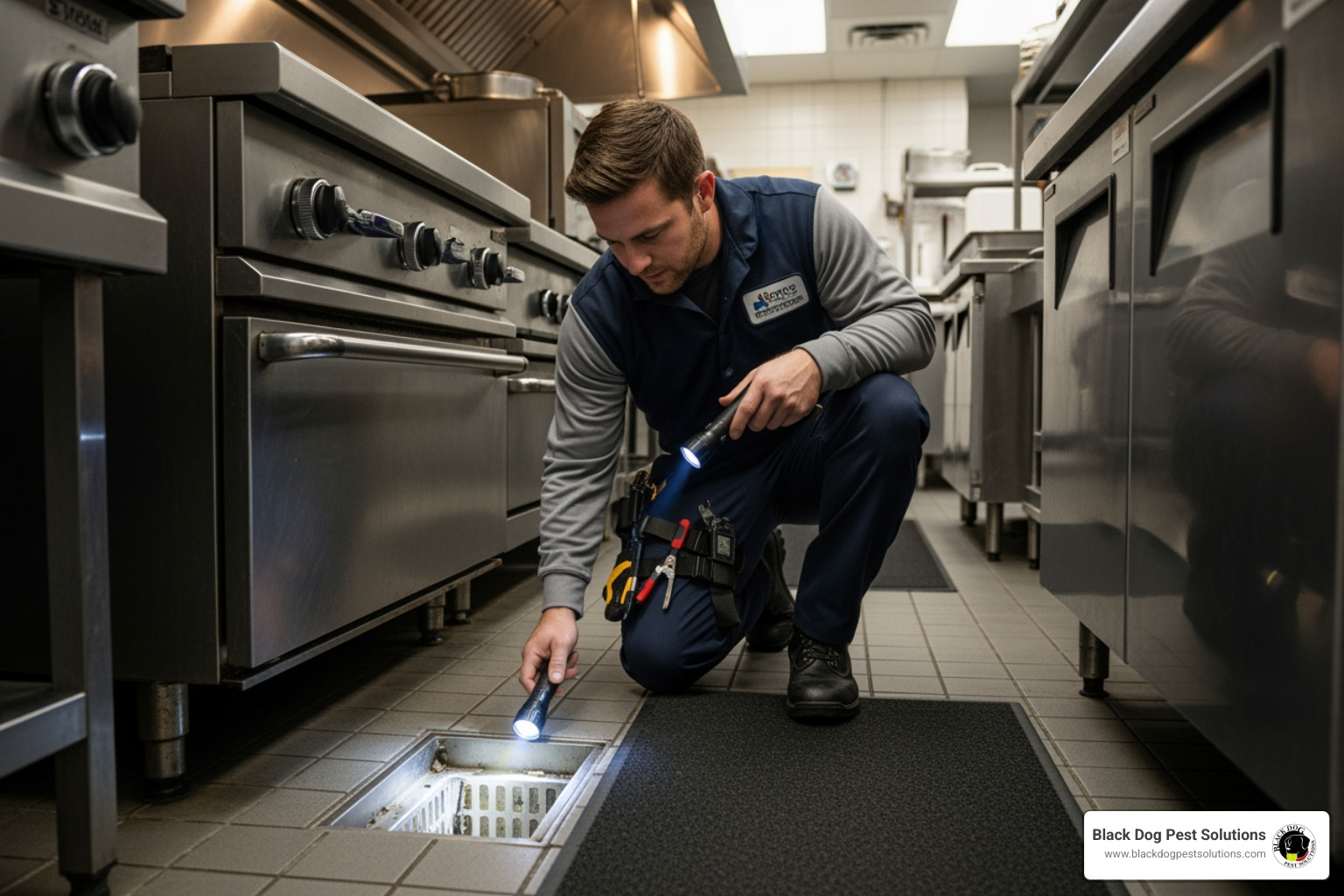
The “footprint” of your facility is one of the biggest price drivers. A larger building requires more bait stations, more liquid barrier, and—most importantly—more of our technician’s time to inspect.
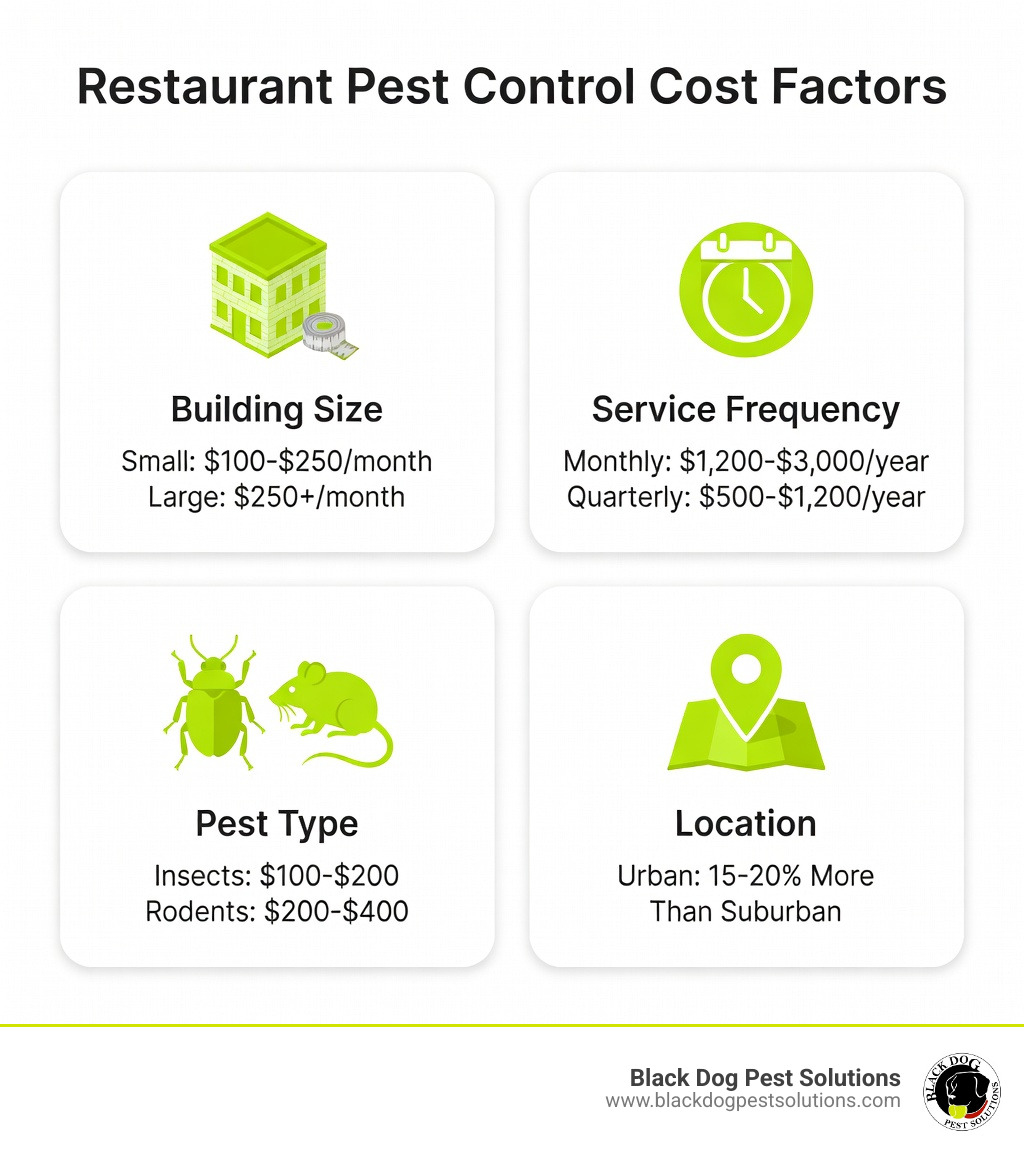
- 5,000 sq ft restaurant: Typically pays around $150 per month for standard prevention.
- 10,000 sq ft restaurant: Typically pays $250 per month or more.
It’s not just about total square footage, though. A 2,000 sq ft bakery with high sugar and flour usage might actually require more intensive monitoring than a 4,000 sq ft furniture store. The kitchen’s complexity, the number of floor drains, and the size of your storage areas all play a role.
Location and Building Condition
Geography matters. In urban centers like Cleveland or downtown Lorain, pest pressure is higher due to neighboring buildings. If the restaurant next door has an issue, it’s only a matter of time before those pests come looking for your kitchen. Urban locations often see costs that are 15-20% higher than suburban or rural areas due to this increased pressure and higher labor expenses.
Building age and condition are also critical. Older buildings in places like Elyria or Amherst may have structural gaps, settling foundations, or old plumbing that provides easy access for Mice. If we have to spend significant time on “exclusion”—sealing up holes and cracks—the initial setup cost will be higher, but your long-term monthly fees will stay lower because we’ve blocked the “front door.”
Pricing by Pest Type and Treatment Method
Different pests require different tools. Treating for a few ants near the front door is a much simpler (and cheaper) task than eradicating a German Cockroach infestation in the heart of a kitchen.
Specialized Pest Control for Restaurant Cost: Rodents vs. Insects
The type of “uninvited guest” you have dictates the price.
- Insects (Ants, Roaches, Spiders): Generally cost around $100 to $200 per month for preventative maintenance.
- Rodents (Rats and Mice): These are more expensive to manage, averaging $200 to $400 per month. This is because rodent control requires heavy equipment like tamper-resistant bait stations, frequent trapping cycles, and constant monitoring of entry points.
Rodents also pose a higher structural risk. They can chew through 16+ pipes, gnaw on electrical wiring, and contaminate thousands of dollars worth of inventory in a single night.
Advanced Treatment Methods
Sometimes, standard sprays and baits aren’t enough.
- Fumigation: This is the “nuclear option.” If an infestation is deep within the walls, tented fumigation may be required. This can cost $1,000 to $8,000+ depending on the size of the building and requires the business to close for several days.
- Thermal Remediation (Heat Treatment): Often used for bed bugs, this chemical-free method uses high heat to penetrate furniture and walls. While effective, it is a premium service that can cost $200 to $400 per room.
- Drain Foaming: A specialized service for Flies and fruit flies. We use biological foams to eat away the organic “gunk” in drains where flies breed. This is often an “ancillary” service that adds a small fee to your monthly bill but saves you from a PR nightmare.
The Real Cost of DIY vs. Professional Extermination
It can be tempting for a new restaurant owner in Avon Lake or North Ridgeville to grab a can of spray from the hardware store and try to handle things in-house. However, DIY pest control is often a “penny wise, pound foolish” strategy.
Health Department Compliance and Documentation
In the restaurant world, if it isn’t documented, it didn’t happen. Professional services provide you with a compliance logbook. When a health inspector from Lorain County or Cuyahoga County walks through your door, they want to see:
- Proof of a licensed pest control provider.
- A record of all treatments and chemicals used (EPA-approved).
- A map of all monitoring devices.
- Trend reports showing that you are proactively managing the facility.
DIY methods don’t provide this audit readiness. A failed health inspection can lead to immediate closure, which is a cost far greater than any monthly service fee. Our Residential Services are great for homes, but for businesses, the documentation side of our Commercial Services is what keeps you legal and open.
Risk Mitigation and Reputation Protection
We live in the age of social media. A single photo of a roach or a Flea shared on a local community Facebook group can tank your reservations for weeks.
- Inventory Loss: Rodents and stored product pests (like weevils or moths) can ruin hundreds of pounds of dry goods.
- Structural Damage: Pests chew through walls and wires, leading to expensive repairs.
- Legal Liability: Pests carry diseases like Salmonella, E. Coli, and Hantavirus. If a customer gets sick, the legal costs can be astronomical.
Professional pest control is essentially an insurance policy for your reputation.
Strategies to Reduce Long-Term Pest Management Expenses
While pest control costs for restaurants is a necessary line item, there are ways to keep those numbers as low as possible through smart management.
Preventative Maintenance and Sanitation
The best way to save money on pest control is to make your restaurant as unattractive to pests as possible. We call this “Integrated Pest Management” (IPM).
- Sanitation: Deep clean under equipment and inside floor drains. Pests can’t survive without food and water.
- FIFO (First In, First Out): Properly rotate your stock so that old bags of flour or grain don’t sit in the back of the pantry and become breeding grounds for beetles.
- Waste Management: Keep dumpsters closed, sanitized, and as far from the back door as possible.
- Moisture Control: Fix leaky pipes immediately. A dripping sink is a 24/7 watering hole for roaches.
Bundling and Contract Negotiation
If you own multiple locations—perhaps one in Rocky River and another in Westlake—you can often negotiate “multi-location discounts.” Bundling services is another great strategy. For example, combining your general insect program with a rodent-proofing plan and a drain-maintenance program is usually significantly cheaper than buying each service separately.
Always look for annual agreements. Most providers in Northern Ohio will offer a 10-20% discount if you commit to a full year of service rather than calling for “as-needed” visits. Check our full list of Services to see how bundling can work for your specific business model.
Frequently Asked Questions about Restaurant Pest Control
What is the average monthly cost for a standard restaurant?
For a standard 5,000 sq ft restaurant in Northern Ohio, you should budget between $125 and $200 per month. This typically covers monthly inspections, preventative spraying of the exterior and interior perimeters, and monitoring for common pests like ants and roaches.
Are initial inspections usually free or paid?
Most professional companies charge an initial inspection fee between $125 and $450 to do a deep dive into your facility’s “hotspots.” However, many providers (including us!) will waive or credit this fee if you sign up for a long-term service contract.
How much does it cost to treat a cockroach infestation?
A minor roach issue might be resolved for $150 to $300. However, a severe, deep-seated German Cockroach infestation in a commercial kitchen can cost $500 to $1,500 because it requires specialized baits, growth regulators, and multiple follow-up visits to kill the eggs that hatch after the first treatment.
Conclusion
Budgeting for pest control for restaurant cost is one of the most important steps you can take to ensure the long-term success of your business. Whether you are in Cleveland, Avon, or Sandusky, the costs of professional prevention are a drop in the bucket compared to the potential losses from health code violations, ruined inventory, or a damaged reputation.
At Black Dog Pest Solutions, we pride ourselves on being the reliable partner Northern Ohio restaurateurs need. With our 4.9/5.0-star rating and decades of local expertise, we understand the unique pest pressures facing our community. We don’t just spray and leave; we provide the documentation, the expertise, and the peace of mind you need to focus on what you do best: serving great food.
Don’t wait for a sighting to become a crisis. Protect your bottom line and your brand today. Explore our Commercial Services to find a plan that fits your budget and keeps your business bug-free.