
What Is Humane Mouse Removal — and How Do You Do It?
Humane mouse removal means getting mice out of your home while minimizing stress and suffering — for the animal and for you. Here is a quick overview of the approach:
- Inspect — Find signs of activity (droppings, gnaw marks, nesting materials)
- Seal — Close off entry points about 1/4 inch or smaller using metal materials more resistant to chewing
- Sanitize — Remove food sources and clutter that attract mice
- Trap if needed — Consider live-catch traps where appropriate, and check them frequently
- Monitor — Watch for new activity and repeat as needed
This Integrated Pest Management (IPM) approach is widely recommended as the most practical and humane control strategy available.
Picture this: it’s a quiet evening, you’re settling in, and something small darts across your kitchen floor. Your first instinct might be to reach for a snap trap or a can of poison — but there are better options.
Mice reproduce quickly, and a small problem can grow before you realize it. Local weather and building conditions can also make homes more attractive to mice, especially as temperatures drop. The good news is that a thoughtful, step-by-step approach can help reduce activity and prevent future entry — without causing unnecessary harm.
Prevention is the best long-term approach. But when mice are already inside, knowing what to do next makes all the difference.
I’m Mat Ledyard, owner of Black Dog Pest Solutions in Avon, and I’ve been working in pest control since 2005 — with humane mouse removal being one of the most common calls I receive from Northern Ohio homeowners. In that time, I’ve learned that the methods you use matter as much as the results you get.
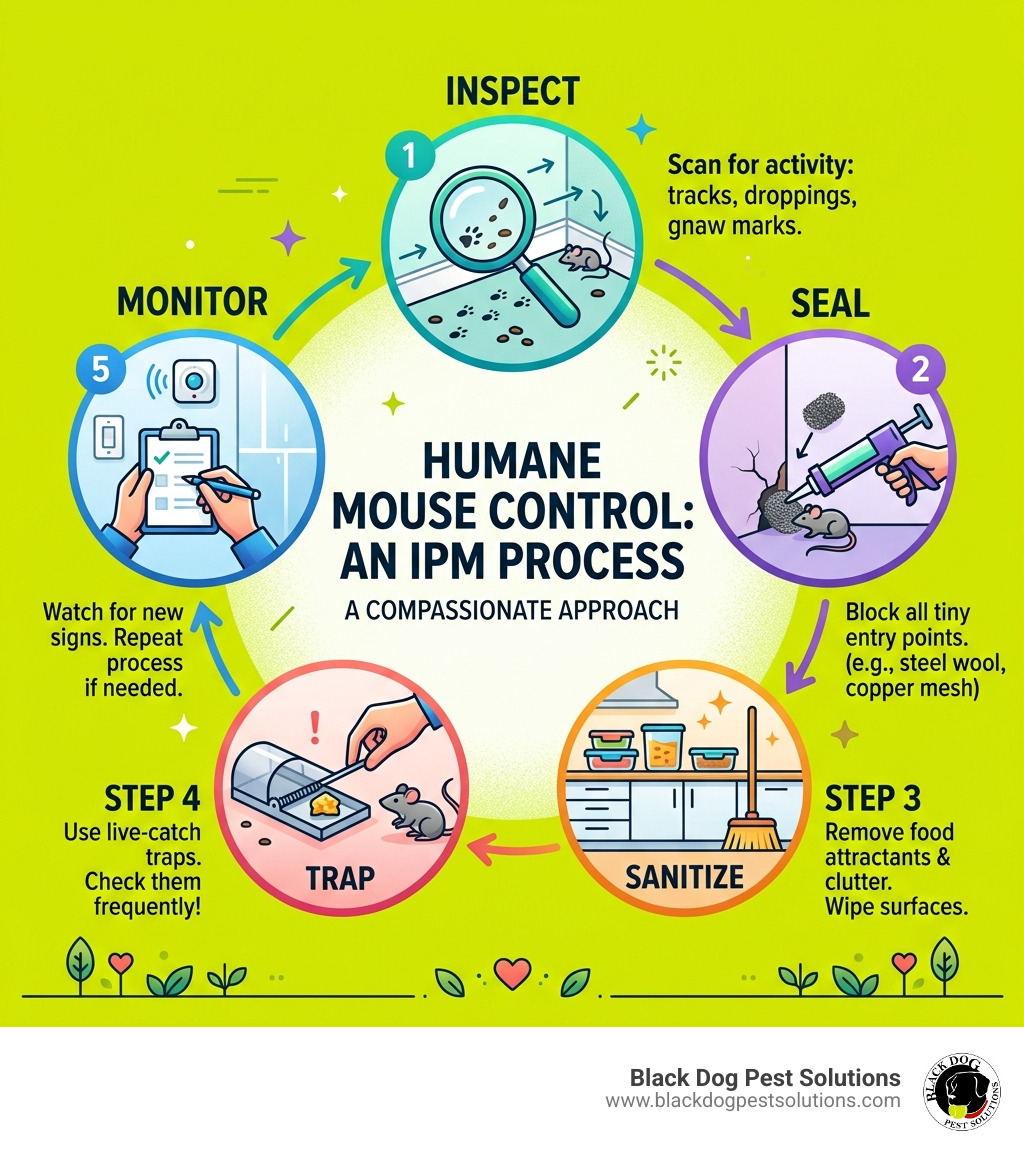
Simple humane mouse removal word guide:
Identifying Signs of a Mouse Infestation
Before we can implement humane mouse removal, we need to know exactly what we are dealing with. Mice are elusive, nocturnal creatures, so you are much more likely to see the evidence they leave behind than the mice themselves.
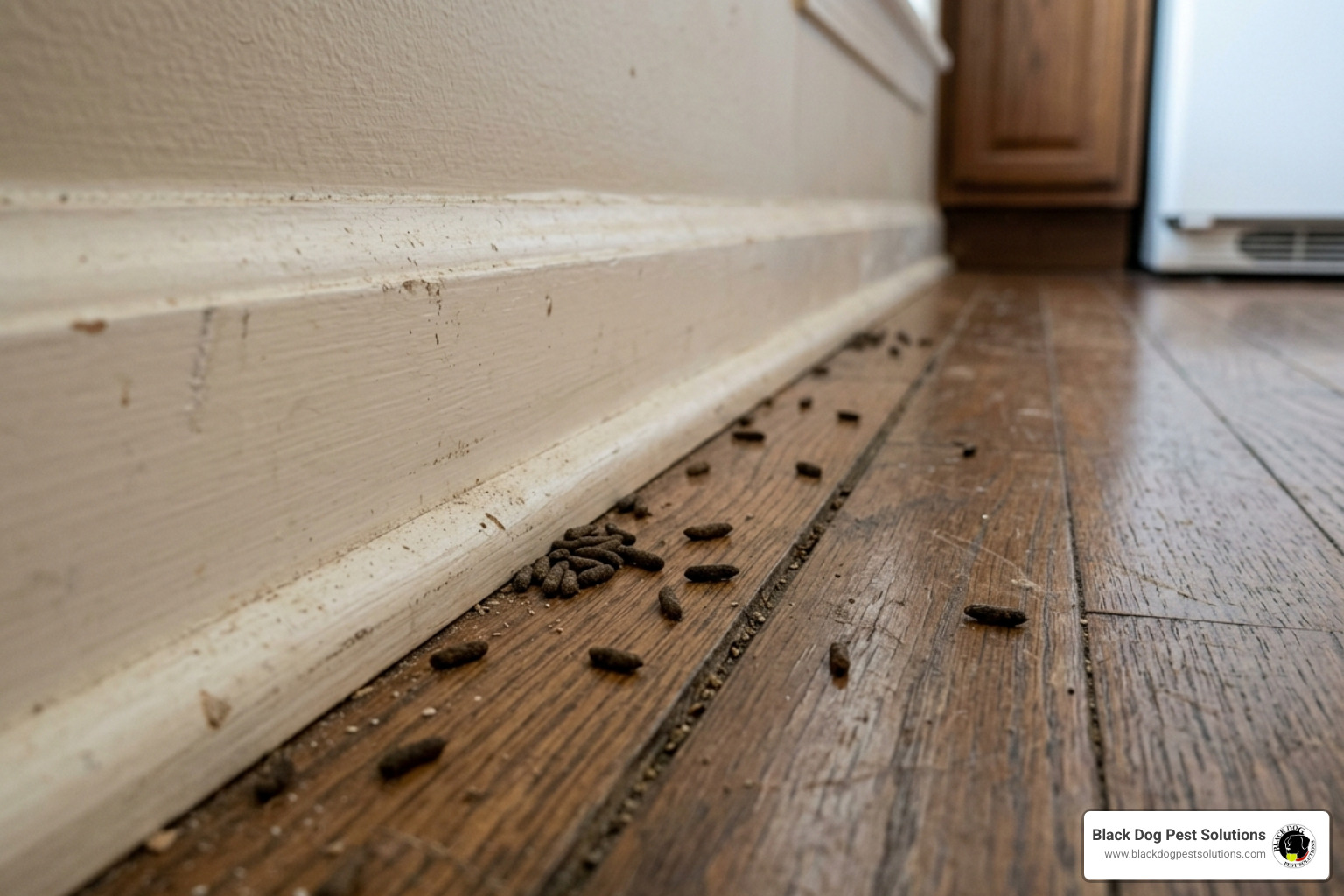
The most common sign is the presence of fecal pellets. A single mouse can produce up to 70 droppings per day, often concentrated near food sources or along baseboards where they travel. You might also notice gnaw marks on food packaging, cardboard boxes, or even electrical wires. Because their teeth never stop growing, mice must chew constantly to keep them filed down.
In quiet moments, particularly at night, you may hear scuttling or scratching sounds coming from the walls or ceiling. If you find shredded paper, insulation, or fabric tucked away in a dark corner, you’ve likely found a nest. For more detailed help on spotting these quiet invaders, check out our guide on how to find mice.
Common Mouse Species in Northern Ohio
In the Greater Cleveland area and across Northern Ohio, we primarily encounter two types of mice. Identifying which one has moved in can help us understand their nesting habits.
| Feature | House Mouse (Mus musculus) | Deer Mouse (Peromyscus maniculatus) |
|---|---|---|
| Appearance | Uniformly gray or light brown | Brownish-red with a white underbelly |
| Tail | Nearly hairless, one solid color | Distinctly two-toned (dark top, white bottom) |
| Snout | Pointed, triangular | Slightly broader |
| Eyes/Ears | Small eyes, large ears | Large, bulging eyes |
| Habitat | Prefers living near humans year-round | Often enters homes for winter shelter |
According to the Wisconsin Humane Society, the house mouse is a “commensal” animal, meaning it has lived alongside humans for centuries and often prefers our pantries to the great outdoors.
Why Prevention is the Best Long-Term Approach
When it comes to humane mouse removal, the most compassionate thing we can do is prevent the mice from wanting to enter in the first place. Once a mouse establishes a nest and finds a steady food supply, removing them becomes much more stressful for the animal.

Local weather and building conditions in places like Avon Lake and Westlake can make homes very attractive. During the cold, damp months typical of Northern Ohio, mice seek warmth and a reliable meal. By making your home less “hospitable,” you encourage them to stay in their natural outdoor habitats. Taking steps to keep your garage clean is a great starting point for overall home protection.
Concisely Managing Food and Shelter
Sanitation is the cornerstone of any humane mouse removal strategy. Mice only need a tiny amount of food to survive—about 1/10th of an ounce daily.
- Airtight Containers: Transfer cereal, crackers, and pet food into glass or heavy-duty plastic containers. Mice can easily chew through cardboard and thin plastic bags.
- Crumb Removal: Clean behind appliances and under toasters frequently.
- Pet Food Management: Avoid leaving pet food bowls out overnight.
- Landscaping: Trim vegetation at least 18 inches away from your foundation and clear away woodpiles or debris where mice might hide near your walls.
Structural Exclusion: Sealing Entry Points
If you don’t seal the holes, humane mouse removal becomes a revolving door. You can catch and release mice all day, but if the entry points remain open, new mice will simply follow the scent trails left by the previous residents.
Mice are incredibly flexible. Because they have soft cartilage rather than a rigid skeleton, they can squeeze through any opening that is about 1/4 inch or smaller. If you can fit a standard pencil into a gap, a mouse can fit through it. For more on securing your upper levels, see our tips on attic rodent guests.
Materials for Long-Term Exclusion
To keep mice out, you must use materials that are more resistant to chewing than wood or plastic. The Humane Society suggests several durable options:
- Steel Wool and Copper Mesh: These are excellent for stuffing into small gaps around utility lines or plumbing. Mice find the texture unpleasant and difficult to chew.
- Hardware Cloth: Use a heavy-gauge metal mesh (1/4 inch or smaller) to cover vents and larger openings.
- Metal Flashing: This is ideal for sealing corners or baseboard gaps where mice have already started chewing.
- Weather Stripping: Ensure door sweeps are tight and windows close securely.
Humane Mouse Removal Tactics and Live-Catch Traps
When mice are already inside, we move to the “eviction” phase. The goal here is to capture the mice while minimizing stress and suffering. This requires a commitment from the homeowner to be diligent and attentive.
Using an Integrated Pest Management (IPM) approach means we use traps as just one part of a larger plan. We focus on the most effective, least-intrusive methods first.
Choosing Humane Mouse Removal Traps
There are several types of live-catch traps available:
- Box Traps: These allow the mouse to enter through a one-way door into a ventilated compartment.
- Multi-Catch Units: These are useful if you suspect you have more than one visitor.
- Baiting Strategy: Peanut butter is the gold standard for bait because it is sticky (so they can’t just grab it and run) and has a strong, attractive scent. You can also try seeds or dried fruit.
Crucial Step: You must check live traps frequently and follow all product instructions. A mouse left in a live trap for too long can die from dehydration or extreme stress within just a few hours. Checking them at least twice a day—once in the morning and once before bed—is a good rule of thumb.
The Role of Deterrents in Humane Mouse Removal
Many people ask about natural deterrents like peppermint oil or ultrasonic devices. While these are popular, their effectiveness is often conditional.
- Peppermint Oil: Some research suggests mice dislike the strong scent of peppermint or eucalyptus. However, once the scent fades, the mice often return. It works best as a temporary measure in small, enclosed spaces like cabinets.
- Ultrasonic Devices: These emit high-frequency sounds intended to annoy rodents. While they may work initially, mice often become accustomed to the noise over time.
According to the Humane Society of the United States, these should be viewed as supplementary tools rather than a primary solution for humane mouse removal.
Ethical Considerations for Relocation and Cleanup
Relocating a mouse is more complex than just letting it go in the backyard. If you release a mouse too close to your house, it will likely find its way back in through the same holes you haven’t sealed yet. However, if you take an “indoor” house mouse and drop it in the middle of a deep forest, its chances of survival are very low.
Release guidance can vary by location and situation. A good strategy is to release the mouse near an outbuilding like a shed or in dense vegetation that provides immediate cover from predators. Always check local weather; releasing a mouse during a blizzard or a torrential downpour is rarely successful.
Health Risks and Safe Sanitation
Mice can carry diseases like Salmonellosis and Hantavirus. Even after the mice are gone, the cleanup process must be handled with care. If you find yourself dealing with the aftermath, our guide on dead mouse removal and odor provides professional-level cleaning tips.
- Wear Protection: Use rubber or nitrile gloves and a mask.
- Disinfect: Do not vacuum or sweep droppings, as this can kick up dust containing pathogens. Instead, spray the area with a 10% bleach solution or a commercial disinfectant and let it sit for several minutes before wiping with a paper towel.
- Double-Bag: Place all waste in a sealed plastic bag before putting it in an outdoor trash can.
When to Contact Pest Control Companies in Avon
While many homeowners successfully handle a stray mouse or two, some infestations require a professional touch. If you are finding droppings in multiple rooms, hearing constant activity in the walls, or seeing new damage even after sealing holes, it’s time to call in the experts.
Working with pest control companies in Avon ensures that the root cause of the infestation is identified. A professional can spot entry points that are easily missed by the untrained eye, such as gaps in the roofline or behind siding. You can learn more about how we handle these situations on our residential services page.
Professional Inspection by Pest Control Companies in Avon
A thorough assessment is the first step. We look at the foundation, utility entries, and even the attic to create a customized plan. Because we are a family-owned business based right here in Avon, we understand the specific construction styles and local weather patterns that affect homes in Northern Ohio.
Integrated Pest Management from Pest Control Companies in Avon
We prioritize a “SMART” approach: Safe, Measurable, Adaptable, Reliable, and Timely. Our process follows the core IPM pillars:
- Inspect the entire perimeter.
- Seal entry points using high-quality metal materials.
- Sanitize and advise on food storage.
- Trap using the most appropriate methods for your specific home.
- Monitor to ensure the activity has stopped.
Frequently Asked Questions about Humane Mouse Removal
How small of a hole can a mouse fit through?
Mice can typically enter through any opening that is about 1/4 inch or smaller. This is roughly the width of a standard pencil. Because their skulls are the only “hard” part of their body that doesn’t compress, if their head fits, the rest of them will too.
Is relocation always the best option for the mouse?
Release guidance can vary by location and situation. Relocation success often depends on local weather, available shelter, and the specific species involved. For example, a Deer Mouse might thrive if moved to a wooded area, whereas a House Mouse might struggle without a structure nearby.
Why should I avoid glue traps and poisons?
Humane mouse removal prioritizes minimizing stress and suffering. Glue traps cause prolonged distress as animals become stuck and may injure themselves trying to escape. Poisons cause a slow death and create secondary risks; a poisoned mouse could be eaten by a neighborhood pet or a local owl, passing the toxins up the food chain. Additionally, mice that die from poison often do so inside your walls, leading to unpleasant odors.
Conclusion
Reclaiming your home from rodents doesn’t have to mean compromising your values. By focusing on structural exclusion, proper sanitation, and the thoughtful use of live traps, you can achieve a mouse-free home while minimizing suffering.
If you’re feeling overwhelmed by a persistent problem, you don’t have to do it alone. There are experienced pest control companies in Avon ready to help. At Black Dog Pest Solutions, we’ve built our reputation on being effective, reliable, and professional.
Owned by Mat Ledyard and serving Northern Ohio since 2014, we are a licensed, family-owned business with a 4.9/5-star Google rating and BBB accreditation. Whether you are in Elyria, North Ridgeville, or Rocky River, we are dedicated to providing long-term solutions for your family.
Ready to secure your home? Contact us for humane mouse removal and let’s get your house back to being squeaky clean—without the squeaks!