
Why Brown Recluse Extermination Is Urgent — and Harder Than You Think
Brown recluse extermination is one of the most challenging pest problems a homeowner can face. These spiders hide deep inside walls, attics, and stored boxes — and a single female can produce up to 300 eggs in her lifetime.
Here’s what you need to know right away:
- Identify first: Brown recluses are tan to light brown, about the size of a quarter, with a distinctive violin-shaped marking on their back and only six eyes (most spiders have eight)
- Act fast: Seeing one or more per day means you likely have an infestation, not a stray spider
- Don’t rely on sprays alone: Brown recluses live inside wall voids where surface sprays can’t reach them
- Expect a long timeline: Even professional treatment can take 6–9 months for full control
- Call a pro if: DIY methods have failed, you’ve found egg sacs, or you have children or pets in the home
These spiders are reclusive by nature — but that doesn’t make them less dangerous. Their venom is necrotic, meaning it can destroy tissue around the bite site. And because they hide so well, many homeowners don’t realize they have a serious infestation until it’s well established.
I’m Mat Ledyard, owner of Black Dog Pest Solutions in Avon, Ohio, with nearly two decades of pest control experience — including handling the kind of stubborn, hidden brown recluse extermination cases that standard quarterly spray services routinely miss. In this guide, I’ll walk you through everything you need to know to identify, eliminate, and prevent brown recluse spiders in your home.
Identifying the True Brown Recluse and Its Look-Alikes
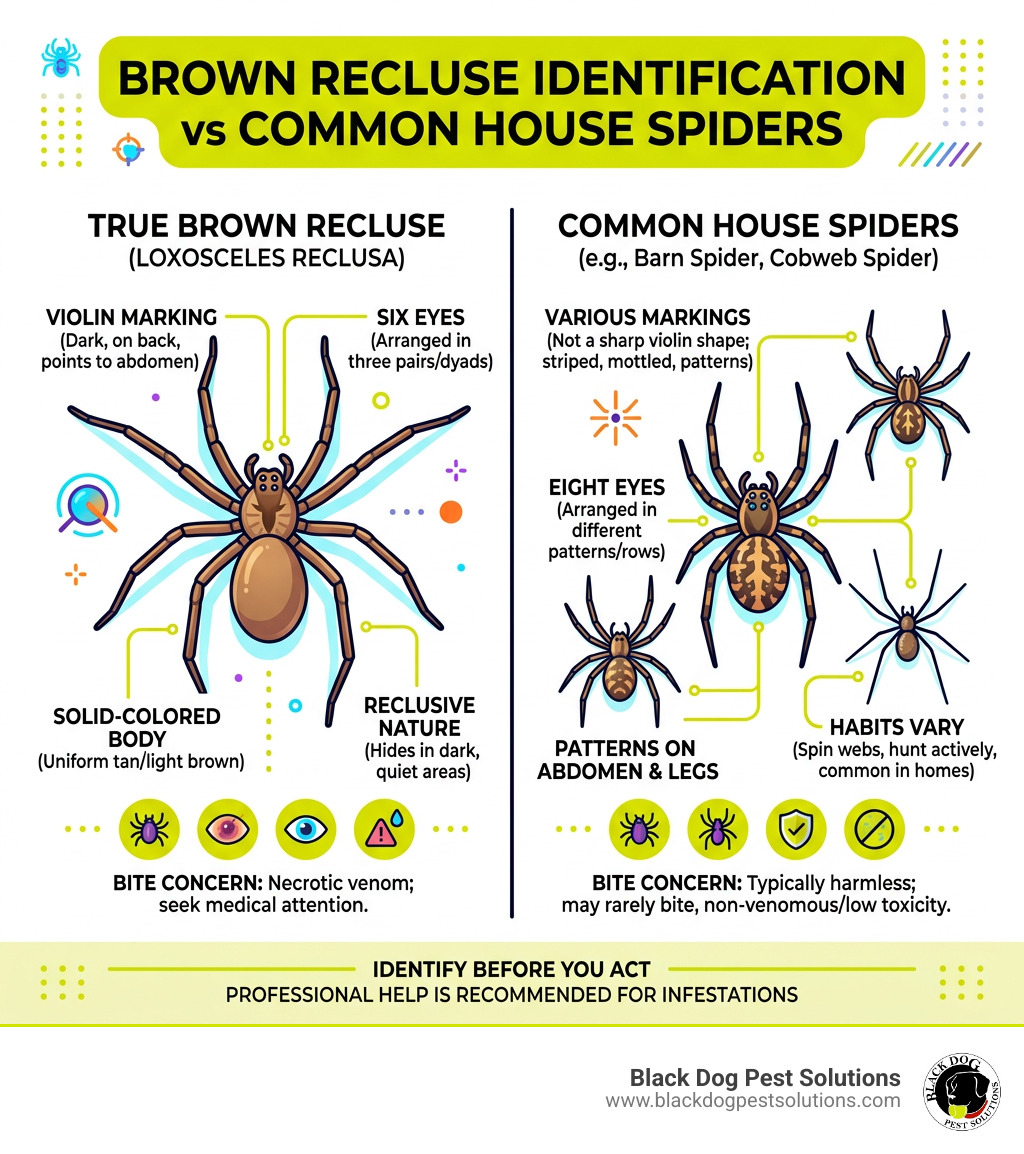
In Northern Ohio, we have over 620 species of spiders. Most of them are completely harmless, but the brown recluse (Loxosceles reclusa) is one of the few that demands your attention. Misidentification is incredibly common; many people see a brown spider and immediately panic, but a true recluse has very specific calling cards.
The most famous feature is the dark, violin-shaped marking on its cephalothorax (the front part of the body where the legs attach). The “neck” of the violin points toward the spider’s abdomen. However, because some other spiders have similar faint markings, we look at the eyes. While most spiders have eight eyes arranged in two rows, the brown recluse is distinguished by having six eyes arranged in three pairs (dyads) in a semi-circle.
They are generally uniform in color—pale brown to light brown—with legs that are not striped or excessively hairy. An adult, with its legs extended, is usually about the size of a U.S. quarter.
It is important to remember that while they are venomous, their danger is often exaggerated. They are not aggressive and typically only bite when squeezed against skin, such as when you reach into a work glove or put on a shoe that has been sitting in the garage.
Brown Recluse vs. Wolf Spider
The wolf spider is the most common “stunt double” for the brown recluse in areas like Cleveland and Elyria. Here is how to tell them apart:
| Feature | Brown Recluse | Wolf Spider |
|---|---|---|
| Markings | Dark violin shape on back | Parallel stripes on head/body |
| Eyes | 6 eyes in 3 pairs | 8 eyes in 3 rows |
| Legs | Smooth, uniform color | Thick, hairy, often banded/striped |
| Size | Approx. 1/2 inch (body) | Up to 1.5 inches (body) |
| Webbing | Irregular, hidden “retreat” webs | Does not build webs (hunts on foot) |
Signs of an Infestation and Common Hiding Spots
Brown recluses aren’t looking for a fight; they are looking for a quiet, dark place to hide. This is why brown recluse extermination is so difficult—you rarely see them until the population is large.
Unlike the common house spider that builds symmetrical webs in window corners, the recluse builds “retreat” webs. these are irregular, off-white, and sticky, usually tucked away in corners or crevices. If you find a shed skin (exuviae) that looks like a dried-up spider, it’s a strong sign of an active resident.
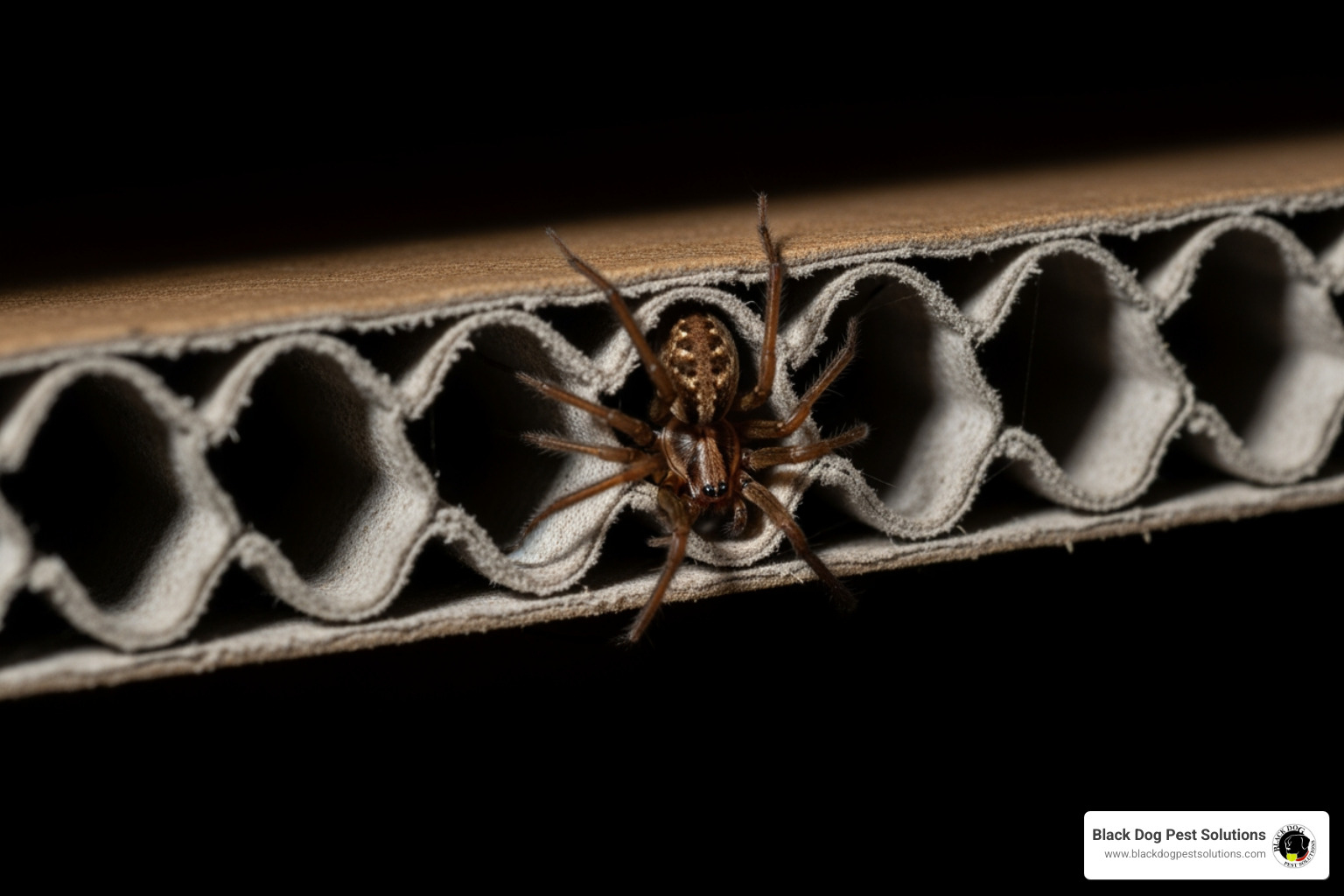
Because they hunt for their prey at night, you might spot them scurrying across a floor or wall after dark. During the day, they retreat to:
- Attics and Crawlspaces: These are the “command centers” for infestations in Ohio homes.
- Cardboard Boxes: The corrugated ridges in boxes are perfect hiding spots.
- Wall Voids: They travel through the spaces behind your drywall, using electrical wire holes as highways.
- Undisturbed Closets: Behind boxes of old clothes or holiday decorations.
A single female can lay up to five egg sacs in her lifetime, each containing about 50 eggs. With the potential for 300 offspring, a small problem in the spring can become a massive infestation by winter if left unchecked.
The Reality of Bites: Symptoms and Immediate First Aid
If you suspect you’ve been bitten, don’t panic. Statistics show that only approximately 1 in 10 brown recluse bites result in significant necrosis (tissue death). Most bites heal on their own like a typical insect sting. However, for that 10%, the venom can cause a painful, expanding ulcer that takes weeks or months to heal.
Symptoms usually don’t appear immediately. You might feel a slight sting, but the real pain develops 6 to 12 hours later. The site may turn purple or blue with a red ring around it—often called the “red, white, and blue” sign.
If you are bitten, the Mayo clinic recommends the following treatment:
- Clean the area: Use mild soap and water.
- Apply an antibiotic ointment: To prevent secondary infection.
- Use a cool compress: This helps reduce swelling and pain.
- Elevate: If the bite is on an arm or leg, keep it raised.
- Monitor: If the center of the bite turns dark or you develop a fever, seek medical attention immediately.
For more details on identifying different pest symptoms, our team at Black Dog Pest Solutions is always available to help you understand what you’re dealing with.
Why DIY Brown Recluse Extermination Often Fails
Many homeowners in Avon Lake and North Ridgeville try to handle things themselves with a trip to the hardware store. While a 1:1 vinegar and water solution can kill a spider on contact, it does nothing to address the hundreds of spiders hiding in your walls.
Here is why DIY efforts usually fall short:
- Extreme Resilience: Brown recluse spiders can survive as long as two years without available food or water. You can’t just “starve them out.”
- Hidden Harborages: Most over-the-counter sprays only hit the surfaces. Recluses spend 90% of their time in voids where the spray never reaches.
- The Bait Myth: Spiders don’t eat bait like ants or roaches do. They are predators that eat live (or very recently dead) insects.
- Timeline Misconceptions: Brown recluse extermination is not instantaneous. Because of their slow metabolism and hidden nature, it can take a full 6–9 months to fully eliminate an infestation, even with professional tools.
If you’ve been struggling with recurring sightings, it’s likely because the “nesting” areas haven’t been touched. Our residential services are designed to go deeper than the surface level.
Professional Brown Recluse Extermination: What to Expect
When we come to your home in Westlake or Sandusky, we don’t just walk around with a spray tank. Professional brown recluse extermination is a strategic operation.
We use an Integrated Pest Management (IPM) approach. This means we combine chemical treatments with physical changes to your home environment. We look for the “hot spots” using specialized monitoring traps. Interestingly, a spider caught on a glue board often acts as “bait” for other spiders, who see it as an easy meal and get stuck themselves.
The Process of Professional Brown Recluse Extermination
- Thorough Inspection: We check the attic, crawlspace, and every dark corner.
- Wall Void Dusting: We use specialized equipment to inject long-lasting insecticidal dust behind outlets and baseboards. This is the only way to reach the spiders where they live.
- Liquid Barriers: We apply professional-grade residual sprays to the perimeters and entry points.
- Mechanical Measures: We help you identify cracks that need sealing and clutter that needs moving.
- Ongoing Monitoring: We place glue boards in strategic areas to track the population decline over several months.
When to Call for Brown Recluse Extermination
You should reach out for professional services if:
- You see more than one spider a day.
- You find egg sacs in your storage areas.
- Your DIY efforts haven’t stopped the sightings after a month.
- You live in an older home with many structural voids (common in Greater Cleveland).
Prevention Strategies to Keep Spiders Out
Prevention is the best form of brown recluse extermination. If you make your home unattractive to them, they will go elsewhere.
- Declutter: This is the most important step. Remove stacks of newspapers, old cardboard boxes, and piles of clothes.
- Use Plastic Tubs: Swap cardboard boxes for plastic bins with tight-sealing lids. Spiders can’t get through the plastic, and there are no corrugated edges to hide in.
- Seal Entry Points: Use caulk or expandable foam to seal gaps around plumbing, vents, and window frames.
- Firewood Placement: Keep firewood at least 20 feet away from your house and off the ground.
- Bed Safety: In infested homes, pull beds away from walls and remove “dust ruffles” or bed skirts that touch the floor. This prevents spiders from crawling into your bed at night.
Frequently Asked Questions about Brown Recluses
Are brown recluse spiders common in Ohio?
While the brown recluse is most famous in the South, they are definitely present in Northern Ohio. They are often “hitchhikers,” moved in boxes and furniture when people relocate from states like Tennessee or Missouri. Once inside an Ohio home, they adapt well to the indoor climate, living comfortably in heated basements and attics year-round.
How long does brown recluse extermination take?
Full elimination usually takes 6 to 9 months. This is because the spiders have a long lifecycle and can remain dormant for long periods. Professional treatments need time to cycle through the emerging spiderlings and the adults that were hidden deep in the structure during the initial visit.
What is the best brown recluse extermination method?
The most effective method is a combination of wall void dusting, residual exterior barriers, and aggressive monitoring with glue boards. Spraying the baseboards alone is rarely enough; you must treat the “voids” where the spiders actually spend their time.
Conclusion
Living with the fear of a venomous spider in your home is no way to live. Whether you are in Avon, Lorain, or Lakewood, the experts at Black Dog Pest Solutions are here to help you take your home back. We understand the biology of these reclusive pests and have the tools to reach them where they hide.
Don’t wait for a bite to happen. If you suspect you have an infestation, get professional help for spiders today. We provide the peace of mind that comes with a 4.9-star rated service and nearly two decades of local expertise. Let us find them before they find you.