
A Closer Look at Ohio’s Largest Ants
Carpenter ants are often a top concern for Ohio homeowners. If you’re seeing large black ants, especially indoors, you might be dealing with these wood-destroying pests. They’re a common household nuisance, capable of causing significant damage to homes and structures over time.
Here’s a quick overview of carpenter ants in Ohio:
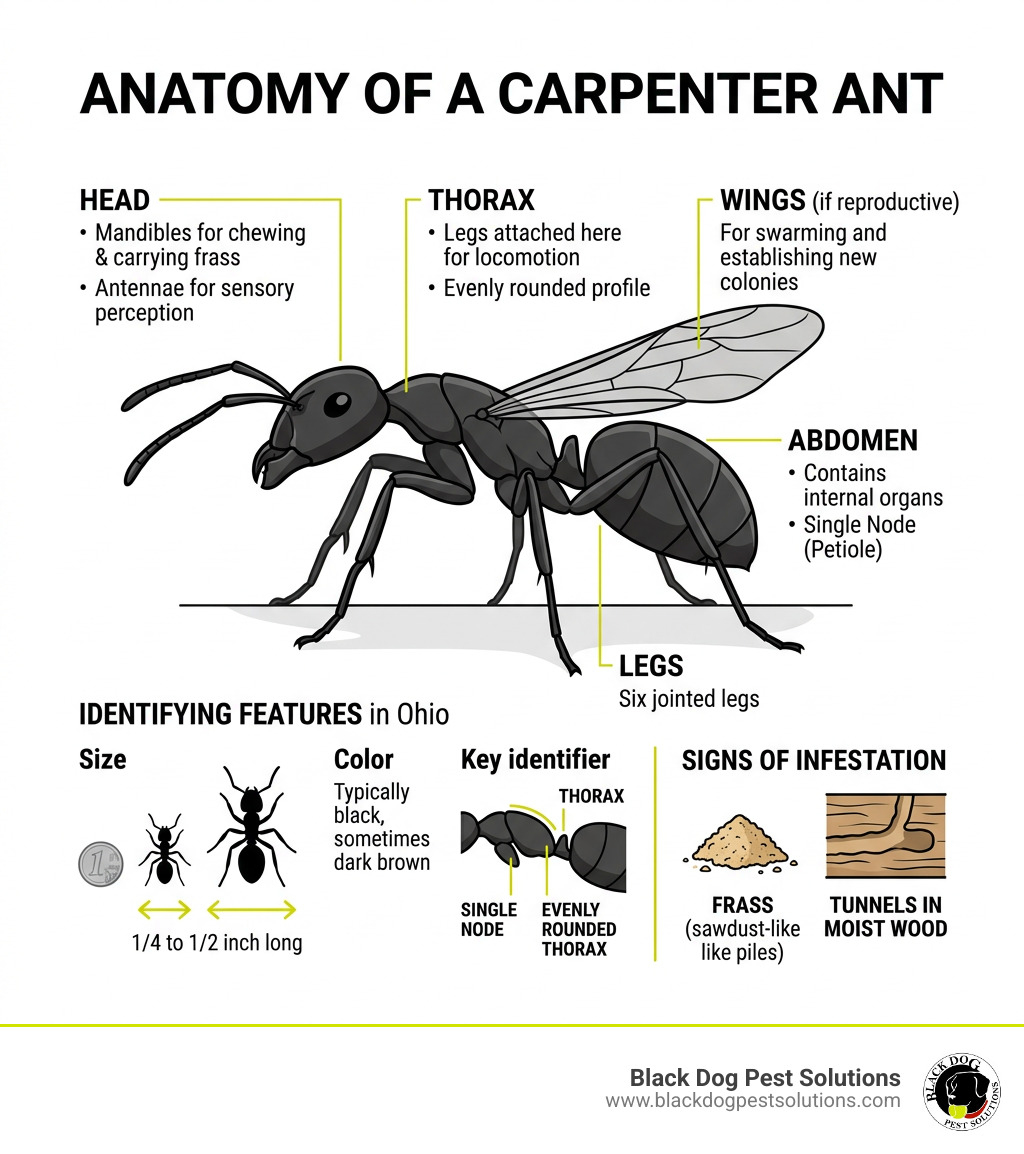
- What they look like: Large, typically black ants, ranging from 1/4 to 1/2 inch long. They have an evenly rounded thorax (the middle body section) and a single “node” or segment between their thorax and abdomen.
- What they do: They don’t eat wood like termites. Instead, they excavate it to create smooth, clean tunnels for their nests. This activity leaves behind tell-tale sawdust-like piles called frass.
- Their threat: While not as fast-acting as termites, carpenter ants can weaken wooden structures, particularly those already softened by moisture.
- Common in Ohio: Carpenter ant inquiries rank first among structural pests in Ohio.
This guide will help you understand these ants, identify them correctly, and learn how to protect your property from their damage.
As Mat Ledyard, owner of Black Dog Pest Solutions, I’ve spent nearly two decades helping Ohio homeowners tackle pest problems, including dealing with challenging carpenter ants in Ohio. My goal is to provide clear, actionable advice to help you restore peace of mind.
Identifying Carpenter Ants in Ohio
If you live in Northern Ohio, from Avon to Sandusky, you’ve likely seen a “big black ant” scurrying across your kitchen floor or patio. In our region, the most common culprit is Camponotus pennsylvanicus, better known as the black carpenter ant. These are among the largest ants in the United States, and seeing them inside your home is often the first sign of a much larger colony nearby.
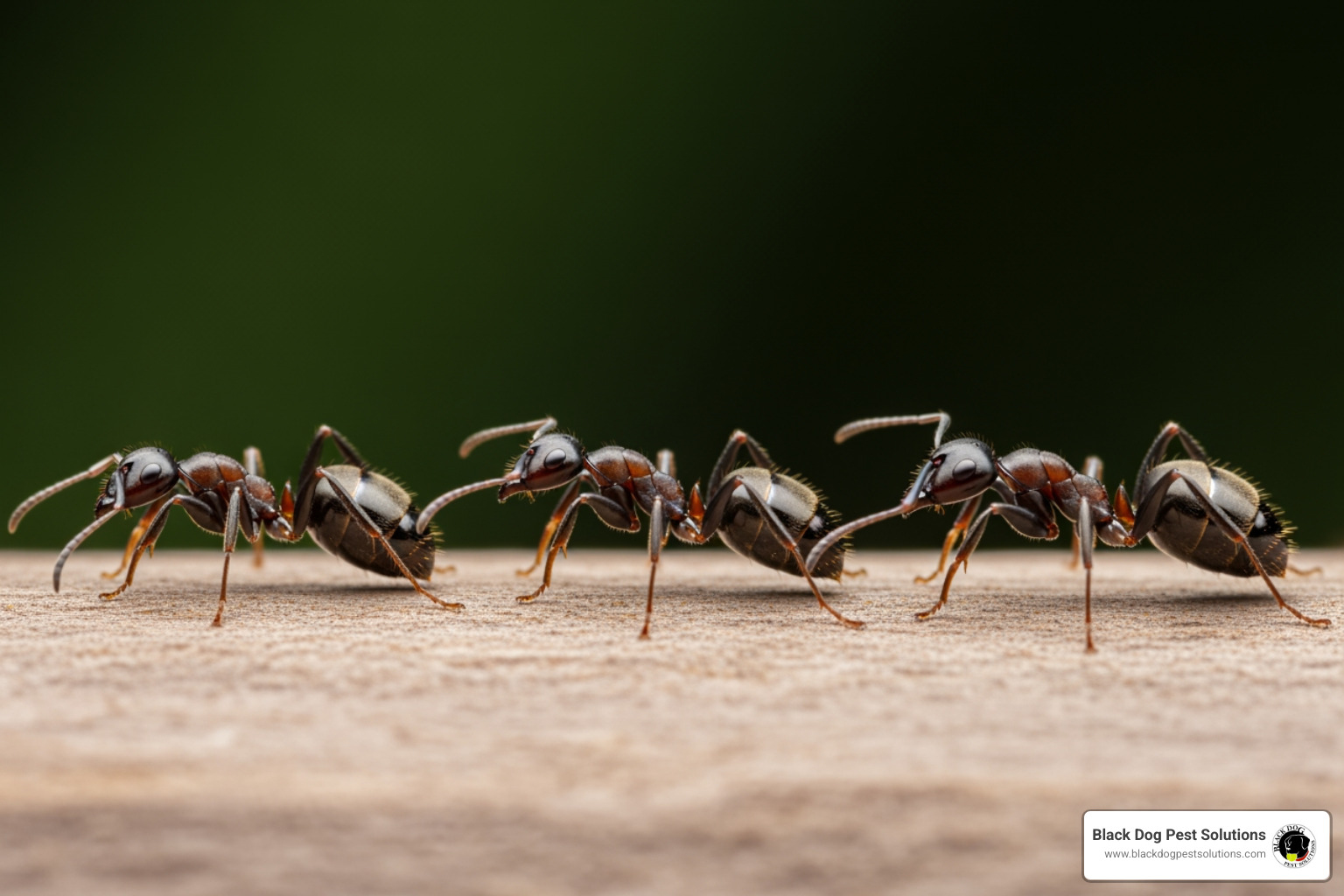
One of the most fascinating (and confusing) things about carpenter ants in Ohio is their polymorphism. This is just a fancy scientific way of saying that workers within the same colony come in different sizes. You might see a tiny ant and a giant ant side-by-side, but they are sisters from the same nest!
To correctly identify them, look for these three key features:
- A rounded thorax: When viewed from the side, the middle section of their body is a smooth, continuous arch.
- A single node: There is only one small hump (node) between the thorax and the abdomen.
- A fringe of hairs: If you have a magnifying glass, you’ll notice a circle of tiny hairs around the tip of their abdomen.
For more detailed visual cues, you can check out the Carpenter Ants (Insects of Ohio) · iNaturalist guide.
Physical Characteristics and Biting Behavior
In a typical Ohio colony, minor workers usually measure about 1/4 inch, while the major workers—the “soldiers” of the group—can reach 1/2 inch or more. The queens are even larger, sometimes exceeding 3/4 of an inch. They generally have heart-shaped heads and powerful mandibles (jaws).
Because they are so large, many people ask: “Do they bite?” The answer is yes, but they don’t have a stinger. If you disturb a nest, they may pinch your skin with those strong jaws and spray a bit of formic acid into the wound. It’s not dangerous, but it can certainly sting! If you’re curious about how these compare to other common house guests, check out our more info about ant identification page.
Distinguishing Ants from Termites and Field Ants
Misidentifying a pest can lead to the wrong treatment, which is a waste of time and money. In Northeast Ohio, homeowners often confuse carpenter ants with termites or field ants (Formica species).
Here is a quick breakdown to help you tell the difference:
| Feature | Carpenter Ant | Termite | Field Ant |
|---|---|---|---|
| Waist | Constricted (Skinny) | Broad/Rectangular | Constricted |
| Antennae | Elbowed (Bent) | Straight (Beaded) | Elbowed |
| Thorax | Evenly Rounded | Flat/Straight | Uneven/Indented |
| Wings | Front wings longer | All wings equal length | Front wings longer |
Termites are “milky” or translucent and have straight antennae, whereas carpenter ants are dark and have “elbows” in their antennae. Field ants look very similar to carpenter ants but have a distinct notch or indentation in their thorax. For a deep dive into these differences, the Carpenter Ants | Ohioline – The Ohio State University fact sheet is an excellent resource.
The Life Cycle and Habits of Ohio’s Largest Ants
A carpenter ant colony doesn’t just appear overnight. It is a slow, methodical process. It typically takes 3.5 to 4 years for a colony to reach maturity. At this stage, the nest may house between 2,000 and 10,000 individuals and begin producing “swarmers”—the winged reproductives that fly out to start new colonies.
The life cycle begins when a winged queen mates and finds a piece of moist, decayed wood to start her nest. She sheds her wings and stays with her first small batch of eggs. Once those eggs become adult workers, they take over the foraging and “nanny” duties, allowing the queen to focus solely on laying eggs for the rest of her life—which can last over a decade!
Seasonal Activity and Foraging Patterns
In Ohio, carpenter ants are most active from March through July, though they can remain active through the fall. They are primarily nocturnal, with their peak “rush hour” occurring between 10 PM and 2 AM. If you suspect an infestation, grab a flashlight and head outside after dark; you might see them trailing along your foundation or power lines.
These ants are impressive hikers. Workers have been known to forage up to 100 yards (300 feet) away from their parent nest. This means the ants in your kitchen might actually live in a stump at the back of your neighbor’s property! To keep them away during the peak season, you can read our guide on how to beat the heat with summer ant strategies.
Diet and Seasonal Food Preferences
Contrary to popular belief, carpenter ants do not eat wood. They are omnivores with a diverse palate. In the wild, they love “honeydew,” a sweet liquid excreted by aphids. They actually “farm” aphids, protecting them from predators in exchange for this sugar.
Their diet shifts with the seasons:
- Spring/Early Summer: They focus on proteins (dead insects) to help the queen produce eggs and feed the growing larvae.
- Late Summer/Fall: They shift toward sugars to provide energy for the workers.
Indoors, they are attracted to sweets, meats, grease, and even damp pet food. This seasonal shift is why a bait that worked in May might be ignored in August.
Signs of an Infestation and Structural Damage
Because they hide inside walls and wood, you might not see the ants themselves until the problem is severe. Instead, you have to look for the clues they leave behind.
The most common sign is frass. Since carpenter ants don’t eat wood, they have to put the “sawdust” somewhere. They kick it out of small holes in the wood. If you see a pile of what looks like pencil shavings mixed with dead ant parts, you’ve found a nest.
Another eerie sign is the sound. In a quiet house, you can sometimes hear a dry, rustling or clicking sound coming from the walls. This is the sound of thousands of ants moving or “talking” by tapping their mandibles against the wood. If you see large ants indoors during the winter, it’s a near-certainty that there is a nest inside the heated structure of your home.
How Carpenter Ants in Ohio Damage Wood
Carpenter ants prefer wood with a moisture content of over 15%. This is why they are often found in areas with leaks: chimneys, skylights, window frames, and behind dishwashers. They excavate “galleries” that are remarkably clean and smooth, looking almost like they were sanded by a tiny carpenter.
Unlike termites, which fill their tunnels with mud, carpenter ant tunnels are completely hollow. This excavation process removes the internal support of the timber. To learn more about identifying these clues, visit our page on how to learn about common pest signs.
Speed of Damage and Structural Threats
While carpenter ants won’t cause your house to collapse in a weekend, they are a long-term threat. In the first few months, the damage is usually minor. However, as the colony grows to thousands of members over several years, the cumulative effect of their tunneling can compromise structural integrity. This is especially true in older Ohio homes where water damage or wood rot may have already softened the beams.
Locating and Eliminating the Nest
The secret to stopping carpenter ants in Ohio is understanding the “Parent vs. Satellite” system. The parent nest is usually outdoors in a high-moisture area like a rotting stump or a hollow tree. This is where the queen lives. Satellite nests are established as the colony expands, often moving into drier areas like wall voids, attic insulation, or hollow-core doors inside your home.
If you only kill the ants in the satellite nest, the queen in the parent nest will simply produce more. You must find and eliminate both to solve the problem.
Inspection Techniques for Homeowners
Finding a nest requires a bit of detective work. Here are some pro tips:
- The Night Watch: Use a flashlight between 10 PM and midnight to follow foraging ants. They often follow “scent trails” along garden hoses, wires, or the edges of your siding.
- The Sound Check: Tap on suspected wood (like a porch pillar). If a nest is inside, you might hear a sudden “hissing” sound as the ants react to the vibration.
- Follow the Food: If you find an ant outside, give it a tiny piece of protein or a drop of honey. Often, it will lead you directly back to the nest entry point.
Effective Treatment Methods for Carpenter Ants in Ohio
DIY sprays from the hardware store often make the problem worse. These “repellent” sprays kill a few ants on contact but cause the rest of the colony to scatter and “bud,” creating even more nests.
Effective control involves:
- Non-Repellent Baits: These are slow-acting. Ants eat the bait and carry it back to the queen, thinking it’s food.
- Void Injections: For nests inside walls, we drill tiny holes and inject specialized dusts or aerosols that fill the cavity.
- Perimeter Barriers: Professional-grade liquid treatments around the foundation prevent new ants from entering.
You can learn more about these professional ant removal methods on our website.
Prevention and Professional Control Strategies
Prevention is always cheaper than a cure. Since these ants love moisture, your first step should be a “moisture audit” of your home.
- Fix leaks: Repair leaky roofs, gutters, and plumbing immediately.
- Trim vegetation: Ensure no tree branches or bushes are touching your house. These act as “ant highways.”
- Manage wood: Keep firewood stored off the ground and at least 20 feet away from your foundation. Remove old stumps within 50 feet of the house.
- Seal gaps: Use caulk to seal cracks where utility lines enter the home.
For a comprehensive approach to protecting your property, explore our residential pest services.
When to Call a Professional Exterminator
Because carpenter ants are so elusive and their colonies are so complex, DIY efforts often fail. A professional exterminator has access to specialized equipment, like moisture meters and non-repellent insecticides that aren’t available to the general public.
When you hire a pro, you aren’t just paying for a spray; you’re paying for an expert inspection that identifies the source of the problem. At Black Dog Pest Solutions, we provide thorough inspections and warranties to ensure the ants don’t just move to a different room.
Frequently Asked Questions about Ohio Ants
Do carpenter ants eat wood like termites?
No, they do not. Carpenter ants simply hollow out wood to create “apartments” for their colony. They dispose of the wood as “frass” (sawdust), which you can often find in piles near their exit holes.
Why do I see large black ants in the winter?
If you see large black ants inside during an Ohio winter, it means there is an active nest inside your home. While outdoor ants go dormant, nests inside heated walls or near water heaters stay active year-round.
Are carpenter ants dangerous to humans or pets?
They are not considered dangerous. They don’t transmit diseases, and they don’t have stingers. While they can give a sharp, defensive bite if handled, they are primarily a threat to your home’s structure, not your health.
Conclusion
Dealing with carpenter ants in Ohio can be a frustrating experience, but you don’t have to tackle it alone. From the lakefront in Bay Village to the suburbs of North Ridgeville, Black Dog Pest Solutions has the local expertise to find the nest and stop the damage.
We pride ourselves on our 4.9-star service and our commitment to the Northern Ohio community. If you’re worried about large black ants in your home, don’t wait for the damage to get worse. Contact us for a carpenter ant inspection today, and let us help you protect your biggest investment.