
Why Carpenter Ants Are a Bigger Problem Than You Think
How to get rid of carpenter ants naturally is something more Northern Ohio homeowners are searching for every spring — and for good reason. These large black ants don’t just crawl across your countertop. They tunnel into the wood framing of your home, silently weakening walls, floors, and support beams over time.
Worried carpenter ants are damaging your home? Call Black Dog Pest Solutions for a free inspection. We help homeowners in Avon, Cleveland, and Northern Ohio identify the source and stop carpenter ant activity. Call 440-654-8234 today.
The good news? You don’t need harsh chemicals to fight back.
Here’s a quick overview of natural methods that work:
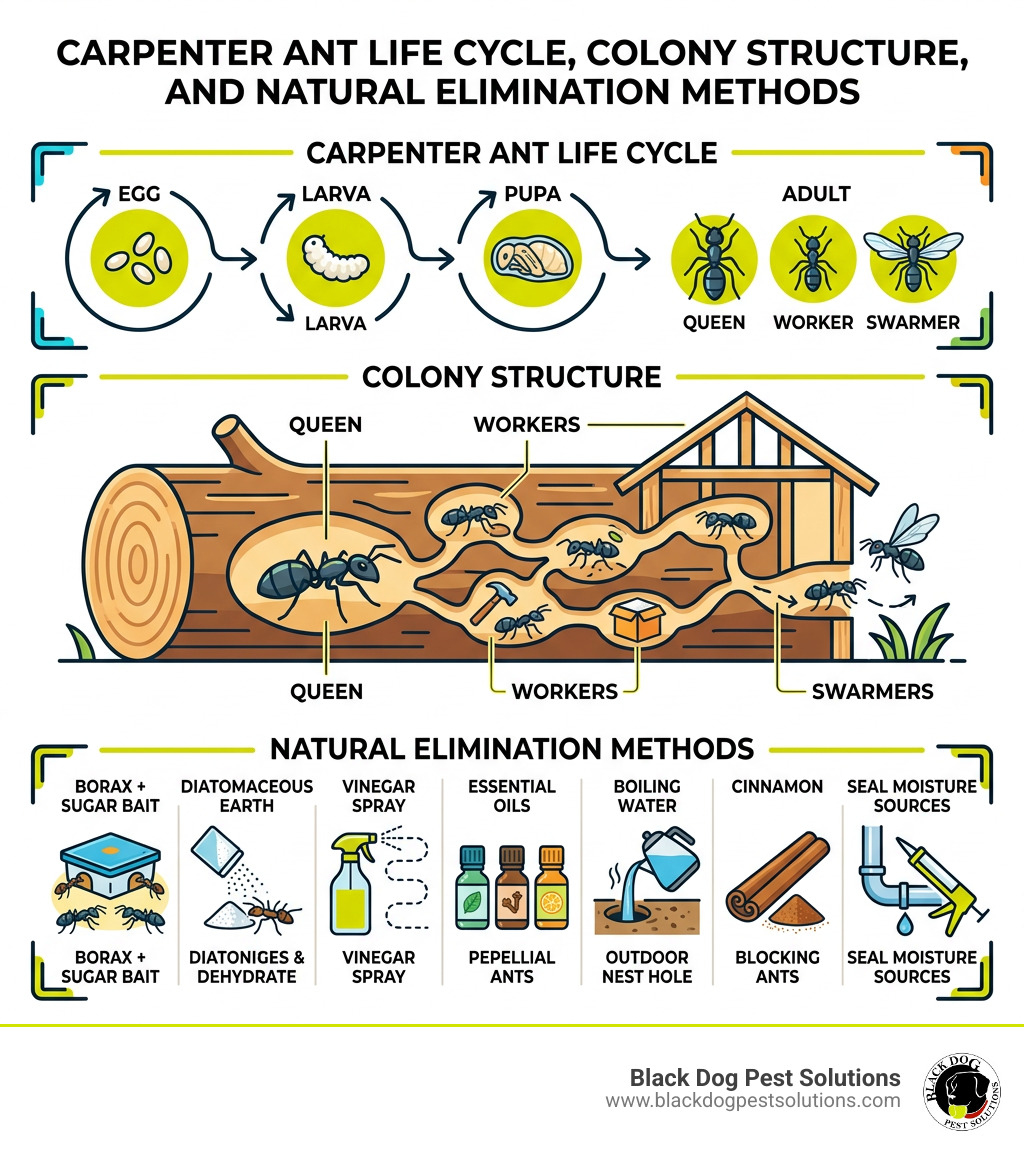
- Borax + sugar bait – Workers carry it back to the colony, eliminating the nest from within
- Diatomaceous earth – Damages the ants’ exoskeletons and dehydrates them
- Vinegar spray – Disrupts the pheromone trails ants use to navigate
- Essential oils (peppermint, clove, citrus) – Repel ants and interfere with scent trails
- Boiling water – Poured directly into outdoor nests for fast elimination
- Cinnamon – Sprinkled at entry points as a natural deterrent
- Seal moisture sources – Removes what attracts them in the first place
Carpenter ants prefer moist, decaying wood — so a leak behind your wall isn’t just a plumbing problem. It’s an open invitation. A mature colony can grow to around 3,000 workers within just a few years, and queens can live up to 25 years, meaning early action matters.
I’m Mat Ledyard, owner of Black Dog Pest Solutions in Avon, Ohio, and I’ve been working in pest control since 2005 — helping homeowners across Northeast Ohio figure out how to get rid of carpenter ants naturally before small problems become structural ones. In the sections below, I’ll walk you through exactly what works, what doesn’t, and when it’s time to call in backup.
Identifying the Intruder: Carpenter Ants vs. Termites
Before we dive into the “how-to,” we need to make sure we’re fighting the right enemy. In Northern Ohio, homeowners often confuse carpenter ants with termites. While both can compromise the structural integrity of your home, their methods and physical traits are quite different.
Carpenter ants are among the largest ants in the United States, measuring up to 20 mm (roughly 3/4 of an inch). Termites, on the other hand, are much smaller, usually 1/8 to 3/16 of an inch long.
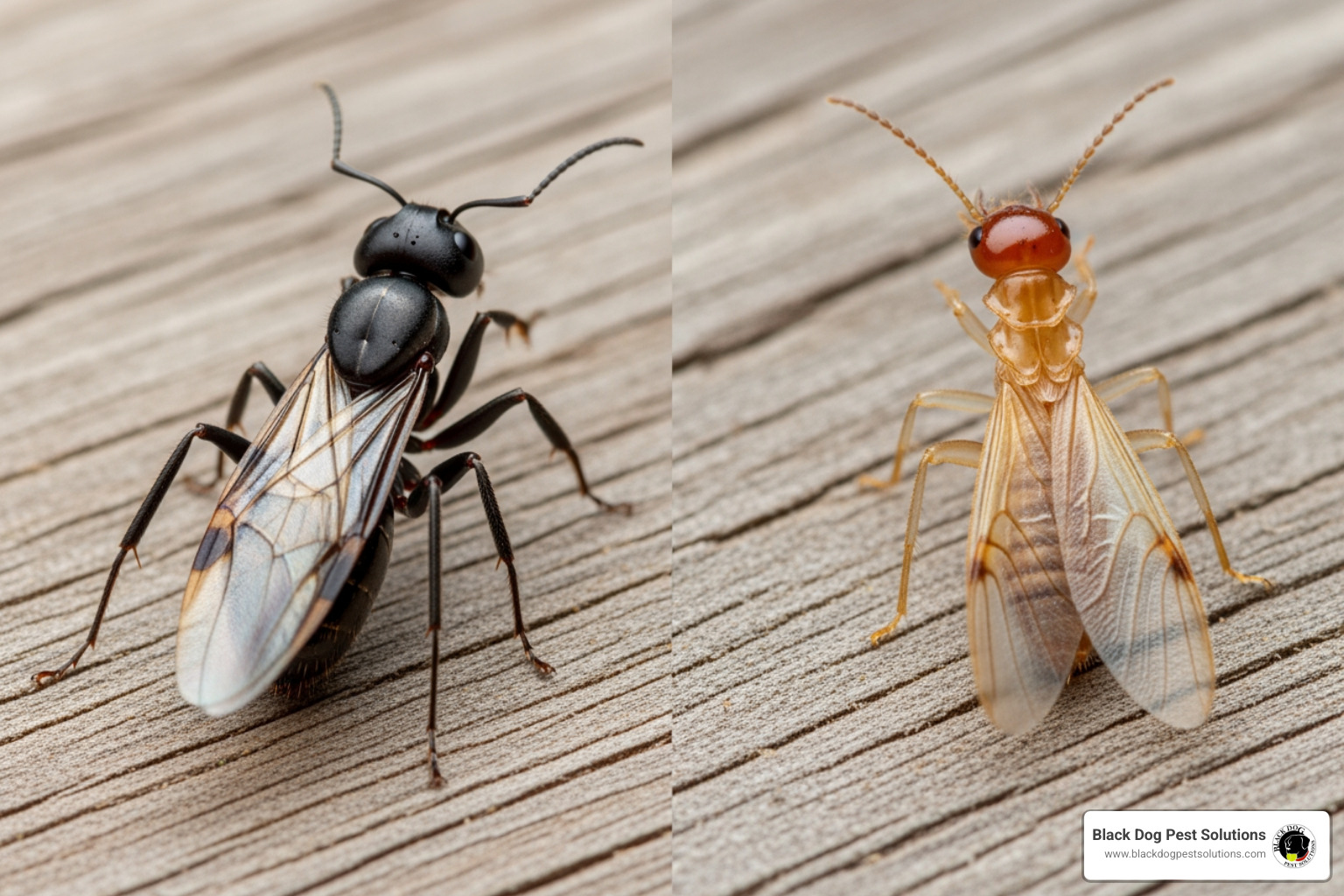
The most significant behavioral difference is that carpenter ants do not eat wood. They are “carpenters” because they excavate wood to create galleries for their nests. They prefer moist, decaying wood because it’s easier to chew through. Termites actually consume the wood for nutrition. This means if you see “sawdust” (we call it frass), you likely have ants. If the wood looks hollowed out with mud tubes, it’s likely termites.
Comparison Table: Carpenter Ants vs. Termites
| Feature | Carpenter Ants | Termites |
|---|---|---|
| Waist | Pinched, narrow waist | Thick, uniform waist |
| Antennae | Elbowed (bent) | Straight (like a string of beads) |
| Wings | Two pairs, front wings longer than back | Two pairs, all equal in length |
| Diet | Sweets, proteins, insects (don’t eat wood) | Cellulose (actually eat wood) |
| Evidence | Piles of sawdust (frass) | Mud tubes and “honeycombed” wood |
For more details on spotting these wood-destroying pests in your home, check out our More information on identifying carpenter ants page.
Signs of a Carpenter Ant Infestation
How do you know if you have a problem? Since these ants are primarily nocturnal, you might not see them marching across your kitchen floor at noon. Instead, look for these tell-tale signs:
- Frass Piles: This is the most common sign. As ants tunnel, they push out wood shavings, dead insect parts, and debris. It looks like a small pile of sawdust, often found near baseboards, windowsills, or in spider webs.
- Rustling Sounds: If you have a large colony in a wall void, you might actually hear them. It sounds like a faint crinkling or rustling, especially at night when the house is quiet.
- Winged Swarmers: Seeing large, winged ants inside your home is a major red flag. These are the “reproductives” looking to start new colonies. If you see them indoors in late winter or early spring, it’s a strong indicator that there is a nest already established inside your structure.
- Smooth Galleries: If you happen to see the inside of the wood they’ve damaged, carpenter ant tunnels are sandpaper-smooth. Termite tunnels, by contrast, are often caked with mud and soil.
According to the Signs of infestation according to UNH Extension, early detection is the best way to prevent the high costs of structural repair.
How to Get Rid of Carpenter Ants Naturally Using DIY Baits
If you’ve confirmed you have an infestation, the next step is elimination. The secret to how to get rid of carpenter ants naturally isn’t just killing the ants you see—it’s killing the ones you don’t see.
Carpenter ants are social creatures. They share food through a process called trophallaxis. By using slow-acting natural baits, you allow the worker ants to carry the “gift” back to the heart of the colony, eventually reaching the queen. This is far more effective than spraying a single ant with a cleaner, which only kills that one individual.
How to Get Rid of Carpenter Ants Naturally with Borax Baits
Borax (sodium borate) is a naturally occurring mineral that is highly effective against ants but has relatively low toxicity for humans and pets when handled correctly. When ingested, it interferes with the ant’s digestive system, leading to death.
The “Sweet & Deadly” Recipe:
- Mix 1/2 cup of sugar with 1.5 tablespoons of Borax.
- Add 1.5 cups of warm water and stir until dissolved.
- Soak cotton balls in the mixture and place them in shallow lids or small containers near ant trails.
The sugar acts as the attractant, while the Borax does the heavy lifting. Be patient! It can take a few weeks to fully eliminate a colony. You might even see more ants at first—don’t spray them! Let them take the bait back to the nest.
For more professional-grade insights into colony elimination, read our guide on Ant Removal 101: Methods Trusted by Professional Services. You can also find Scientific research on boric acid as a low-toxicity pesticide to understand why this method is a staple in natural pest control.
Effective Household Repellents and Desiccants
Sometimes you want to create a “no-fly zone” (or no-crawl zone) around your home. This is where repellents and desiccants come into play.
Diatomaceous Earth (DE): This is a fine powder made from fossilized algae. To us, it feels like flour. To an ant, it’s like walking over broken glass. It cuts through their waxy exoskeleton, causing them to dehydrate and die. Always use food-grade DE. Sprinkle a thin layer in cracks, crevices, and behind appliances where ants travel. You can find More info about how diatomaceous earth works to see why it’s a favorite for eco-conscious homeowners.
Vinegar Spray: White vinegar is a fantastic tool for disrupting pheromone trails. Ants leave invisible scent markers so their friends can find food. Spraying a 50/50 mix of vinegar and water on your counters and floorboards “blinds” the ants, making it harder for them to navigate your home.
How to Get Rid of Carpenter Ants Naturally using Essential Oils
If you want your home to smell like a spa while fighting off invaders, essential oils are your best friend. Certain scents are highly offensive to carpenter ants and can even interfere with their hormonal systems.
- Peppermint Oil: This is perhaps the most popular repellent. Mix 15-20 drops of peppermint oil with water in a spray bottle and apply it to entry points like windowsills and door frames.
- Clove and Lemongrass: These oils contain compounds that are naturally insecticidal.
- Capsaicin: Derived from chili peppers, this acts as a powerful irritant. Research on capsaicin as a natural repellent shows it can effectively turn ants away from treated areas.
Locating and Eliminating the Nest
If you really want to win the war, you have to find the “Mother Ship.” Carpenter ants often have a parent nest (usually outdoors in a stump or tree) and multiple satellite nests (often indoors in wall voids).
To find the nest, grab a flashlight and wait until about an hour after dark. Follow the foraging ants. They usually travel along “highways” like garden hoses, fence rails, or utility wires. If they disappear behind a piece of siding or into a crack in the foundation, you’ve likely found an entry point to a nest.
If you suspect a nest is in a wall, listen for that rustling sound. You can also tap on the wood; “hollow” sounding wood or the sound of ants scurrying in response to the vibration is a dead giveaway. If the DIY hunt gets too frustrating, our Residential pest control services can help pinpoint exactly where they are hiding.
Eliminating Outdoor Nests Safely
If you find the parent nest in your yard—perhaps in an old rotting stump or a pile of firewood—you can often eliminate it without chemicals.
- Boiling Water: This is the most direct natural method. Pouring several gallons of boiling water into the nest entrance can collapse the colony instantly. For better results, add a little liquid dish soap to the water to help it penetrate the ants’ exoskeletons.
- Firewood Management: Never store firewood directly against your house. Keep it elevated and at least 20 feet away.
For more tips on keeping your yard from becoming an ant playground, check out More info about our general pest services.
Long-Term Prevention: How to Get Rid of Carpenter Ants Naturally for Good
The best way to deal with carpenter ants is to make your home as unattractive to them as possible. In Northern Ohio, from Avon to Sandusky, moisture is the primary culprit.
- Fix Leaks Immediately: Whether it’s a leaky roof, a dripping pipe under the sink, or a clogged gutter, moisture softens wood and invites ants to move in.
- Seal the Perimeter: Use silicone caulk to seal cracks around windows, doors, and where utility lines enter the house.
- Trim Your Trees: Ants use branches like bridges. Ensure no tree limbs or bushes are touching your roof or siding.
- Ventilate: Use dehumidifiers in damp basements or crawlspaces to keep wood dry.
For a deeper dive into seasonal strategies, read our article on Beat the Heat: Summer Ant Prevention Strategies for Ohio Homes.
Frequently Asked Questions about Natural Ant Control
Are natural remedies safe for homes with pets and children?
Generally, yes, but caution is still required. Food-grade Diatomaceous Earth is safe to touch, but you shouldn’t breathe in the dust. Borax should be kept in areas where pets and toddlers can’t reach it, as it is still a mineral salt that shouldn’t be ingested in large quantities. If you are looking for plant-derived options, you can check out the Safety info on pyrethrins, which are derived from chrysanthemums.
How long does it take for natural methods to fully eliminate a colony?
Natural methods require more patience than chemical sprays. Baits typically take 2 to 4 weeks to fully wipe out a colony because you have to wait for the workers to feed the queen and the larvae. If the colony is massive (up to 50,000 individuals), it may take longer or require multiple rounds of treatment.
When should I call a professional pest control service?
Natural methods are great for small, early-stage infestations. However, you should call us at Black Dog Pest Solutions if:
- You see large numbers of winged “swarmers” inside (indicating a very mature nest).
- You find significant structural damage or “soft” spots in your flooring or walls.
- The ants return every year despite your best DIY efforts.
- The nest is in an inaccessible location, like deep inside a structural beam.
You can learn more about how we handle these tough cases on our Black Dog Pest Solutions professional services page.
Conclusion
At Black Dog Pest Solutions, we know that your home is your biggest investment. Whether you are in Avon, Cleveland, or anywhere in Northern Ohio, protecting that investment from wood-destroying pests is a top priority. Learning how to get rid of carpenter ants naturally is a great first step toward a healthier, chemical-free home.
By managing moisture, sealing entry points, and using clever DIY baits, you can often handle minor ant issues on your own. But remember, carpenter ants are persistent. If they’ve moved deep into your walls, they can cause damage that’s expensive to fix. If you’re worried about the structural integrity of your home, don’t wait. Schedule a professional carpenter ant inspection with our team today, and let’s make sure those ants buzz off for good!