
Signs a Chipmunk Is in Your House: What to Look For Right Away
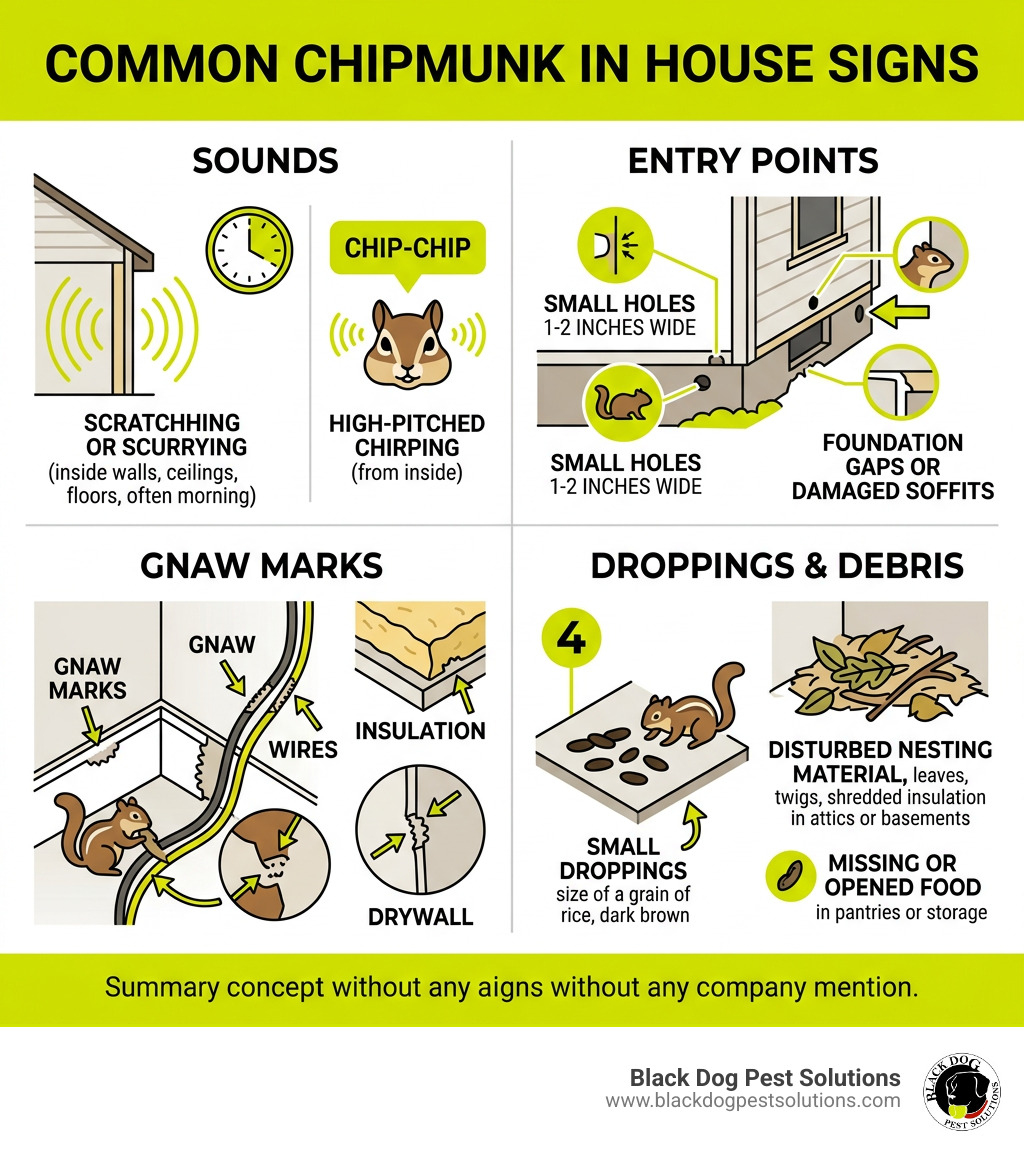
Signs of chipmunks in your house are easy to miss until real damage is done. Here’s a quick overview of what to watch for:
- Scratching or scurrying sounds inside walls, ceilings, or floors — especially in the morning
- High-pitched chirping (“chip-chip” or “chuck-chuck”) coming from inside the home
- Small droppings about the size of a grain of rice, dark brown in color
- Gnaw marks on baseboards, wires, insulation, or drywall
- Small holes (1–2 inches wide) near the foundation or along the exterior
- Disturbed nesting material — leaves, twigs, or shredded insulation in attics or basements
- Missing or opened food in pantries or storage areas
Chipmunks look harmless. And honestly, watching one stuff its cheeks with acorns in the backyard is pretty entertaining. But once one gets inside your home, that cuteness fades fast.
These small rodents have teeth that never stop growing. That means they never stop chewing — on wood, wires, insulation, drywall, and whatever else is in their way. In Northern Ohio, chipmunks are a common nuisance from spring through fall, and homes with gaps in the foundation, damaged soffits, or overgrown vegetation near the roofline are especially vulnerable.
The tricky part? Chipmunks are small and fast. By the time most homeowners notice the signs, the damage is already underway.
I’m Mat Ledyard, owner of Black Dog Pest Solutions in Avon, Ohio, with nearly 20 years in pest control — and signs of chipmunks in the house are something I’ve helped Northern Ohio homeowners identify and deal with more times than I can count. Let’s walk through exactly what to look for and what it means.
Recognizing the Most Common Signs of Chipmunks in your House
When a chipmunk decides your home in Cleveland or Sandusky is its new headquarters, it doesn’t usually announce its arrival with a knock at the door. Instead, it leaves a trail of subtle clues. Because chipmunks are diurnal (meaning they are active during the day), you are most likely to notice these signs during the early morning or late afternoon hours.
One of the most frequent signs we encounter is the sound of activity within wall voids or attics. Unlike mice, which are nocturnal and keep you up at night, chipmunks are early risers. If you hear scurrying or scratching as soon as the sun comes up, there is a high probability you are dealing with a chipmunk or a squirrel rather than a mouse or rat.

Beyond the noise, keep an eye out for physical evidence. Chipmunks are notorious for raiding pantries. If you find bags of birdseed, pet food, or even cereal in your kitchen that have been gnawed open, take a closer look. These “little buggers” can hold upwards of ten almonds in their cheek pouches at once, and they are experts at transporting food from your pantry to a hidden nesting site in your crawlspace or attic.
If you aren’t sure if what you’re seeing is a major issue, it helps to learn more about identifying pest problems early on. Catching a chipmunk before it establishes a permanent residence can save you thousands in structural repairs.
Auditory Signs of Chipmunks
If you hear a bird chirping inside your walls, it might not be a bird at all. Chipmunks have a very distinct vocalization. They make a high-pitched “chip-chip” sound, which is often mistaken for a bird’s song. They also utilize a lower-pitched “chuck-chuck” call. When they feel threatened or startled—perhaps by you walking into a room—they may let out a sharp “wee” sound as they scramble for cover.
According to scientific identification of chipmunk sounds, these vocalizations are part of their communication system. In a home environment, these sounds often echo through the vents or wall cavities, making them seem louder than they actually are. If the chirping is persistent and coming from a fixed location like a corner of the basement or a specific wall, it’s a major red flag.
Visual Signs of Chipmunks
Visually, the most obvious signs are the marks left behind by their teeth. Chipmunks have incisors that grow continuously, and they must chew on hard materials to grind them down. You might see gnawed baseboards, chewed plastic pipes, or even shredded insulation.
To help you figure out exactly what has moved in, we’ve put together this comparison table:
| Sign | Chipmunk | House Mouse | Tree Squirrel |
|---|---|---|---|
| Active Time | Day (Diurnal) | Night (Nocturnal) | Day (Diurnal) |
| Sound | High-pitched chirps | Squeaks/Scratching | Heavy scurrying/Barking |
| Droppings | Grain of rice (tapered) | Small grain (pointed) | Larger oblong pellets |
| Main Food | Seeds, nuts, berries | Crumbs, grains | Nuts, acorns, fruit |
| Entry Hole | 1–2 inches wide | 1/4 inch wide | 2–4 inches wide |
Identifying Chipmunk Droppings and Tracks
Identifying the waste left behind is one of the most reliable ways to confirm a chipmunk infestation. However, it requires a keen eye. Chipmunk droppings are approximately 1/4 inch long—roughly the size of a grain of rice—and are typically dark brown or black.
While chipmunks often store their waste in a specific chamber within their outdoor burrows, when they are inside a home, they tend to leave “waste trails” along the edges of walls or near food sources. If you’re finding these in your Northern Ohio home, you can find more info about identifying mice to ensure you aren’t confusing the two, as their droppings look remarkably similar.
Tracks are another giveaway. Chipmunks have four toes on their front feet and five on their hind feet. Because they hop or “gallop,” their tracks show a unique pattern where the larger hind prints actually land in front of the smaller front prints. You might spot these in dusty areas of the attic or in loose soil near your foundation.
Distinguishing Droppings from Other Rodents
It is critical to distinguish chipmunk waste from that of rats. Rat droppings are generally larger (up to 3/4 inch) and more blunt. You can find more info about rat identification here to help tell the difference.
Regardless of the species, never handle rodent droppings with your bare hands. Chipmunks can carry various parasites like mites, ticks, and fleas. More importantly, they are known carriers of diseases such as salmonella, leptospirosis, and hantavirus. If you find a “latrine” area in your attic or basement, it’s a sign of a significant presence that needs professional attention.
Structural Risks and Damage Caused by Chipmunks
Don’t let their small size fool you; chipmunks are destructive. In the wild, their burrows can measure up to 30 feet long and include complex nesting chambers and escape tunnels. When they bring that digging instinct to your home in Westlake or Strongsville, the results can be devastating.
One of the greatest risks is to your home’s foundation. Chipmunk holes are typically 1 to 2 inches in diameter. While they look small on the surface, the expansive tunnel systems underneath can lead to cracked sidewalks, sinking porches, and even structural instability in your foundation.
Inside the home, the damage shifts to your utilities. Chipmunks love to tunnel through fiberglass insulation, which ruins your home’s energy efficiency and leads to higher heating bills. Even more dangerous is their tendency to chew on electrical wiring. By stripping the plastic coating off wires, they create a significant fire hazard.
To prevent them from digging near your home, the Humane Society recommends installing an L-shaped footer. This involves burying wire mesh in an “L” shape around the perimeter of your foundation to stop them from burrowing underneath. If you already have a guest inside, you might look into Bob Vila’s guide to humane trapping for relocation tips, though we always recommend professional exclusion to ensure they don’t just find another way back in.
How Chipmunks Get Inside and Prevention Strategies
Chipmunks are opportunistic. They don’t need a wide-open door to get in; any gap larger than an inch is an invitation. Common entry points include:
- Cracks in the foundation or “step” cracks in brickwork
- Gaps around utility pipes (gas, water, or AC lines)
- Damaged soffits and fascia boards along the roofline
- Unscreened chimney caps or dryer vents
Prevention starts in the yard. Chipmunks are drawn to areas with plenty of cover and food. If your garden is a buffet, they’ll want to live nearby. Longfield Gardens bulb protection tips suggest planting bulbs in wire cages to deter them. You can also use natural repellents like pureed garlic or hot peppers around the perimeter of your home to make the area less attractive.
Sealing Common Entry Points
Once you’ve identified the signs, you must seal the “front door.” We recommend a multi-step approach:
- Caulk and Seal: Use high-quality exterior caulk for small cracks in the foundation.
- Steel Wool and Mesh: For larger gaps around pipes, stuff them with steel wool (which rodents hate to chew) and secure it with hardware cloth.
- Gutter Maintenance: Keep gutters clean. Clogged gutters can lead to rotted wood, which chipmunks can easily chew through to enter your attic.
- Vegetation Control: Trim tree branches and shrubs so they are at least 3 to 6 feet away from your house. This removes the “bridge” chipmunks use to reach your roof.
- Remove Food Sources: If you have bird feeders, move them away from the house or use a catch tray to prevent seeds from piling up on the ground.
Frequently Asked Questions about Chipmunk Infestations
Can chipmunks chew through drywall and walls?
Yes, absolutely. Because their incisors are strong enough to crack nuts, gypsum-based drywall is no match for them. They will often chew through drywall to enlarge an entry point or to create a shortcut between a wall void and a pantry. This not only causes cosmetic damage but can also lead to significant energy loss as conditioned air escapes into the wall cavities.
What are the health risks of chipmunks in the house?
While chipmunks are rarely aggressive, they can bite or scratch if cornered. The primary health risk, however, comes from the parasites they carry—like fleas and ticks—and the diseases present in their droppings. These include salmonella and hantavirus. Furthermore, if a chipmunk dies inside your walls, the decaying carcass can attract flies and create a foul odor that is very difficult to remove.
How do I tell if I have a chipmunk or a mouse?
The easiest way to tell is the clock. If you hear noise at 2:00 AM, it’s likely a mouse. If you hear it at 7:00 AM, it’s likely a chipmunk. Additionally, chipmunks are much louder vocalizers. While mice squeak occasionally, chipmunks “sing” with persistent chirps.
Conclusion
At the end of the day, chipmunks are fascinating creatures—as long as they stay in the woods. When they move into your Northern Ohio home, they transform from cute neighbors into destructive pests that threaten your home’s safety and value.
Recognizing the signs that chipmunks are in your house early is the key to preventing a minor nuisance from becoming a major repair bill. From Avon to Sandusky, we’ve seen the damage these little rodents can do, and we know exactly how to stop them.
If you’ve heard the scratching, seen the holes, or found the droppings, don’t wait for the damage to get worse. At Black Dog Pest Solutions, we pride ourselves on fast, professional service and a 4.9-star reputation for getting the job done right. We don’t just remove the pest; we help you seal your home so they don’t come back.
Ready to take your home back? Contact us for expert wildlife and chipmunk removal today, and let’s get those chipmunks back where they belong.