
When a Few Mice Become a Full-Blown Problem
Mice infestation removal is something thousands of Northern Ohio homeowners face every year — often starting with a single mouse sighting and quickly spiraling into a serious problem.
Here’s how to get rid of a mice infestation:
- Identify the scope — Check for droppings, gnaw marks, grease trails, and nesting materials
- Cut off food and water — Store food in sealed containers, fix leaks, eliminate clutter
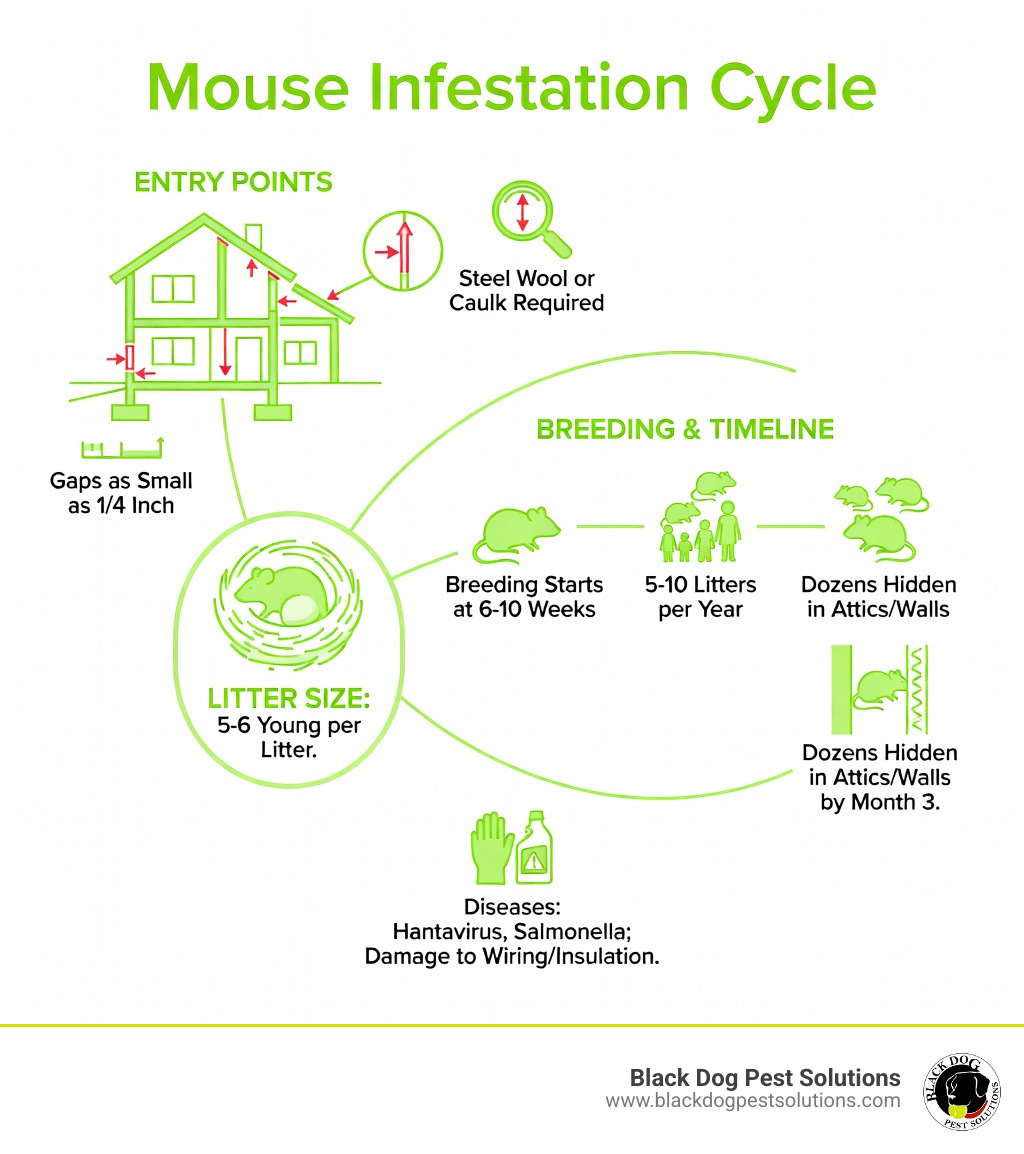
- Seal all entry points — Close any gap larger than ¼ inch with steel wool, copper mesh, or caulk
- Set snap traps — Place them perpendicular to walls, baited with peanut butter, spaced 6–10 feet apart
- Clean up safely — Use gloves, a bleach solution, and a HEPA vacuum on all affected areas
- Call a professional — If traps aren’t working or the infestation is large, get expert help fast
The problem with mice is how fast things escalate. A single female mouse can produce 5 to 10 litters per year — with 5 to 6 young per litter — and her offspring can start breeding within just 6 to 10 weeks. What starts as one mouse in the kitchen can become dozens hiding in your walls, attic, and insulation before you even realize it. On top of that, mice can squeeze through openings as small as ¼ inch, meaning your home likely has more entry points than you think.
They’re not just a nuisance. Mice carry diseases like hantavirus and salmonella, damage electrical wiring, and destroy insulation. Ignoring the problem — or relying on a trap or two — rarely solves it.
I’m Mat Ledyard, owner of Black Dog Pest Solutions in Avon, Ohio, and I’ve been working in pest control since 2005 — helping homeowners across Northeast Ohio tackle everything from a single mouse to full-scale mice infestation removal in heavily impacted homes and businesses. In this guide, I’ll walk you through exactly what works, what doesn’t, and when it’s time to call in a pro.
Basic Mice infestation removal vocab:
- 24 hour pest control mice
- Garage mice control
- best way to get rid of rats fast
Identifying the Scope of Your Mice Infestation
Before we can start the mice infestation removal process, we need to play detective. Mice are nocturnal and experts at staying out of sight, so you’ll often see their calling cards long before you see a whisker.
The most obvious sign is droppings. A single mouse can produce 50 to 60 droppings per day. If you’re finding hundreds of small, rice-shaped pellets in your pantry or under the sink, you’re not dealing with a “visitor”—you have a resident population.
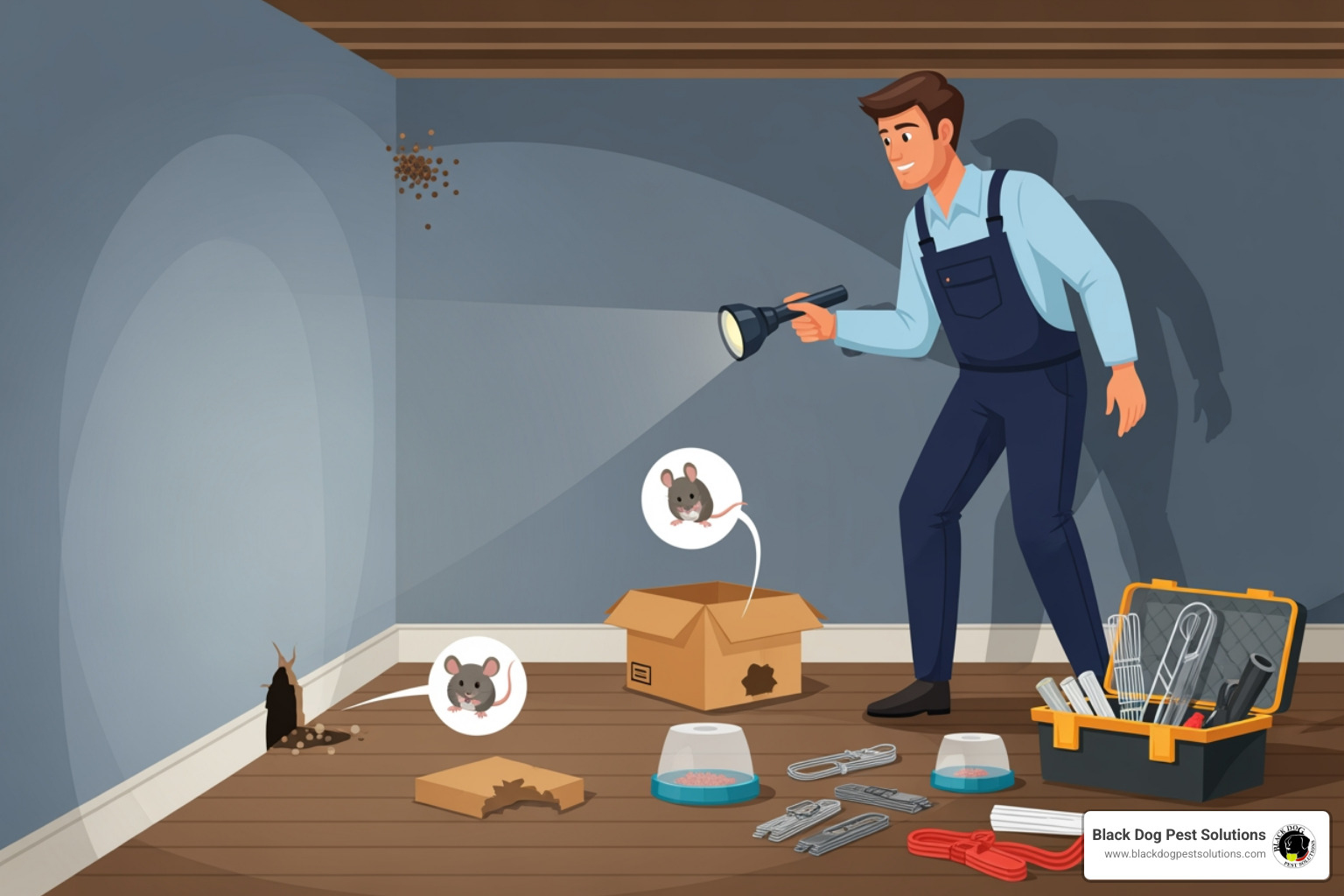
Other signs to watch for include:
- Gnaw Marks: Mice have teeth that never stop growing, so they chew on everything from cereal boxes to baseboards and even electrical wires.
- Sebum Trails: Mice have oily fur. As they run along the same paths every night (usually hugging the walls), they leave behind dark, greasy smudge marks known as sebum trails.
- The Smell: A heavy infestation has a distinct, musky odor. This is a combination of mouse urine and the pheromones they use to communicate with each other.
- Noises: If you hear scratching, scurrying, or squeaking in the walls or ceiling at night, that’s a major red flag.
To see these signs in action, check out this video on Rodent Management II: Signs of a Rodent Infestation.
House Mouse vs. Deer Mouse
In Northern Ohio, from Cleveland to Sandusky, we primarily deal with two types of mice:
- The House Mouse: These are usually light brown to dark grey with a lighter belly. They are incredibly adaptable and prefer to live indoors near human food sources.
- The Deer Mouse: These guys are brown or grey with a distinct white belly and white feet. They are more common in rural areas like Grafton or Wellington but will move into homes when the weather turns cold. Deer mice are particularly concerning because they are the primary carriers of Hantavirus.
Learn more about these species on our mice information page.
Mice vs. Rats: Key Differences
It’s easy to confuse a large mouse with a small rat, but for effective mice infestation removal, you need to know which one you’re fighting.
| Feature | House Mouse | Norway/Roof Rat |
|---|---|---|
| Size | 5–8 inches (including tail) | 15+ inches (including tail) |
| Weight | ~0.5 to 1 ounce | Up to 1 pound (0.5 kg) |
| Droppings | Small, pointed ends (like rice) | Large, blunt ends (like a capsule) |
| Tail | Hairy | Scaly and hairless |
| Entry Hole | 1/4 inch (size of a pencil eraser) | 1/2 inch to 1 inch |
| Behavior | Curious (explores new traps) | Neophobic (fears new things) |
Rats are much more cautious than mice. If you put a new trap out, a rat might avoid it for days, whereas a mouse will often check it out immediately. For more help identifying these larger rodents, visit our rat identification page.
Why Mice Infestation Removal is Critical for Your Health
We often hear people say, “It’s just a mouse, how bad can it be?” The truth is, mice are a significant health hazard. They don’t just eat your food; they contaminate everything they touch with urine, saliva, and feces.
Key health risks include:
- Hantavirus: A severe respiratory disease spread through contact with infected rodent urine or droppings.
- Salmonella: Mice frequently walk through filth and then across your kitchen counters, spreading bacteria that cause food poisoning.
- Leptospirosis: A bacterial disease that can lead to kidney damage or meningitis.
- Asthma Triggers: Mouse urine contains proteins that are major allergens, especially for children in urban environments like Cleveland or Lorain.
Beyond diseases, there are also risks associated with DIY chemical use. The Poison Control Center receives about 1,000 reports of accidental pesticide exposures every year in NYC alone, and half involve children under five. This highlights why following health risks and rodenticides guidelines is so important.
Structural Risks and Fire Hazards
Mice are also destructive. They love to shred attic insulation for nesting material, which can skyrocket your heating bills in an Ohio winter. Even worse, they have a dangerous habit of chewing on the plastic coating of electrical wires. This is a leading cause of “undetermined” house fires. If you have mice in your walls, your home’s safety is literally being gnawed away.
Step-by-Step Guide to Mice Infestation Removal
If you’ve confirmed you have an infestation, it’s time to take action. Successful mice infestation removal requires a three-pronged approach: Sanitation, Exclusion, and Population Control.
Effective Baiting and Trap Placement
The “better mousetrap” isn’t a myth—it’s usually just a standard snap trap used correctly. We recommend the classic Victor-style snap traps. They are cheap, effective, and provide a quick kill.
Pro Tips for Trapping:
- Placement is Everything: Mice don’t like to run across open floors. Place traps along walls where you’ve seen droppings. The trigger end of the trap should be facing the wall.
- The “T” Strategy: Place two traps side-by-side or in a row (about 1 inch apart). This prevents mice from jumping over a single trap.
- Bait Choice: Forget the cheese. Peanut butter is the gold standard because it’s sticky and mice have to work to get it off, which triggers the trap. You can also use cotton balls or dental floss, which female mice will try to steal for nesting material.
- Spacing: In a heavy infestation, space traps every 6 to 10 feet along active runways.
For a deep dive into the best tools for the job, check out The Best Mousetrap review.
Safe Cleanup of Droppings and Nests
Cleaning up after mice infestation removal is the most dangerous part of the job because stirring up dust can release airborne pathogens.
NEVER sweep or vacuum dry droppings. This sends viruses into the air where you can breathe them in.
The Safe Method:
- Wear rubber or plastic gloves and a mask (ideally an N95).
- Spray the droppings or nest with a disinfectant (1 part bleach to 10 parts water). Let it soak for 5 minutes.
- Use a paper towel to pick up the waste and place it in a plastic bag.
- Mop or sponge the area with disinfectant.
- Dispose of the bag in a sealed outdoor trash can.
Follow the full CDC cleanup recommendations to stay safe.
Professional Mice Infestation Removal vs. DIY
While a few traps might catch a stray mouse, a full-blown infestation is a different beast. Many homeowners in areas like Avon Lake or North Ridgeville find themselves in a “trap cycle”—they catch a few mice, think the problem is gone, and then see more droppings a week later.
When to Call a Professional for Mice Infestation Removal
You should call us at Black Dog Pest Solutions if:
- You see mice during the day. Mice are nocturnal. Seeing them in the daylight usually means the nest is overcrowded and the infestation is severe.
- DIY methods have failed. If you’ve been trapping for two weeks and are still seeing fresh signs, you aren’t getting ahead of their reproduction rate.
- You have a large property. Large homes or commercial buildings in Westlake or Rocky River have too many hiding spots for a few store-bought traps to handle.
- You smell dead mice. If you used poison and a mouse died in your wall, the smell can be unbearable. Pros have tools to locate and remove these issues.
Explore our residential services or commercial services for more details.
The Professional Removal Process
When we come to your home, we don’t just “throw some bait around.” We use an Integrated Pest Management (IPM) approach. This starts with a 360-degree inspection of your property’s exterior and interior.
We look for the “why” and “how.” Why are they there? (Usually food or warmth). How are they getting in? We use tools like the Exterior Inspection Form to ensure no stone is left unturned. We may also use non-toxic monitoring blocks that make mouse droppings glow under UV light, allowing us to track their exact movements through your house.
Long-Term Prevention and Exclusion Techniques
The only way to ensure permanent mice infestation removal is to turn your home into a fortress. If you kill the mice but leave the holes open, new mice will move in within weeks.
Sealing Entry Points for Permanent Mice Infestation Removal
Remember: if a pencil eraser can fit through a hole, a mouse can too.
- Steel Wool and Caulk: This is the classic combo. Mice can’t chew through steel wool, and the caulk keeps it in place and seals out drafts.
- Copper Mesh: Better for wet areas because it won’t rust like steel wool.
- Door Sweeps: Install heavy-duty metal door sweeps on all exterior doors, including the garage.
- Utility Lines: Check where gas, water, and electrical lines enter your house. These are common “superhighways” for rodents.
For more on these techniques, see the guide on Managing Mice and Rats.
Sanitation Habits to Starve Out Rodents
Mice are “nibblers.” They eat about 200 small meals every night. If you remove their buffet, they’ll look for a new restaurant.
- Airtight Containers: Move cereal, crackers, and pet food into glass or heavy plastic containers.
- Manage Garbage: Use trash cans with tight-fitting lids and keep them away from the side of the house.
- Eliminate Clutter: Mice love cardboard boxes. Switch to plastic bins for storage in your basement or attic.
- Moisture Control: Fix leaky pipes and don’t leave pet water bowls out overnight if you can help it.
Frequently Asked Questions about Mice
How long does it take to fully eliminate a mouse infestation?
In a typical Northern Ohio home, a professional program usually takes about one month. This allows time for all mice (including those currently in the nest) to encounter our control measures. DIY efforts often take much longer because they fail to address the root cause.
Are ultrasonic repellent devices actually effective?
Honestly? No. While they might startle a mouse for a day or two, rodents quickly habituate to the sound. Plus, the sound waves don’t travel through walls or furniture, which is exactly where the mice are hiding. Save your money for better traps or professional sealing.
Can household pets like cats and dogs solve a mouse problem?
While a “mouser” cat or a terrier might catch an occasional mouse, they rarely solve an infestation. In fact, pet food is often what attracts the mice in the first place! Furthermore, you don’t want your pets interacting with mice that might be carrying parasites or diseases.
Conclusion
Dealing with a mouse problem can be stressful, but you don’t have to do it alone. Successful mice infestation removal is about more than just setting a few traps; it’s about a comprehensive strategy that protects your family’s health and your home’s integrity.
At Black Dog Pest Solutions, we take pride in our 4.9-star reputation across Avon, Cleveland, and the surrounding areas. We know the local architecture, the local climate, and exactly how the local mice like to hide. Whether you’re in a historic home in Lakewood or a new build in Brunswick, we have the expertise to get the job done right the first time.
Don’t let a few mice turn into a permanent problem. Eradicate your infestation today and get back to enjoying a pest-free home.