
Carpenter Pest Control: What Avon Homeowners Need to Know First
If you’re dealing with carpenter pest control in your home, here’s what matters most:
Quick Answer: How to Handle Carpenter Pests
- Identify the pest — carpenter ants excavate wood for nesting; carpenter bees bore holes to lay eggs
- Look for signs — wood shavings (frass), rustling sounds in walls, or visible holes in wood
- Address moisture — both pests prefer damp or damaged wood
- Treat the source — baiting and non-repellent perimeter sprays are most effective for ants; sealing and treating holes works for bees
- Call a professional — hidden satellite nests and undetected colonies often require expert treatment
Carpenter ants and carpenter bees are two of the most structurally damaging pests a homeowner can face. Unlike termites, carpenter ants don’t eat wood — they hollow it out to build nests. Left untreated, they can remain hidden inside your walls for 8 to 10 years, quietly weakening beams, framing, and other wooden structures. Carpenter bees cause a different but equally frustrating problem, boring entry holes into decks, siding, and fascia boards that invite water damage and rot over time.
For homeowners in Avon and across Northeast Ohio, the problem is very real. Insurance companies typically don’t cover insect damage, meaning the cost of repairs comes straight out of your pocket.
I’m Mat Ledyard, owner of Black Dog Pest Solutions in Avon, Ohio — I’ve been working in carpenter pest control since 2005 and have seen how quickly these infestations can escalate when the warning signs are missed. In this guide, I’ll walk you through exactly how to identify, treat, and help prevent carpenter pest problems in your home.
Identifying Carpenter Pests: Ants vs. Bees
Carpenter ants and carpenter bees both damage wood, but they do it in very different ways. Knowing which pest you have changes the treatment plan completely.
Carpenter ants are social insects. They live in colonies with workers, brood, and a queen. Mature colonies often contain 10,000 to 20,000 workers, and some can grow past 50,000. They usually build a parent nest outdoors and may create satellite nests inside a home. That is one reason they can keep coming back if only the ants you see are treated.
Carpenter bees are solitary. They do not form large colonies like ants. Instead, each female bee drills nesting tunnels into wood to lay eggs. Males may hover nearby and act tough, but they do not have stingers. Females can sting, though they usually do so only if handled or threatened.
For a closer look at large black ants often seen around homes here, read Is Everything Bigger in Ohio? A Guide to Large Black Ants. For additional reference on carpenter ant identification, the NPMA guide on Signs of Carpenter Ants: How to Get Rid of Carpenter Ants is also useful.
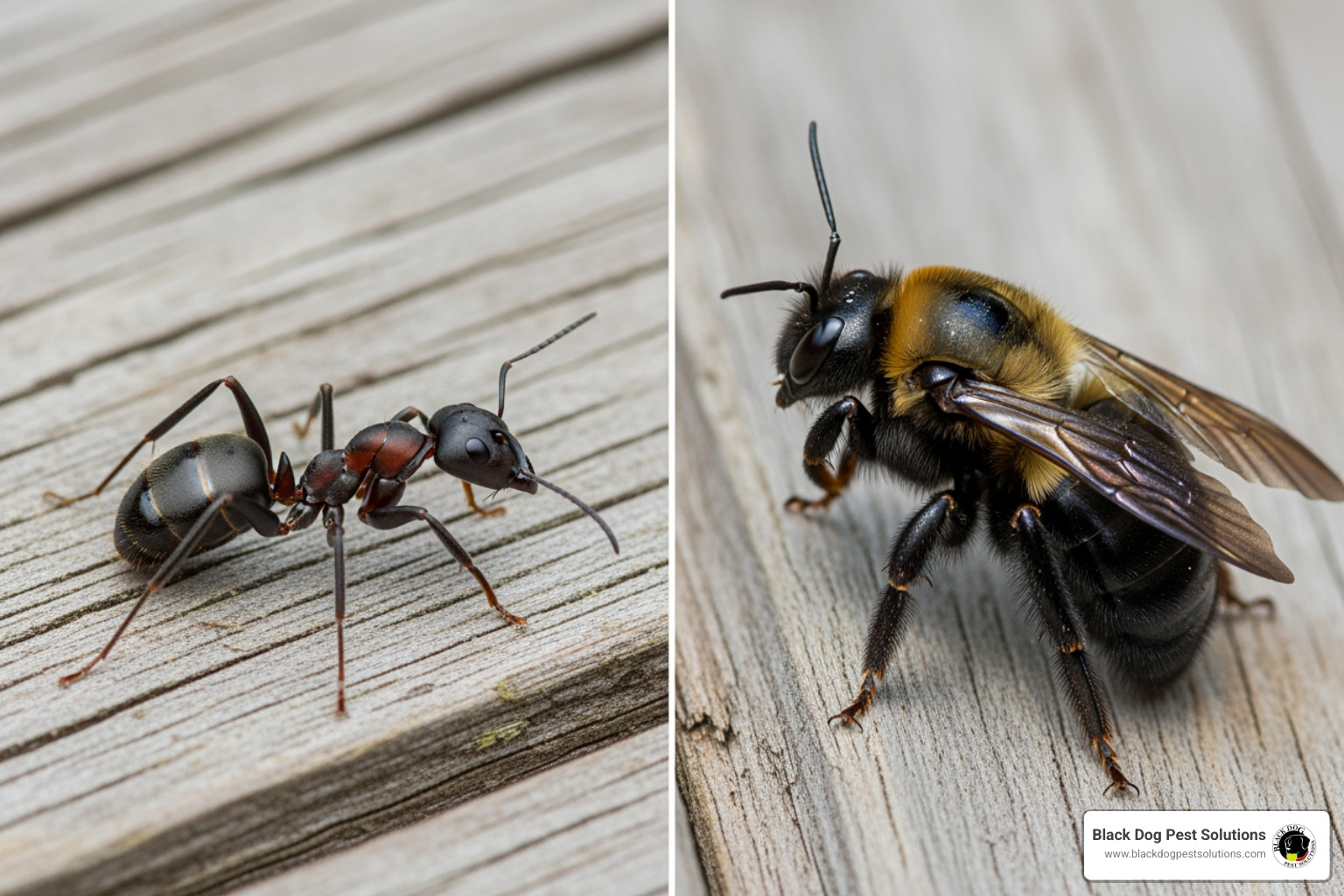
Physical Differences and Nesting Habits
Here is the easiest way to tell them apart:
- Carpenter ants have elbowed antennae, narrow waists, large mandibles, and a rounded thorax when viewed from the side.
- Many carpenter ants are black or dark brown, though some are reddish or mixed in color.
- Workers are large compared with many household ants, often around 1/4 inch to 1/2 inch long.
- Carpenter bees are bee-shaped, about 1/2 inch to 1 inch long, and often mistaken for bumblebees.
- The key giveaway on a carpenter bee is the shiny, mostly hairless black abdomen. Bumblebees look fuzzier.
Their wood damage differs too:
- Carpenter ants excavate smooth galleries inside wood. They do not eat it.
- Carpenter bees bore near-perfect round entry holes into exposed wood, then create tunnels inside.
Carpenter ants usually prefer moist, decayed, or previously damaged wood to get started, then may expand into sounder wood nearby. Carpenter bees tend to target exposed, unpainted or weathered wood on decks, railings, siding, trim, eaves, fascia, and fences.
The Morton Arboretum notes an important point in its guide on Carpenter Ants: carpenter ants are attracted to decaying wood, but they are not the original cause of the decay. In other words, the ants are often a symptom of a moisture problem that needs fixing.
Professional Carpenter Pest Control Strategies
Effective carpenter pest control usually requires more than one tool. We use an Integrated Pest Management approach, which means we do not rely on a single spray and hope for the best. We inspect, identify the source, target the nest or activity zone, reduce conditions that attract pests, and monitor results.
For carpenter ants, the most effective treatment plans often combine:
- Sweet baits when ants are in a sugar-feeding cycle
- Protein or grease baits when they shift food preferences
- Non-repellent residual treatments around likely entry points and activity zones
- Targeted void applications when nest locations are strongly suspected
- Exterior treatments around trees, stumps, wood piles, decks, and structural perimeters when needed
That feeding-cycle detail matters. Carpenter ants do not always want the same food. They can switch between sweet and protein needs, so using only one bait can limit results. This is why broad, thoughtful treatment tends to outperform random store-bought applications.
For more on our approach, see The Ultimate Guide to Evicting Carpenter Ants from Your House. Additional background on baiting and treatment timing is available from Carpenter Ant Facts | Carpenter Ant Control | TERRO®.

Integrated Pest Management for Carpenter Pest Control
IPM is the best long-term framework for carpenter ants and carpenter bees because it addresses why the pests are there, not just where they happen to be standing at the moment.
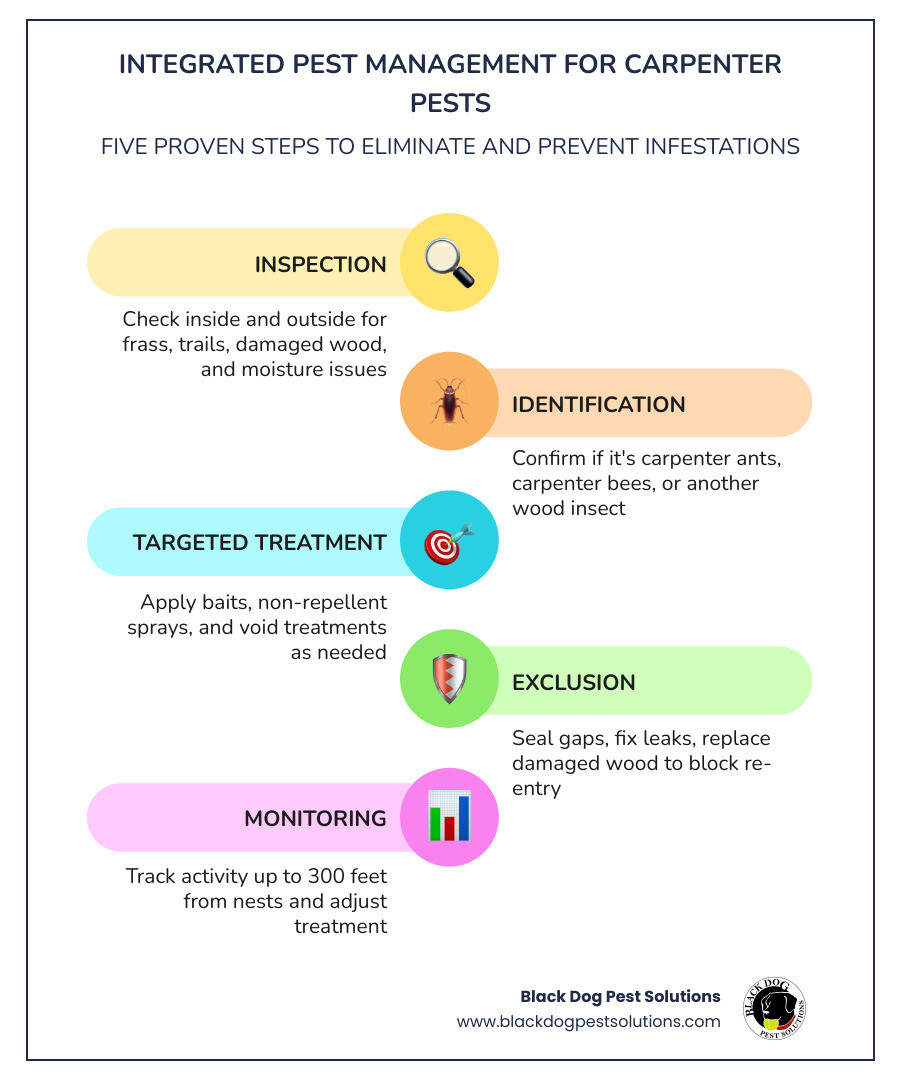
Our carpenter IPM process typically includes:
Inspection
We inspect interior and exterior areas for frass, moisture issues, trails, damaged wood, void activity, and likely nesting locations.Identification
We confirm whether the pest is a carpenter ant, carpenter bee, or another wood-associated insect. Misidentification wastes time and product.Targeted treatment
For ants, that may mean baiting, non-repellent applications, and void work where appropriate. For bees, it may include treatment of active holes and timing follow-up work carefully.Exclusion and correction
We recommend sealing gaps, repairing leaks, replacing damaged wood, and changing conditions that invite reinfestation.Monitoring
Because hidden nests can be stubborn, monitoring matters. Carpenter ants may forage up to 300 feet from a nest, and workers can travel long distances along edges, wires, branches, and foundations.
The EPA has a good overview of Integrated Pest Management (IPM) Principles if you want a deeper look at the method.
DIY vs. Professional Carpenter Pest Control
A lot of homeowners start with DIY. We understand why. The challenge is that carpenter pests are often hidden, and what you see is only the tip of the problem.
| Approach | DIY Products | Professional Service |
|---|---|---|
| Identification | Often based on guesswork | Pest and damage confirmed accurately |
| Carpenter ant baiting | Usually one bait type | Sweet and protein strategies can both be used |
| Residual control | Limited or repellent products common | Non-repellent materials with longer residual are often more effective |
| Nest location | Hard to find parent and satellite nests | Inspection focuses on trails, moisture, and void activity |
| Carpenter bee control | Sprays may hit adults only | Active holes, timing, and structural recommendations are coordinated |
| Safety and precision | Risk of overapplication or wrong placement | Label-driven, targeted application methods |
| Long-term results | Mixed, especially with hidden nests | More complete management plan and follow-up |
DIY may help with very early activity, especially if you have clearly visible foraging ants and no evidence of deep nesting. But DIY often falls short when:
- ants are coming from wall voids
- swarmers appear indoors
- damage is recurring
- there are multiple nesting sites
- carpenter bees are reusing old holes year after year
That is where experienced pest control companies in Avon bring real value. The goal is not just to knock down visible activity. It is to locate the source, reduce the conditions behind it, and help prevent the same headache next season.
Signs of Infestation and Structural Damage
Carpenter pests are sneaky. If they wore tool belts, at least they would be easier to spot.
Common signs of carpenter ant activity include:
- piles of frass that look like coarse sawdust
- frass mixed with insect parts
- rustling or faint crinkling sounds inside walls
- large ants trailing near baseboards, sinks, windows, or at night
- winged ants indoors, especially from spring into summer
- small slit-like openings in wood where debris is pushed out
Carpenter bee signs are usually more visible:
- round holes in exposed wood
- yellowish staining beneath holes
- coarse sawdust below nesting areas
- hovering bees near decks, railings, soffits, or fascia
- repeat activity in the same wood season after season
When carpenter ants tunnel, they leave galleries that are smooth and sanded-looking inside. Carpenter bees create long tunnels that can be reused and expanded over time. Old bee holes may also attract woodpeckers, which can make damage worse in a hurry.
For more on the risks of untreated damage, see Don’t Let Your Home Crumble Under Carpenter Ant Damage.
Identifying Hidden Damage in Wall Voids
Hidden damage is what makes carpenter ants especially frustrating. They often stay out of sight and travel behind walls, under insulation, around plumbing penetrations, and through structural voids.
A few clues can point to concealed activity:
- wood sounds hollow when tapped
- ants appear in one room, then vanish into trim or outlets
- activity increases at night
- there is a history of roof leaks, window leaks, or condensation
- soft wood is present around tubs, sinks, door frames, or crawlspaces
Research shows carpenter ants can remain undetected for 8 to 10 years in a home. That is not because they are magical. It is because satellite nests can stay tucked inside walls while workers forage elsewhere.
We often remind homeowners that visible ants do not always equal the main nest. A house may contain only a satellite nest, while the parent colony is outdoors in a stump, log, landscape timber, or rotting tree. That is one reason quick spray-only fixes may not solve the full problem.
If you are seeing ants around decks, trees, or outdoor wood features, this guide may help too: The Best Ways to Clear Carpenter Ants from Your Deck and Trees.
Prevention Strategies for Avon Homeowners
In Avon and nearby communities, local weather and building conditions can make homes more inviting to carpenter pests, especially where moisture and exposed wood meet. Prevention is rarely flashy, but it is usually cheaper than repairs.
The best prevention steps include:
- fix plumbing leaks, roof leaks, and gutter overflow
- replace rotted trim, fascia, or decking boards
- paint or seal exposed exterior wood
- trim branches so they do not touch the house
- move firewood and scrap lumber away from the structure
- keep mulch and heavy vegetation from staying packed against siding
- seal entry points around utility lines, doors, and windows
- clean up food sources that support foraging ants
For more practical home prevention ideas, visit Natural Ways to Tell Carpenter Ants to Buzz Off.
Moisture Control and Structural Sealing
If we had to pick one prevention category that matters most for carpenter ants, it would be moisture control.
Carpenter ants are strongly associated with damp or decaying wood. Carpenter bees also favor wood that is weathered and easier to excavate. So drying things out and tightening up the structure helps prevent future activity.
Focus on these areas:
- window frames
- roof edges and soffits
- chimney flashing
- bath traps and plumbing areas
- basements and crawlspaces
- deck ledgers and stairs
- garage trim and door frames
Seal gaps and cracks, especially anything about 1/4 inch or smaller that could support ant entry or make existing openings worse over time. Where repairs are needed, metal flashing, screens, and other metal materials are more resistant to chewing and wear than many soft materials.
For carpenter bees, paint or solid stain is often more protective than leaving wood bare. Filling old holes only works best after activity is addressed; otherwise, the bees may simply reopen or expand nearby areas.
Good prevention is one reason homeowners comparing pest control companies in Avon should ask about inspection and exclusion, not just treatment products.
When to Call Professional Pest Control Companies in Avon
Sometimes the best DIY decision is knowing when to stop DIY.
You should call a professional if:
- you see winged carpenter ants indoors
- you hear rustling in walls
- frass keeps appearing after cleanup
- ants return after baiting
- there is visible wood damage
- bees are drilling into multiple parts of the home
- activity is high around decks, fascia, or siding
- there are moisture problems you have already corrected, but pests remain
Carpenter ants are not a casual pest once a colony is established. Queens may live up to 25 years, laying 9 to 16 eggs in the first year, and eggs can develop through the life cycle in roughly 6 to 12 weeks. A mature colony can become a very large colony over time, which is why early intervention matters.
And because carpenter ants may forage far from the nest, what looks like a small kitchen ant problem may actually be part of a larger exterior-to-interior system.
Benefits of Local Pest Control Companies in Avon
Working with local pest control companies in Avon offers a few practical advantages.
First, local experience helps. Pest pressure in Avon, Avon Lake, Bay Village, Westlake, North Ridgeville, Elyria, Lorain, and surrounding Northern Ohio communities follows local weather, housing styles, moisture patterns, and seasonal insect activity. A treatment plan should reflect that.
Second, local service is more likely to include the structure-specific details that matter, such as:
- where moisture collects on Lake Erie-area homes
- which exterior wood features are commonly attacked
- how ant trails move from yard features into buildings
- what follow-up timing makes sense for the season
At Black Dog Pest Solutions, Mat Ledyard and the team provide licensed, family-owned service based in Avon. The company emphasizes inspection-first service, clear communication, and long-term pest management plans built around the actual structure and source of activity. That practical approach matters when homeowners are comparing pest control companies in Avon.
Frequently Asked Questions about Carpenter Pests
Do carpenter ants eat wood?
No. Carpenter ants excavate wood to create smooth nesting galleries, but they do not consume wood like termites. Instead, they push out frass made of wood shavings and debris.
How long can an infestation remain undetected?
Carpenter ants can remain in homes undetected for 8 to 10 years, especially when nests are hidden inside wall voids, beams, or moisture-damaged structural areas.
Are carpenter bees a threat to my home?
Yes. Carpenter bees bore into wood siding, fascia, decks, railings, and similar features. Over time, that damage can allow moisture intrusion, contribute to rot, and even attract woodpeckers looking for developing larvae.
What is the best treatment for carpenter ants?
In many cases, the most effective treatment combines inspection, baiting, non-repellent residual treatment, and moisture correction. Because carpenter ants can switch between sweet and protein feeding cycles, a one-product approach may not be enough.
Can I handle carpenter bees myself?
Sometimes minor activity can be addressed early, but recurring carpenter bee issues often need professional timing and follow-up. Treating only the visible adults usually does not solve the nesting problem inside the wood.
Why do carpenter ants keep coming back?
Often because the visible ants are from a satellite nest, while the parent colony remains elsewhere. If moisture issues, entry points, or outdoor nesting sources remain, activity may continue.
Conclusion
Carpenter pests are not just annoying houseguests. They are wood-damaging pests that can quietly turn a small warning sign into a much larger repair issue. The good news is that early identification, targeted treatment, and solid prevention can make a major difference.
If you need help with carpenter pest control in Avon or anywhere across our Northern Ohio service area, we are here to help. Black Dog Pest Solutions is a licensed, family-owned company led by Mat Ledyard, proudly serving the region with fast, professional service and a strong reputation reflected in our 4.9-star Google rating. We are also BBB accredited, and we focus on practical, long-term solutions rather than one-size-fits-all treatments.
If you are comparing pest control companies in Avon, start with a thorough inspection and a plan built around the actual pest, the actual structure, and the actual source of the problem.