
Carpenter Ant Damage Signs: What Every Homeowner Needs to Know
Carpenter ant damage signs are easier to spot than most people think — if you know what to look for. Here’s a quick overview:
Key signs of carpenter ant damage:
- Frass (sawdust-like debris) near baseboards, window sills, or small holes in wood
- Rustling or scratching sounds inside walls, especially at night
- Hollow-sounding wood when tapped with a hard object
- Large black ants (up to ⅝ inch) seen indoors, particularly after dark
- Winged ants emerging from walls or windows in spring
- Stuck doors or windows, sagging floors, or warped walls in advanced cases
These signs range from subtle early warnings to serious structural red flags. The longer an infestation goes undetected, the more costly the damage becomes.
Carpenter ants work from the inside out. They tunnel through wood — especially wood that’s been softened by moisture — hollowing out beams, joists, and framing without ever showing themselves on the surface. By the time most homeowners notice something is wrong, the damage is already well underway.
This isn’t a pest you can ignore and hope it goes away on its own.
I’m Mat Ledyard, owner of Black Dog Pest Solutions in Avon, Ohio, and I’ve been identifying and treating carpenter ant damage signs since 2005. In that time, I’ve seen how quickly a small problem inside a wall can turn into a major structural repair bill.
Carpenter ant damage signs vocab explained:
Identifying the Culprit: Carpenter Ants vs. Termites
When homeowners in Northern Ohio see wood shavings or damaged trim, the first word that usually comes to mind is “termites.” While termites are certainly a threat in the Greater Cleveland area, carpenter ants are just as capable of compromising your home’s structural integrity. However, they are very different animals with very different habits.
The most important thing to understand is that carpenter ants do not eat wood. They are simply master excavators. They chew through wood to create galleries and tunnels for their nests, then spit the wood out. Termites, on the other hand, consume the cellulose in the wood for food. This distinction is why carpenter ant damage signs often include piles of “sawdust,” whereas termite damage rarely does.
To help you tell them apart, we’ve put together this handy comparison:
| Feature | Carpenter Ants | Termites |
|---|---|---|
| Waist | Pinched, narrow waist (single node) | Thick, straight waist |
| Antennae | Elbowed (bent) | Straight, like a string of beads |
| Wings | Front wings are longer than back wings | All four wings are equal in length |
| Gallery Appearance | Smooth, polished, and clean | Rough, messy, and filled with mud/soil |
| Debris | Piles of sawdust (frass) | Mud tubes or uniform fecal pellets |
If you are seeing large, dark insects around your home, you are likely dealing with Carpenter Ants. These ants are among the largest you’ll find in Ohio, with workers typically measuring about 5/8 of an inch. They have a distinct heart-shaped head and a thorax (the middle section) that is evenly rounded when viewed from the side. Knowing how to identify carpenter ants vs. termites is the first step in protecting your home equity.
The 4 Stages of a Carpenter Ant Infestation
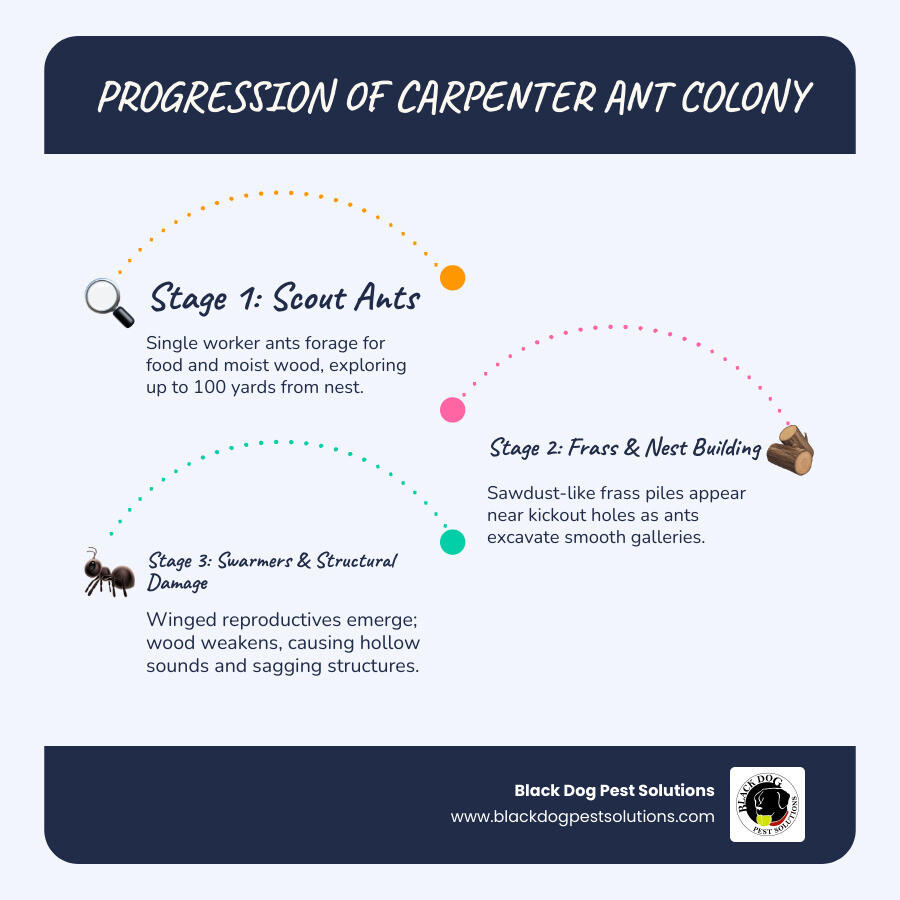
An infestation doesn’t happen overnight. It is a progressive process that often starts outside and slowly migrates into the structure of your home. Understanding the 4 Stages of Carpenter Ant Infestations can help you intervene before the repair costs skyrocket.
Stage 1: The Worker Scouts
Every great invasion begins with a scout. During this stage, you might see one or two large black ants wandering across your kitchen island or bathroom floor. These are foragers looking for food or moisture. Because carpenter ants can forage up to 100 yards from their nest, seeing a single ant doesn’t always mean they live in your walls yet—but it does mean your home is on their radar.
Stage 2: Frass Accumulation
Once a colony decides to set up a “satellite nest” inside your home, the construction begins. As they tunnel through your wall studs or floor joists, they need to get rid of the “trash.” They create tiny “kickout holes” and push out wood shavings, dead ant parts, and bits of insulation. This debris, known as frass, is one of the most reliable carpenter ant damage signs. If you find a pile of what looks like pencil shavings in a corner, you’ve hit Stage 2.
Stage 3: Winged Reproductives (The Swarmers)
When a colony becomes mature (usually after 3 to 6 years), it produces winged swarmers. These are the kings and queens whose only job is to fly out, mate, and start new colonies. If you see winged ants crawling on your window sills or emerging from a baseboard, it is a sign that a mature, well-established nest is already living inside your home.
Stage 4: Structural Failure
This is the “danger zone.” After years of tunneling, the wood becomes so hollowed out that it can no longer support the weight of the house. You might notice your floors feel “springy” or sloped. Windows and doors may start to stick because the framing has shifted. At this stage, the damage is no longer just a pest issue—it’s a construction project.
6 Critical Carpenter Ant Damage Signs to Watch For
Because these ants are nocturnal and live inside the wood, they are often invisible. You have to use your other senses to find them. Here are the 6 Signs of Carpenter Ant Damage that we tell all our neighbors in Avon and Westlake to watch for:
- Sawdust-like Frass: Look for piles of wood shavings under baseboards, inside cabinets, or in the garage. Unlike termite “frass,” which looks like tiny pepper grains, carpenter ant frass looks like actual sawdust from a saw.
- Rustling Noises: If you press your ear against a suspect wall at night, you might hear a faint rustling or “crinkling” sound. This is the sound of thousands of tiny mandibles scraping against the wood.
- Hollow-Sounding Wood: Take a screwdriver handle or a small hammer and tap on your wooden trim, door frames, or support beams. If it sounds “hollow” or “thin” compared to healthy wood, there’s a good chance the inside has been excavated.
- Presence of Moisture-Damaged Wood: Carpenter ants prefer wood that is soft and decaying. If you have a leaky roof, a dripping pipe under the sink, or a deck with rot, these are prime targets.
- Stuck Windows and Doors: As the ants remove the internal structure of the wood, the frames can warp or sag. If a window that used to slide easily is now a struggle to open, don’t just blame the humidity.
- Large Ants and Shed Wings: Seeing the ants themselves is the most obvious sign. Keep an eye out for discarded wings near windows, which indicate that swarmers have recently taken flight.
If you spot any of these, it’s time to look into Ant Removal 101 Methods Trusted By Professional Services to ensure the entire colony—including the queen—is eliminated.
Where to Look for Carpenter Ant Damage Signs Indoors and Out
In Northern Ohio, our weather plays a huge role in where these ants decide to hide. From the humid summers in Sandusky to the damp springs in Cleveland, moisture is the common denominator.
Common Indoor Nesting Sites and Carpenter Ant Damage Signs
Carpenter ants love areas with high moisture levels because it makes the wood easier to chew. When we perform Residential Services for our clients, we always start our inspection in these high-risk zones:
- Wall Voids and Insulation: They love the space behind your drywall, especially if there is foam insulation, which they can tunnel through with ease.
- Under Sinks and Behind Tiles: Leaky plumbing in bathrooms and kitchens provides the perfect environment. They often nest behind bathroom tiles or around tubs.
- Window Sills and Door Frames: These areas are prone to condensation and rain seepage, making them prime real estate for a satellite nest.
- Attics and Chimneys: Faulty chimney flashing or a small roof leak can lead to an infestation in the uppermost parts of your home.
Identifying these pests early in these hidden spots is the key to preventing long-term damage.
Outdoor Indicators of an Infestation
Most indoor infestations actually start as a “parent colony” somewhere on your property. By managing the exterior, you can often stop the ants before they ever find a way inside. Our services often involve inspecting these outdoor hotspots:
- Firewood Piles: Never store firewood directly against your house. This is like a five-star hotel for carpenter ants.
- Tree Stumps and Dead Roots: Rotting stumps are the most common site for a parent colony.
- Overhanging Branches: Ants use branches like a highway to reach your roof or siding.
- Landscaping Timbers and Deck Posts: Any wood that has direct contact with the soil will eventually absorb moisture and become attractive to ants.
Following Beat The Heat Deter The Ants Summer Ant Prevention Strategies For Ohio Homes Businesses can help you keep your yard from becoming a breeding ground.
Prevention and Professional Solutions for Northern Ohio Homes
Prevention is always cheaper than a cure. Once you know the carpenter ant damage signs, you can take proactive steps to make your home less inviting.
How to Prevent Future Carpenter Ant Damage Signs
To keep your home safe, we recommend a “whole-home” approach to maintenance:
- Moisture Control: This is the #1 rule. Fix leaky faucets, repair roof leaks, and ensure your basement or crawl space is dry. Use a dehumidifier if necessary.
- Seal the Gaps: Use caulk to seal cracks in your foundation and gaps around utility pipes and wires.
- Gutter Maintenance: Keep your gutters clean so water doesn’t overflow and rot your fascia boards.
- Trim the Vegetation: Keep trees and shrubs trimmed at least 12 inches away from your home’s exterior.
- Eliminate Wood-to-Ground Contact: Ensure that your siding and door frames are not touching the soil.
While DIY steps are great, Carpenter Ant Damage: Signs, Risks & How to Protect Your House often requires a professional eye. At Black Dog Pest Solutions, we use specialized equipment to find nests that are tucked deep inside wall voids where store-bought sprays can’t reach.
Frequently Asked Questions about Carpenter Ants
Do carpenter ants eat wood like termites?
No, they do not. Their dietary habits are much more like ours—they love proteins and sugars. Outdoors, they eat other insects and “honeydew” produced by aphids. Indoors, they’ll go after pet food, meat, and sweets. They only chew wood to create living space, which is why they produce frass and leave behind smooth, clean galleries.
How long does it take for carpenter ants to cause structural damage?
It usually takes several years for a colony to cause significant structural damage. However, the speed depends on the size of the colony and the condition of the wood. In moist, rotting wood, they can excavate much faster. Because they are hidden, the destruction is often “silent” until a support beam is finally weakened enough to sag.
Does seeing one carpenter ant mean I have an infestation?
Not necessarily. Since worker ants can forage up to 100 yards from their nest, a single ant might just be a traveler from a neighbor’s yard or a nearby tree stump. However, if you see more than 20 ants indoors, or if you see them consistently in the late winter or early spring, it is a strong indicator that a nest is active inside your home.
Conclusion
Your home is likely your biggest investment, and we don’t want to see it compromised by a pest that works in the shadows. From Avon to Cleveland and across Northern Ohio, Black Dog Pest Solutions is dedicated to protecting the structural integrity of our community’s homes.
Identifying carpenter ant damage signs early can save you thousands of dollars in structural repairs. If you’ve heard strange noises in your walls, found mysterious piles of sawdust, or spotted large black ants in your kitchen, don’t wait for the damage to get worse. Our team provides fast, professional, and effective extermination services tailored to the unique needs of Greater Cleveland homeowners.
Protect your home from carpenter ants today. Give us a call or visit our website to schedule a comprehensive inspection. Let us help you keep your home standing strong for years to come!