
Why Professional Mouse Removal Is Worth It — And What to Expect
Professional mouse removal is the most reliable way to eliminate a mouse infestation and help prevent it from coming back. Here’s a quick overview of what the process typically involves:
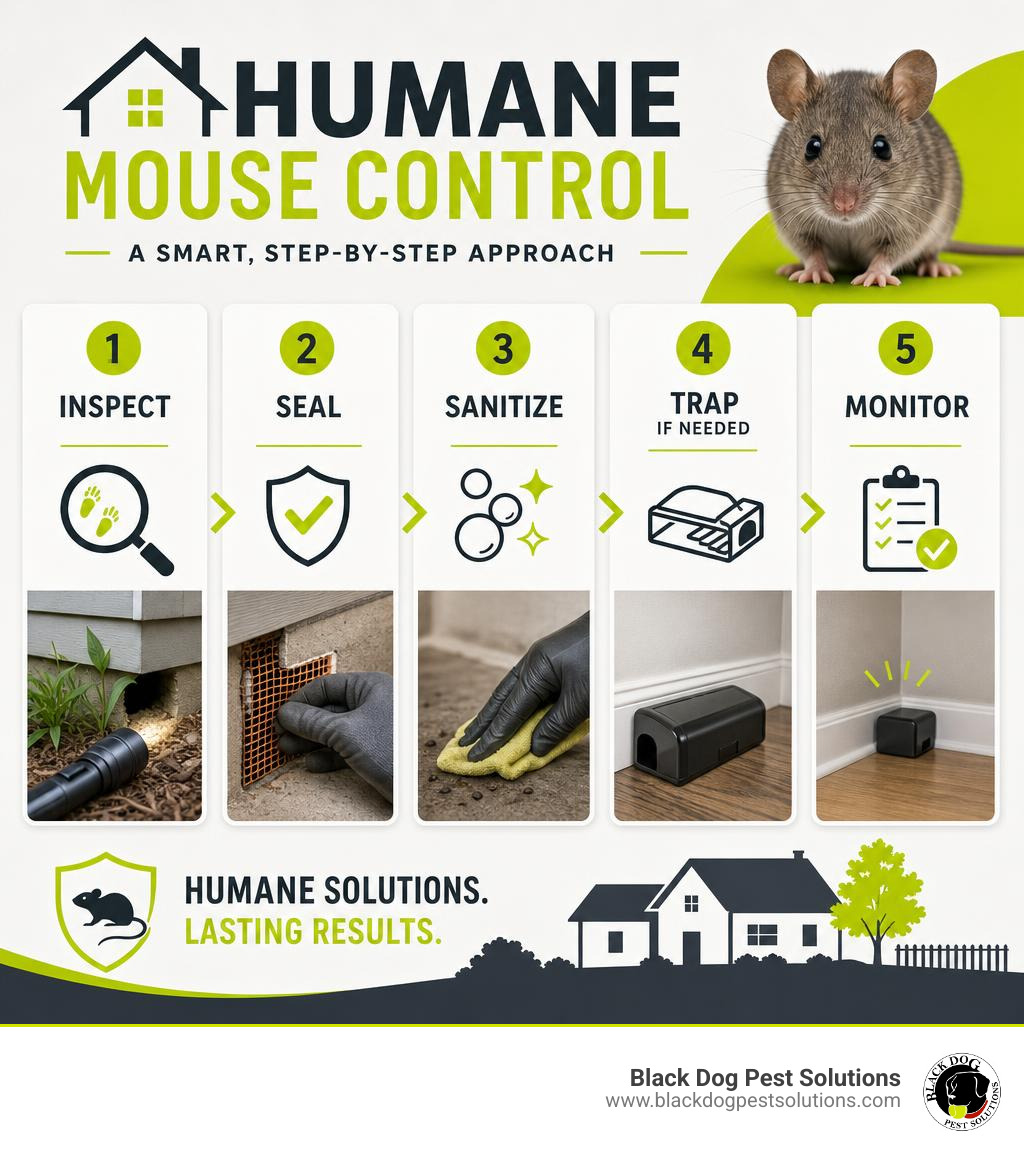
How professional mouse removal works:
- Inspect — A technician identifies entry points, travel routes, and nesting areas inside and outside your home
- Seal — Gaps about 1/4 inch or smaller are closed using materials more resistant to chewing, like copper mesh and metal flashing
- Sanitize — Droppings, nesting material, and contaminated areas are safely cleaned up
- Trap if needed — Snap traps, enclosed stations, or live-catch traps are placed along active routes
- Monitor — Follow-up visits track activity and catch any new movement early
DIY traps and store-bought bait can reduce the number of mice you see — but they rarely address why mice got in or how to keep them out long-term. That’s where professional service makes the difference.
Mice are small, quiet, and fast breeders. By the time most homeowners notice droppings in the pantry or hear scratching behind the walls at night, an infestation is often already underway. And because mice reproduce quickly, a problem that seems minor today can grow into something much harder to manage in just a few weeks.
Whether you’ve spotted one mouse or suspect a larger problem, understanding what professional removal actually involves helps you make a smarter, faster decision.
I’m Mat Ledyard, owner of Black Dog Pest Solutions in Avon, Ohio — a licensed, family-owned pest control company I’ve been running since 2014, with experience in the industry going back to 2005. Professional mouse removal has been a core part of my work across Northern Ohio, and in this guide I’ll walk you through everything you need to know to handle the situation the right way.
Professional mouse removal terms made easy:
How to Recognize a Mouse Infestation Before It Spreads
Mouse problems are easiest to manage when they are caught early. The challenge is that mice are mostly active at night, avoid open spaces, and use walls, cabinets, appliance voids, garages, attics, and crawlspaces as hidden travel lanes.
If you live in Avon, Greater Cleveland, Lorain, Elyria, Westlake, Bay Village, North Ridgeville, Lakewood, Strongsville, Sandusky, Medina, or nearby Northern Ohio communities, keep an eye out for small clues. Mice do not need much space, food, or time to settle in.

For a deeper overview of mouse behavior and identification, see our guide to Mice.
The Most Common Signs Homeowners Notice First
The most common signs of a mouse infestation include:
- Droppings: Mouse droppings are small, dark, and often compared to grains of rice. Look under sinks, behind appliances, along baseboards, in drawers, and near stored food.
- Nighttime scratching or squeaking: Sounds in walls, ceilings, attics, and cabinets are often more noticeable after the house gets quiet.
- Chewed food packaging: Mice can gnaw through cardboard, plastic bags, cereal boxes, pet food bags, and pantry packaging.
- Gnaw marks: Fresh gnawing on wood, drywall, wiring, insulation, stored boxes, or furniture can point to active mouse movement.
- Nesting material: Shredded paper, fabric, insulation, grass, and cardboard may be tucked into hidden areas.
- Musky odor: A stale, ammonia-like or musky smell can develop where mice travel or nest.
- Grease marks and tracks: Mice often leave faint smudges along walls, pipes, and tight pathways because they repeatedly use the same routes.
- Odd pet behavior: Dogs or cats may stare at walls, paw at cabinets, or sniff around appliances before you notice anything yourself.
- Garage clutter activity: Stored holiday decorations, cardboard boxes, old furniture, and pet food in garages can create easy nesting and feeding spots.
One mouse sighting is worth taking seriously. It does not always mean you have a large infestation, but it does mean an inspection is smart.
Health Risks and Property Damage Linked to Mice
Mice are more than an unpleasant surprise in the pantry. They can create health and safety concerns inside the home.
Potential risks include:
- Food contamination from droppings, urine, saliva, and hair
- Salmonellosis and other foodborne illness risks when contaminated surfaces or food are not handled properly
- Leptospirosis risk associated with contact with infected rodent urine
- Hantavirus concerns, especially around deer mice and contaminated droppings
- Allergy and asthma triggers from droppings, urine, dander, and nesting debris
- Insulation contamination in attics and crawlspaces
- Wiring damage from gnawing, which can increase fire risk
- Damage to stored belongings, including books, clothing, boxes, furniture, and keepsakes
Industry estimates often place rodent-related property damage in the billions each year in the United States, with some estimates around $20 billion annually. That includes chewed wiring, damaged insulation, contaminated food, structural damage, and cleanup costs.
If you find droppings, avoid dry sweeping or vacuuming. Disturbing dried rodent waste can send particles into the air. Follow CDC guidance on cleaning up after rodents, which generally recommends ventilation, gloves, disinfectant, and careful disposal.
Common Mouse Species Found in Homes
In Northern Ohio homes, the most common mouse concerns usually involve house mice, deer mice, and white-footed mice. Correct identification matters because nesting behavior, health concerns, and control strategies can vary.
| Species | Common Appearance | Typical Indoor Behavior | Key Concern |
|---|---|---|---|
| House mouse | Gray-brown body, small size, relatively uniform coloring, hairless or lightly haired tail | Often nests near food, kitchens, wall voids, basements, garages, and storage areas | Rapid reproduction and food contamination |
| Deer mouse | Brown or reddish-brown upper body with a white belly and feet; often larger eyes and ears | More common near wooded or field edges but may enter homes, garages, sheds, and cabins | Associated with hantavirus concerns in some regions |
| White-footed mouse | Similar to deer mouse, usually brownish with white feet and underside | Often found near wooded lots, brushy areas, and structures close to natural cover | Can contaminate stored areas and enter through small gaps |
Homeowners do not need to become mouse biologists. If you are seeing droppings, hearing movement, or finding chewed packaging, the practical next step is identifying how mice are entering and where they are active.
How Mice Enter Homes and Why Small Problems Grow Quickly
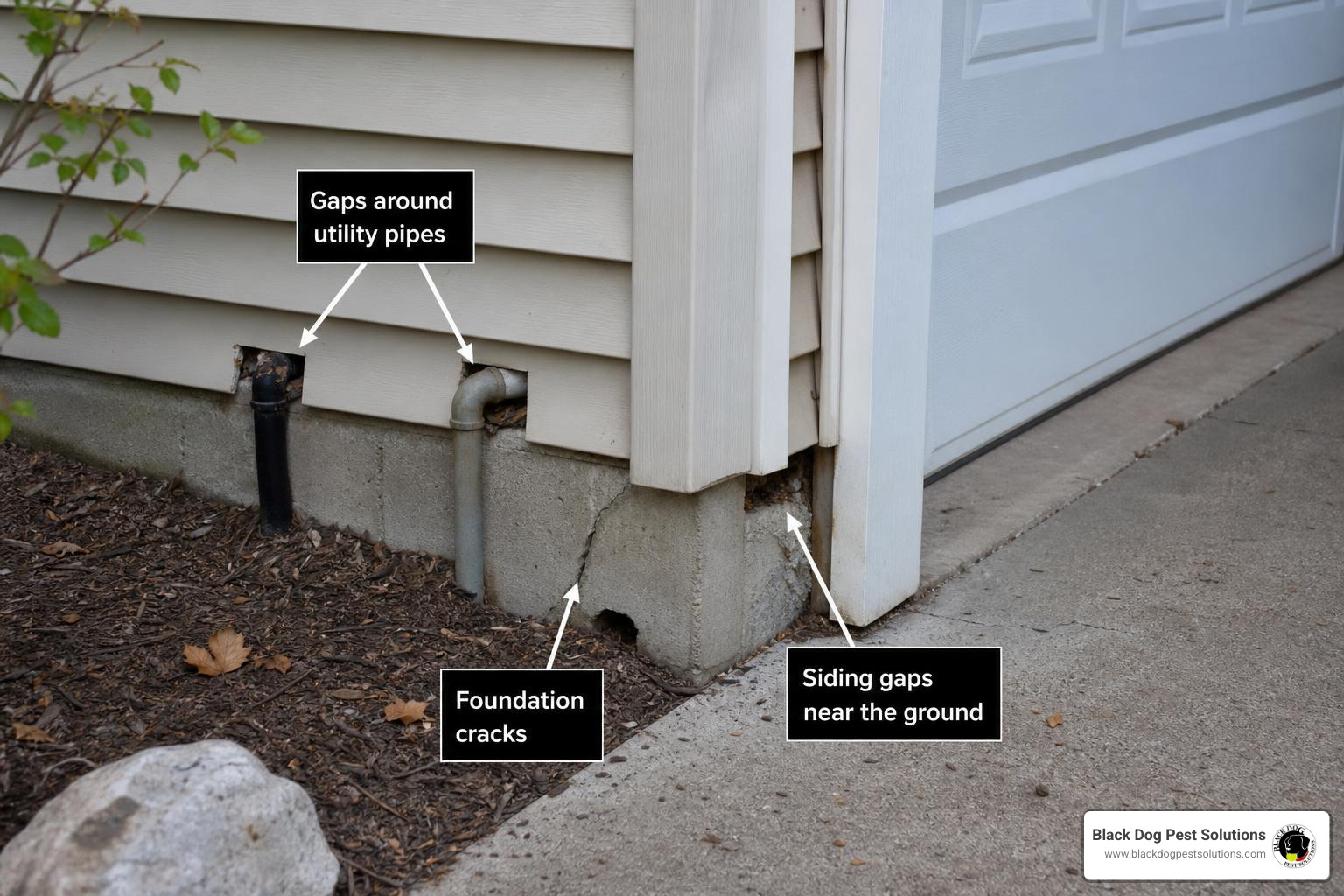
Mice enter homes through tiny openings around foundations, garages, utility penetrations, vents, siding gaps, rooflines, crawlspaces, and doors. They are excellent climbers and can use pipes, wires, brick texture, vegetation, and rough surfaces to reach openings.
A mouse does not need a dramatic hole in the wall. An opening about 1/4 inch or smaller may be enough for a determined mouse to squeeze through. That is why exclusion is such a big part of professional mouse removal.
Entry Points Homeowners Should Check
Common mouse entry points include:
- Foundation cracks and gaps
- Openings around plumbing lines
- Cable, internet, electrical, and HVAC penetrations
- Dryer vents and damaged vent covers
- Gaps under garage doors
- Worn door sweeps
- Basement window gaps
- Crawlspace vents
- Sill plate gaps where the framing meets the foundation
- Roofline gaps and soffit openings
- Damaged screens
- Utility meter openings
- Gaps around exterior doors
- Openings near decks, patios, and attached garages
For sealing, materials matter. Foam alone is often not enough because mice can chew through many soft materials. Professional exclusion commonly uses copper mesh, metal flashing, hardware cloth, sealants, and other materials that are more resistant to chewing.
Why One Mouse Can Become an Infestation
Mice reproduce quickly. Indoors, where food, warmth, and shelter are available, they may breed year-round.
That means a small problem can expand fast when mice have:
- Easy food access
- Warm shelter
- Cluttered nesting areas
- Hidden wall travel routes
- Unsealed entry points
- Minimal disturbance
- Access to garages, attics, basements, or crawlspaces
This is why we do not recommend waiting to “see if it goes away.” Mice are not known for respecting household boundaries. If they find snacks, shelter, and a quiet wall void, they tend to make themselves comfortable.
For more on larger infestations, read Beyond a Few Pests: Eradicating a Full-Blown Mice Infestation.
Northern Ohio Pest Patterns Homeowners Should Know
In Northern Ohio, mouse pressure often increases in fall and winter as temperatures drop. Mice do not hibernate. Instead, they look for warmth, food, and protected nesting areas.
That said, mouse activity can happen any time of year. Spring nesting, summer garage activity, and fall shelter-seeking are all common. Local weather and building conditions can make homes more attractive to mice, especially around:
- Older foundations
- Attached garages
- Wooded lots
- Lake-effect weather patterns
- Crawlspaces and basements
- Gaps created by settling, utility work, or aging materials
- Stored bird seed, grass seed, or pet food
This is one reason homeowners often compare pest control companies in Avon when they start hearing scratching in the walls. Local experience matters because homes in Avon, Greater Cleveland, Lorain County, and surrounding communities often share similar structural and seasonal pest patterns.
Professional mouse removal: What a Complete Service Should Include
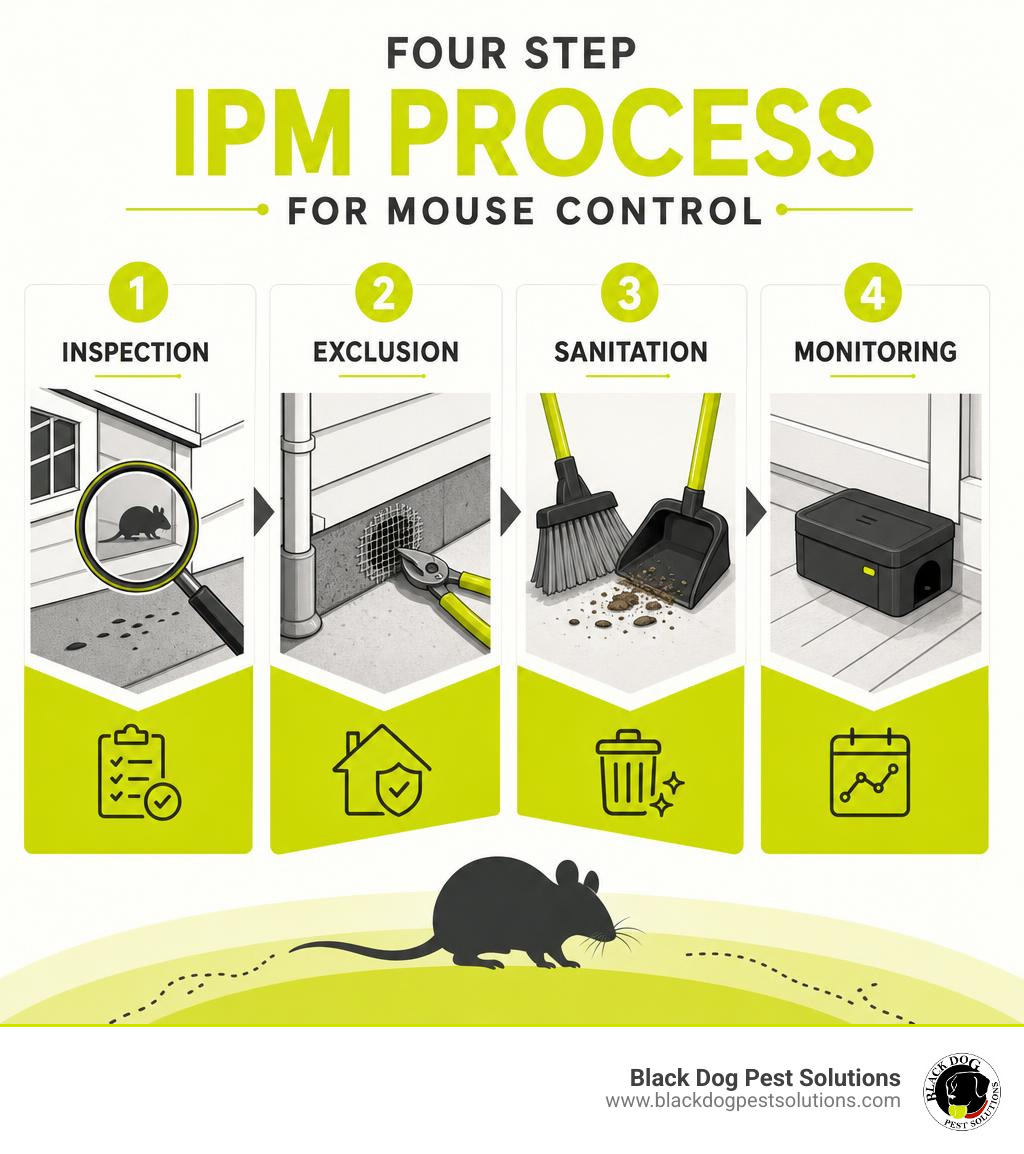
A complete professional mouse removal service should do more than place a few traps. The goal is to reduce current activity, identify why mice got in, help prevent re-entry, and monitor for new signs.
A strong service plan usually includes:
- Inspection
- Species and activity identification
- Travel route mapping
- Entry point documentation
- Trapping or removal strategy
- Exclusion repairs
- Sanitation guidance or cleanup
- Follow-up monitoring
- Prevention recommendations
This approach follows the principles of integrated pest management, or IPM. The EPA describes IPM as a practical strategy that uses inspection, prevention, monitoring, and targeted treatment rather than relying on one method alone. You can learn more from the EPA guidance on Integrated Pest Management and our guide, Get Smart About Mice: What Is Integrated Pest Management?.
Why Professional mouse removal Often Works Better Than DIY
DIY mouse control can catch some mice. In a very small, isolated situation, homeowners may reduce activity with careful trap placement and sanitation. The problem is that DIY methods often miss the root cause.
Professional service often works better because technicians know how to find:
- Hidden entry points
- Dropping patterns
- Wall and appliance travel routes
- Nesting areas
- Attic and crawlspace activity
- Garage and foundation vulnerabilities
- Food sources homeowners may overlook
- Structural gaps behind siding, pipes, vents, and utility lines
Trap placement also matters. A trap in the middle of a room is often less effective than a trap placed along a known travel route, near a wall, or near active droppings. Mice tend to hug edges and move through familiar paths.
Professionals can also help with safer decision-making around baits, traps, pets, children, and non-target wildlife. Among pest control companies in Avon, an IPM-first approach is especially important because long-term prevention depends on sealing and monitoring, not just catching what is visible today.
For related information, see Quick Kill: The Fastest Ways to Evict Mice From Your House.
The Professional Inspection and Diagnosis
A professional inspection usually starts outside and works inward. We look for how mice are getting in before deciding how to remove them.
Exterior inspection may include:
- Foundation gaps
- Garage seals
- Utility penetrations
- Crawlspace vents
- Basement windows
- Siding gaps
- Soffits and roofline openings
- Vegetation touching the home
- Stored materials near the foundation
- Burrows or exterior droppings
Interior inspection may include:
- Kitchens and pantries
- Behind refrigerators and stoves
- Under sinks
- Basements
- Garages
- Attics
- Crawlspaces
- Utility rooms
- Storage closets
- Wall void clues
- Areas with odors, droppings, or gnawing
The technician is not just looking for a mouse. We are looking for the whole pattern: where they entered, where they travel, where they feed, where they may be nesting, and what conditions are helping them stay.
Removal Methods Used by Professionals
Professional removal methods vary based on the home, activity level, safety needs, and infestation pattern. Common tools include:
- Snap traps placed along active travel routes
- Enclosed trapping stations to reduce accidental contact
- Multiple-catch traps where appropriate
- Live-catch traps in certain situations, with frequent checks according to instructions
- Tamper-resistant bait stations when rodenticides are used as part of a carefully controlled plan
Rodenticides require caution. They should be used according to label directions and placed to reduce exposure risks for children, pets, and non-target wildlife. In many homes, trapping and exclusion are preferred first-line tools because they allow better tracking of activity and reduce the chance of hidden carcass odors.
Humane mouse control does not always mean every mouse can be handled the same way. It means choosing methods thoughtfully, minimizing stress and suffering where possible, and focusing heavily on prevention as the best long-term approach. Release guidance can vary by location and situation, so live-catch decisions should be handled carefully.
Exclusion, Sanitation, and Monitoring
Exclusion is the part many DIY efforts miss. If mice can still enter, the problem can return even after several traps are successful.
Professional exclusion may include:
- Sealing foundation gaps
- Installing or repairing door sweeps
- Reinforcing garage door seals
- Screening vents
- Sealing utility openings
- Repairing gaps around pipes and wires
- Adding copper mesh, metal flashing, or hardware cloth
- Closing roofline or soffit gaps when accessible
Sanitation is also important. This does not mean your home is dirty. Mice can invade clean homes too. But reducing food access makes the home less inviting.
Helpful sanitation steps include:
- Store cereal, rice, pet food, and bird seed in sealed containers
- Clean crumbs under appliances
- Remove nesting clutter where possible
- Keep trash lids tight
- Avoid leaving pet food out overnight
- Dispose of contaminated food packaging
Monitoring is the final piece. Follow-up visits help confirm whether activity is decreasing, whether new droppings appear, and whether additional sealing or trapping is needed. For more on humane methods, visit Compassionate Critter Control: Humane Mouse Removal Strategies
Cost, Timeline, Safety, and Prevention After Removal
The cost and timeline for professional mouse removal depend on the size of the home, the severity of activity, the amount of exclusion needed, and whether sanitation or attic cleanup is required. We do not recommend choosing a service based on price alone. A cheaper visit that only sets traps may not address the reason mice entered.
For more detail, read Everything You Need to Know About Pest Control Mice Cost.
Professional mouse removal Costs, Timelines, and Follow-Up
A professional estimate may consider:
- Home size
- Number of active areas
- Dropping volume
- Attic, crawlspace, basement, or garage access
- Number and complexity of entry points
- Exclusion materials and labor
- Follow-up visits
- Sanitation or contaminated insulation concerns
- Ongoing monitoring needs
Some homes may need a focused service visit and a few follow-up checks. Others may need a multi-visit program, especially when activity is established in wall voids, attics, basements, or attached garages.
Many homeowners notice reduced activity within days once traps are correctly placed and food access is reduced. However, there is no universal timeline. Some jobs may take one to three weeks or longer depending on activity, structure, and exclusion needs.
A good provider should explain the scope clearly and provide an itemized estimate. For more about how our pricing approach works, see The Complete Guide to Black Dog Pest Solutions Pricing.
Eco-Friendly and Pet-Safer Mouse Control Options
Eco-friendly and pet-safer mouse control usually starts with IPM, not chemicals. The most sustainable mouse strategy is to make the home harder to enter and less attractive to rodents.
Options may include:
- Detailed inspection before treatment
- Exclusion using durable materials
- Sanitation and food-source reduction
- Strategic trap placement
- Enclosed stations where appropriate
- Live-catch traps in suitable situations
- Frequent trap checks according to product instructions
- Tamper-resistant bait stations if rodenticides are needed
- Careful label compliance to reduce exposure risk
No pest control method is completely risk-free in every setting, especially when pets, children, or wildlife are present. The goal is to choose the lowest-risk effective strategy for the situation while minimizing stress and suffering.
This is one reason many homeowners contact pest control companies in Avon that emphasize IPM, humane mouse control, and long-term prevention.
How Homeowners Can Help Prevent Future Infestations
After removal, prevention becomes the most important part of the plan. Mice live outdoors throughout Northern Ohio, so the goal is to make your home much less accessible and less inviting.
Practical prevention steps:
- Store pantry goods in airtight containers
- Keep pet food sealed and avoid leaving bowls out overnight
- Clean crumbs and spills quickly
- Empty trash regularly and use tight-fitting lids
- Reduce cardboard storage in garages and basements
- Keep garage floors organized and easier to inspect
- Trim vegetation away from the foundation
- Keep woodpiles and stored materials away from exterior walls when possible
- Check door sweeps and weatherstripping each season
- Inspect around utility lines and vents
- Clean behind refrigerators, stoves, and under cabinets
- Avoid storing bird seed or grass seed in thin bags
- Schedule periodic inspections if your home has recurring activity
Garages are especially common mouse zones because they provide warmth, clutter, and easy access. For more garage-specific tips, read Keep Your Garage Squeaky Clean: A Guide to Effective Mice Control.
Frequently Asked Questions About Professional Mouse Removal
Here are quick answers to the questions we hear most often from Northern Ohio homeowners.
Is one mouse in the house a big deal?
It can be. One visible mouse does not always mean a large infestation, but mice are social, secretive, and fast breeders. By the time one runs across the kitchen, others may be active in walls, cabinets, appliances, or storage areas.
Early inspection is the best move. If it is a small issue, you can address it before it spreads. If there is hidden activity, you can begin removal and exclusion before damage increases.
Should I clean mouse droppings myself?
Small, limited areas may be cleaned carefully if you follow safety guidance. Wear gloves, ventilate the area, avoid dry sweeping, and disinfect droppings before removal. The CDC provides helpful instructions here: CDC guidance on cleaning up after rodents.
Call a professional if:
- Droppings are widespread
- Droppings are in attic insulation
- There is a strong odor
- You suspect deer mouse activity
- You have respiratory concerns
- Contaminated material needs removal
- You are unsure how extensive the problem is
Do I need emergency mouse removal?
You may need fast scheduling if you have:
- Active mouse sightings in living areas
- Droppings in the kitchen or pantry
- Scratching in walls or ceilings
- Chewed electrical wiring
- Strong odors
- Children, pets, or vulnerable family members in the home
- A sudden increase in activity
- Mice in bedrooms, food storage, or commercial spaces
If the situation feels urgent, read Don’t Panic: How to Find Emergency Mice Exterminators Near You. Emergency service should still follow the same core principles: inspect, seal, sanitize, trap if needed, and monitor.
Conclusion
Professional mouse removal is not just about catching mice. It is about understanding why they entered, removing current activity, sealing vulnerable gaps, cleaning contaminated areas safely, and monitoring so new activity is caught early.
The best long-term approach is simple:
- Inspect thoroughly
- Seal entry points
- Sanitize affected areas
- Trap if needed
- Monitor and adjust
At Black Dog Pest Solutions, we serve Avon and communities across Northern Ohio, including Greater Cleveland, Lorain, Elyria, Avon Lake, Bay Village, North Ridgeville, Westlake, Lakewood, Strongsville, Medina, Sandusky, and nearby areas. We are a licensed, family-owned pest control provider led by Mat Ledyard, with a 4.9/5 Google rating and BBB accreditation.
If you are comparing pest control companies in Avon and want a practical, humane, prevention-focused plan, we are here to help.
Ready to stop the scratching and take back your pantry? Schedule mouse control help.