

This is no longer an “other part of the state” problem. On February 17, 2026, the Ohio Department of Agriculture (ODA) issued a statewide quarantine for the invasive spotted lanternfly, Lycorma delicatula. Before that, only 18 Ohio counties were quarantined (ODA).
So the Ohio spotted lanternfly quarantine now covers every county here. Lorain, Cuyahoga, Medina, Erie and Huron are all inside a regulated area.
Late August is a good time to begin inspecting likely egg-laying surfaces before fall activity increases. Penn State Extension places egg laying from late summer into early winter, September through December, with most masses deposited in October (Penn State Extension).
What the Ohio spotted lanternfly quarantine regulates
The quarantine is primarily a movement-control rule, not a homeowner spraying mandate.
Businesses moving regulated articles should inspect them and comply with Ohio requirements and any applicable quarantine rules in the destination state. Interstate shipments may require documentation or certification, depending on where the items are going (ODA, OAC 901:5-56).
SLF is also designated a destructive plant pest under Ohio law. That allows inspections and restricts movement of certain items (ODA program page). The governing rule is Ohio Administrative Code Chapter 901:5-56, first announced in October 2021.
Because every Ohio county is now within the regulated area, the old question of whether a property was inside or outside the quarantine no longer applies.
| Item | Detail | Source |
| Statewide effective date | February 17, 2026 | ODA news release |
| Prior scope | 18 Ohio counties | ODA news release |
| First Ohio detection | 2020 | ODA SLF page |
| Governing rule | OAC 901:5-56, announced October 2021 | Ohio Administrative Code |
| Regulated articles | SLF at any life stage and items that may carry it, including trees, nursery stock, firewood, logs, plant material, produce and other conveyances | OAC 901:5-56-03 |
| Sighting reports | ODA no longer encourages community members to report sightings | ODA news release |
| Strongly preferred host plant | Tree-of-heaven (Ailanthus altissima) | ODA news release |
Under the old county map, reports helped track spread. With a statewide rule in force, ODA is no longer asking the public to report sightings (ODA). For property owners, the practical focus is inspecting outdoor items and managing SLF where it is found.
Why Ohio treats this insect as a serious threat
Heavy SLF feeding can stress plants and cause significant damage to grapevines and other preferred hosts. Grapevines, black walnut saplings and tree-of-heaven are named specifically (ODA SLF page).
It is a pest of grapes, hops and apples, plus many other plant species. ODA flags the risk to Ohio’s grape and wine industry, which adds more than $6 billion in economic activity to the state each year (ODA).
For a homeowner in Avon Lake or Vermilion, the nuisance side looks different. Heavy feeding can produce honeydew, which promotes sooty mold and can leave decks, patios, vehicles and outdoor surfaces sticky. Same insect, same eggs, different headache.
Prepare for fall egg-laying activity
Here is the seasonal reason to pay attention in late August. Egg laying can begin in late summer and continue into early winter, with most egg masses deposited in October. Each mass holds an average of 30 to 50 eggs, and one female can lay at least two masses (Penn State Extension).
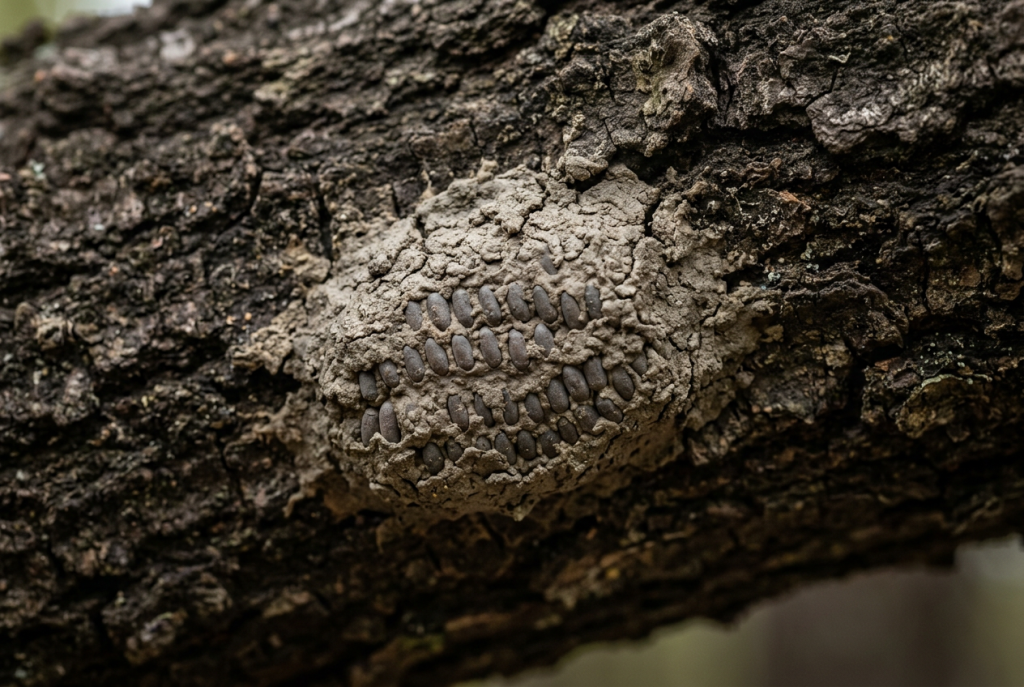
There is one generation per year. Eggs are laid September through December and hatch the following late April through June (Penn State Extension management guide).
Two facts make the eggs worth your attention. First, egg masses are the only stationary life stage, which makes them practical targets for inspection and removal (Penn State Extension).
Second, they may be laid on many outdoor surfaces. Tree bark, decks, houses, outdoor equipment and rocks all qualify, and each mass sits beneath a mud-like coating (Penn State management guide).
Where to look for spotted lanternfly egg masses
Check accessible surfaces such as:
- Tree trunks and bark
- Undersides of limbs
- Decks and patio structures
- Outdoor furniture and picnic tables
- Vehicles and trailers
- Outdoor equipment
- Rocks and other hard surfaces
Egg masses are often found in protected locations. Undersides of limbs, picnic tables and other surfaces angled toward the ground are typical. Females also lay near existing masses, so several may appear in the same area (Penn State Extension).
There is an important limit to egg removal. On maples 30 to 40 feet tall, less than 2% of masses sit within reach at 0 to 10 feet. Roughly 98% are higher, and ladders or tree climbing are not recommended.
Each accessible egg mass can contain roughly 30 to 50 eggs, so removing masses that can be reached safely may reduce the number of nymphs that hatch the following spring (Penn State Extension).
What a statewide rule changes for Northern Ohio properties
Most of the quarantine paperwork lands on nurseries, growers, landscapers and shippers. For a household in Sheffield Lake, Amherst or Rocky River, what changes is the planning question.
Under the old 18-county map, you asked whether your county was in or out. That question is gone. Every property here is inside a regulated area, so the question becomes seasonal instead of geographic.
For most homeowners, the quarantine does not create a routine permit requirement for normal local property activities. Its practical impact is preventing the accidental movement of SLF on outdoor items.
Timing is set by biology
There is one generation per year, with eggs laid September through December and most egg masses deposited in October (Penn State). Late August is a good time to begin checking likely egg-laying surfaces before fall activity increases.
Host plants drive pressure
Tree-of-heaven is a strongly preferred host plant (ODA). Late-season adults also favor red maple, silver maple and willow near feeding sites (Penn State).
Moving outdoor items can spread spotted lanternfly
Regulated articles include firewood, logs and nursery stock (ODA). Inspect firewood, outdoor furniture, vehicles and equipment before moving them, particularly when they are traveling out of state.
Commercial sites have a fourth issue: more material may be staged outdoors. Inspect stored outdoor furniture, pallets, equipment, firewood, decks, vehicles and other outdoor items because egg masses can be laid on many smooth or protected surfaces (ODA, Penn State).
What ODA recommends on your own property
ODA’s guidance centers on the host tree and the eggs.
- Find tree-of-heaven. It is a strongly preferred host plant (ODA). Knowing whether it stands on the property can help identify where activity may be concentrated.
- Destroy accessible eggs. Scrape masses into soapy water or rubbing alcohol, or treat them with horticultural oils in winter or early spring, always following the product label (ODA). Penn State’s scraping window runs September through May (Penn State Extension).
- Follow ODA’s treatment guidance. Recommendations for treating SLF on your property are published in ODA’s Spotted Lanternfly Management Guide (ODA).
Do not use ladders or climb trees to reach egg masses. Focus on masses and surfaces that can be inspected safely from the ground.
Scale and access are where this can turn into professional work. Mapping host trees, treating accessible areas at the right time and managing nuisance pest pressure around buildings can require additional time and equipment.
Black Dog Pest Solutions serves properties across Northern Ohio. See our residential services and commercial services pages for information about our service visits.
Concerned about spotted lanternfly activity on your property?
Black Dog Pest Solutions helps homeowners and businesses throughout Northern Ohio address pest activity around homes, buildings and outdoor spaces.
Frequently asked questions
Is my county under the Ohio spotted lanternfly quarantine?
Yes. ODA issued a statewide quarantine effective February 17, 2026. Before that, 18 counties were regulated (ODA).
Should I still report spotted lanternfly sightings in Ohio?
No. ODA no longer encourages community members to report sightings in the state (ODA).
When are spotted lanternfly egg masses laid?
Egg masses are laid from late summer into early winter, September through December, with most deposited in October. They hatch the following late April through June (Penn State Extension).
How many eggs are in one spotted lanternfly egg mass?
An average mass contains 30 to 50 eggs. A single female can lay at least two masses (Penn State Extension).
What does the rule mean if I move firewood or nursery stock?
Items such as firewood, nursery stock, logs, plant material and equipment can carry SLF. Businesses and residents moving these items out of state should check destination-specific quarantine and inspection requirements (ODA, OAC 901:5-56-03).
Is scraping spotted lanternfly eggs enough to control the pest?
Not by itself. On 30-to-40-foot maples, less than 2% of masses are within reach at 0 to 10 feet, so management of nymphs and adults may still be needed (Penn State Extension).
Get help with pest activity around your Northern Ohio property
Seeing spotted lanternflies around your home or business? Black Dog Pest Solutions serves Avon and communities throughout Northern Ohio. Contact our team to schedule an inspection and get help managing pest activity around your property before peak fall egg-laying activity.