
Identifying a Springtail Infestation in House
A springtail infestation in house settings is more common than most Ohio homeowners realize — and if you’re seeing tiny jumping bugs near your drains, windowsills, or bathroom floor, you’re not alone.
Here’s what to do right away:
- Reduce moisture — run a dehumidifier and fix any leaks immediately
- Vacuum visible springtails and empty the canister outside
- Clean drains with an enzyme cleaner to remove the biofilm they feed on
- Spray affected surfaces with a 50/50 vinegar and water solution
- Remove mulch and leaf litter from around your foundation
- Keep indoor humidity below 50% to make your home inhospitable to them
The good news? Springtails don’t bite, don’t spread disease, and won’t damage your home or belongings. The bad news? When they show up in large numbers, they’re almost always signaling a moisture problem that won’t fix itself.
Springtails are tiny, wingless, jumping insects — usually less than 1/16 of an inch long — that thrive in damp conditions. They’re drawn indoors by excess humidity, mold, and decaying organic matter. In the right environment, populations can explode fast. Scientists have recorded as many as 50,000 springtails per cubic foot of forest litter, so even a small moisture issue in your home can fuel a surprisingly large infestation.
I’m Mat Ledyard, owner of Black Dog Pest Solutions in Avon, Ohio, and I’ve been helping homeowners tackle pest problems — including springtail infestations in houses — since 2005. In this guide, I’ll walk you through exactly how to identify, eliminate, and prevent springtails for good.
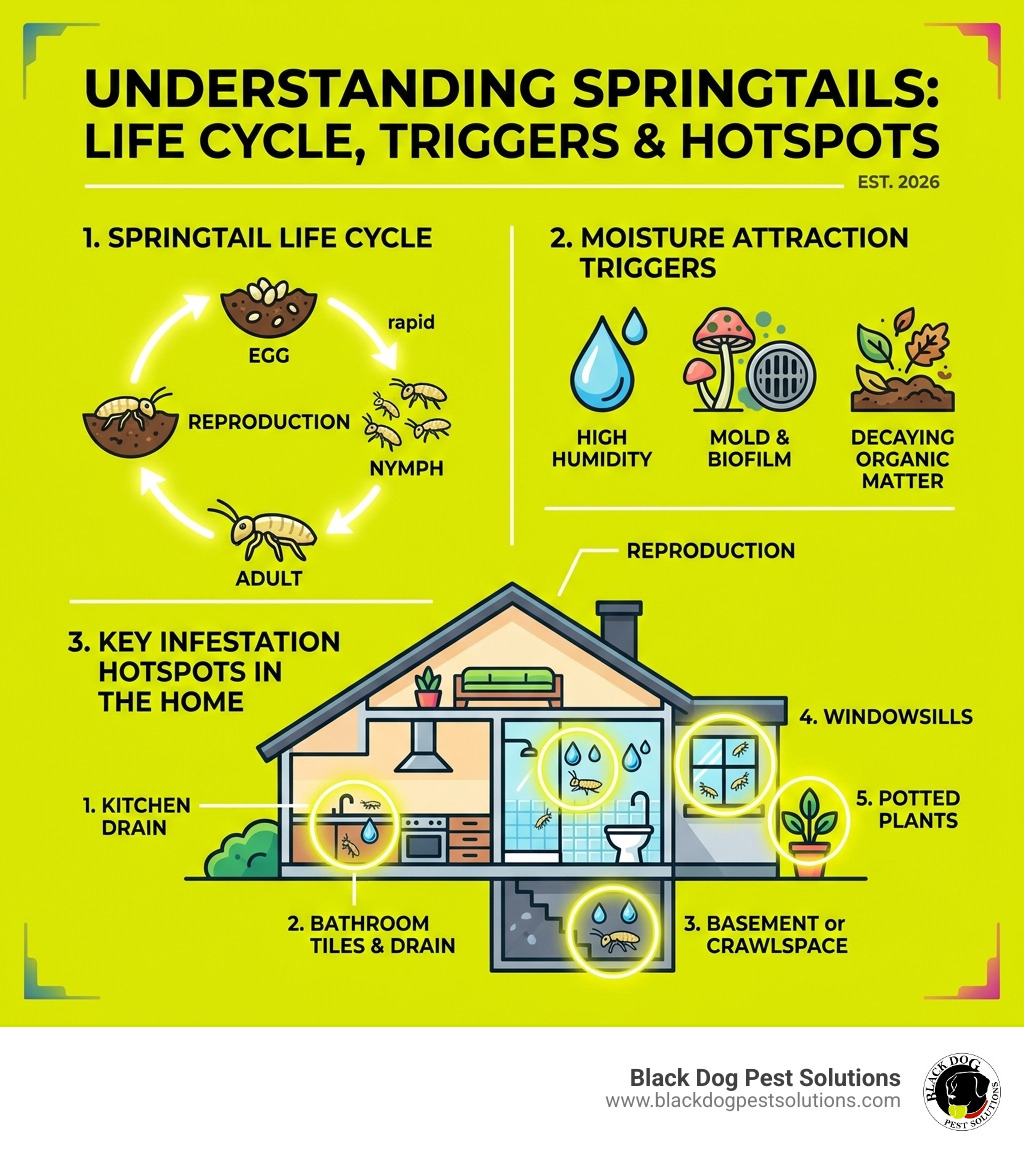
Springtail infestation in house word guide:
If you’ve noticed tiny, dark specks jumping around your bathroom or kitchen, you might be dealing with a springtail infestation in house areas where moisture is high. According to the Springtail Pest Guide, these critters are among the most abundant arthropods on the planet. In fact, a single cubic meter of soil can house up to 100,000 individual springtails!
While they are technically hexapods (six-legged creatures) and not “true” insects, they are closely related. Their most famous feature is the furcula—a tail-like structure tucked under their abdomen. When threatened, this “spring” releases, launching them several inches into the air. This behavior often leads homeowners to mistake them for fleas.
Physical Characteristics and Behavior
Springtails are minute, usually measuring between 1/16 and 1/8 of an inch long. They have segmented bodies that are typically oblong, though some species are more globular. In Northern Ohio, we most commonly see them in shades of gray, black, or white, though some can be quite colorful.
One fascinating (and slightly chilly) relative is the “snow flea.” These are springtails that stay active during winter thaws. You might see them as dark flecks—looking like spilled pepper—on top of melting snow near the base of trees or your home’s foundation.
Unlike fleas, springtails do not have wings and cannot fly. More importantly, they do not bite humans or pets. They are strictly moisture-seekers that feed on algae, fungi, and decaying plant matter. If you want to learn more about other small, jumping, or crawling pests we deal with in the Cleveland area, check out our more info about crawlers page.
Signs of a Springtail Infestation in House
The most obvious sign of an infestation is simply seeing them. Because they are so small, they often look like a layer of fine ash or soot until they start jumping.
Common signs include:
- Clusters near water: You’ll find them in kitchen sinks, bathtubs, or around toilet bases.
- Activity on windowsills: They are often attracted to the condensation that builds up on glass.
- Basement “clouds”: In damp Ohio basements, they can appear in massive numbers on the floor or along the bottom of walls.
- Potted plant activity: If you overwater your houseplants, you may see them jumping in the soil when you move the pot.
If you’re unsure if what you’re seeing is a major issue or just a few stragglers, our guide on Do You Have a Pest Problem? Key Signs Every Owner Must Know can help you distinguish between occasional visitors and a full-blown invasion.
| Feature | Springtails | Fleas |
|---|---|---|
| Biting | No | Yes (painful) |
| Jumping Mechanism | Furcula (tail-spring) | Powerful hind legs |
| Diet | Mold, fungi, algae | Blood |
| Habitat | High moisture/decay | Host animals/carpets |
| Body Shape | Soft, segmented | Hard, flattened sideways |
Why Springtails Invade Your Home
Springtails don’t “want” to be in your house; they are forced there by environmental changes. According to research on Springtails in the Home and Landscape, these creatures require high humidity—often above 80%—to thrive because they breathe through their skin. If their outdoor habitat dries out during a hot Ohio summer, or if it becomes oversaturated during heavy spring rains, they migrate in search of the “Goldilocks” zone of moisture.
Their presence is actually a helpful, if annoying, warning. They are the “canary in the coal mine” for moisture problems. If you have springtails, you likely have mold, fungi, or decaying organic matter nearby, as this is their primary food source. For more context on why these pests emerge specifically in our region, see our article on how to tackle Northeastern Ohio’s most common spring pests.
Common Indoor Hiding Spots
Once inside, springtails head straight for the dampest spots they can find.
- Wall Voids: If you have a slow pipe leak or poor insulation leading to condensation inside your walls, springtails will set up shop there.
- Damp Sheetrock: Plumbers often find them living behind walls where wet drywall has started to grow surface mold.
- HVAC Systems: Condensation pans and drain lines are prime real estate for a springtail infestation in house settings.
- Kitchen and Bathroom Drains: They feed on the “slime” or biofilm that builds up inside pipes.
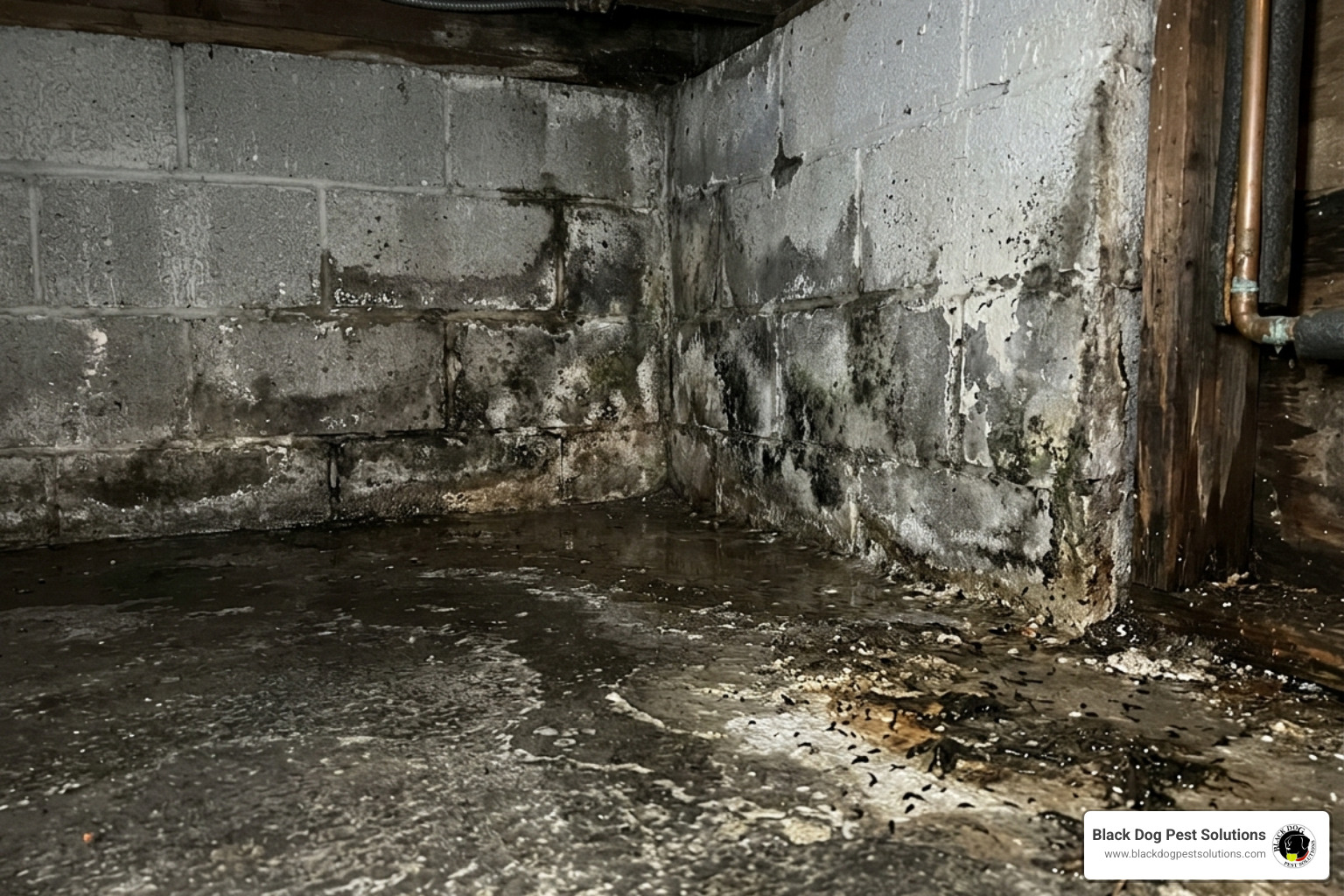
External Factors and Migration
External conditions play a huge role in why they enter your home.
- New Construction: Interestingly, new homes are often hit hard. This is because damp building materials (like wood or drywall stored in the rain) can support mold growth inside wall voids before the house is even finished.
- Mulch and Landscaping: Thick layers of mulch hold moisture and decaying wood, creating a springtail metropolis right against your foundation. When that mulch dries out, they move toward the house.
- Heavy Rainfall: In areas like Lorain or Elyria, heavy spring storms can flood the soil, forcing millions of springtails to seek higher, drier ground—which often means your basement or crawl space.
To better understand how our local climate affects pest behavior, read What Cleveland Homeowners Need to Know About Pest Problems.
How to Get Rid of a Springtail Infestation in House
Eliminating springtails is less about “killing bugs” and more about “managing water.” If you kill the ones you see but leave the moisture, a new batch will arrive within days.
The first step we recommend to our clients in Avon and Westlake is a thorough vacuuming. Use a vacuum with a HEPA filter to suck up visible clusters. Immediately take the canister or bag outside and empty it into a sealed trash bin. This provides instant relief, but it’s only the beginning. For a deeper look at our professional approach, visit our more info about residential services page.
Natural Remedies and DIY Solutions
If you prefer a more natural approach, several household items can help manage a springtail infestation in house environments:
- Vinegar Spray: A 50/50 mix of white vinegar and water kills springtails on contact by disrupting their pH balance and breaking down their exterior. It’s great for wiping down windowsills and baseboards.
- Soapy Water: A mixture of dish soap and water (about 2 tablespoons per quart) is an effective contact killer. The soap breaks the surface tension of the water, causing the springtails to drown.
- Diatomaceous Earth (DE): Use food-grade DE in dry areas like wall voids or under baseboards. The microscopic sharp edges of the DE cut through the springtail’s exoskeleton, dehydrating them. Note: DE only works when dry.
- Essential Oils: Cedar, peppermint, and eucalyptus oils can act as temporary repellents.
For more expert-tested tips on safe removal, check out this guide on How to Get of Rid of Springtails Quickly and Safely.
Treating Drains and High-Moisture Areas
Drains are a major “highway” for springtails. To stop them here, you need to remove their food source.
- Enzyme Cleaners: Use a professional-grade enzyme cleaner to eat away at the organic biofilm inside your pipes. This is much more effective than bleach, which often fails to penetrate the slime layer.
- Dehumidification: This is the single most important step. Run a dehumidifier 24/7 in your basement or crawl space. Your goal is to keep indoor humidity below 50%. Springtails cannot survive in an environment this dry; they will literally dry up and die.
- Ventilation: Always run exhaust fans during and for at least 20 minutes after showers to clear out humidity.
Long-Term Prevention and Outdoor Maintenance
Once you’ve cleared the current population, you must “harden” your home against future invasions. This is especially important in Northern Ohio, where our humid summers and wet springs provide constant pressure.
Start by looking up. Clogged gutters overflow, dumping water directly against your foundation and saturating the soil. Ensure your downspouts discharge at least 5 to 10 feet away from the house. For more seasonal advice, see The Ultimate Guide to Spring Pest Management in Northeastern Ohio.
Sealing Entry Points
Springtails are so small that they can fit through cracks you can barely see.
- Caulk and Seal: Use high-quality silicone caulk to seal gaps around basement windows, utility pipes, and where the siding meets the foundation.
- Weather Stripping: Replace worn-out door sweeps and weather stripping on all entry doors and garage doors.
- Fine Mesh: Ensure your window screens are in good repair and consider using a finer mesh if you live in a particularly damp area.
For a comprehensive list of common entry points, visit our more info about pests section.
Landscaping for Springtail Control
Your yard is the “source” of the infestation. By making the perimeter of your home less attractive, you reduce the chances of them moving inside.
- The Gravel Border: Create a 12-to-18-inch “dry zone” around your foundation using gravel or river rock instead of mulch. Mulch is essentially springtail food and a giant sponge for moisture.
- Air Space: Ensure there is at least an 18-inch gap between your siding and any shrubs or plants. This allows for airflow, which helps the foundation stay dry.
- Irrigation Adjustment: Don’t overwater. Adjust your sprinklers so they aren’t spraying directly against the side of the house.
- Debris Removal: Rake up leaf litter and remove old wood piles or grass clippings near the foundation.
Our more info about resources page offers more DIY landscaping tips for local homeowners.
Frequently Asked Questions about Springtails
Are springtails harmful to humans or pets?
No. This is the most common question we get in Avon and Rocky River. Springtails do not bite, they do not sting, and they do not carry diseases. They don’t even eat your food or your furniture. They are strictly a “nuisance pest” that indicates a moisture problem. While they might cause a bit of “fragile sanity” due to their sheer numbers, they are physically harmless.
How long does it take to eliminate springtails?
Typically, it takes two to four weeks to see a total resolution. You can kill the ones you see today, but you have to wait for the environment to dry out enough to stop the breeding cycle. If you fix the moisture source and use a combination of vacuuming and dehumidification, the population will crash quickly.
Why do springtails keep coming back?
If they return, it usually means there is a hidden moisture source you haven’t found yet. This could be a roof leak that is trickling down through a wall void, a leaking pipe under a slab, or even just high humidity in a crawl space that hasn’t been properly encapsulated. In some cases, persistent springtails indicate that your mulch is too deep or your siding is holding moisture against the house.
Conclusion
Dealing with a springtail infestation in house environments can be frustrating, but remember: these tiny jumpers are just messengers. They are telling you that your home has a moisture issue that needs attention. By following the steps in this guide—reducing humidity, fixing leaks, and managing your landscaping—you can reclaim your home and stop the hop for good.
At Black Dog Pest Solutions, we pride ourselves on our deep knowledge of Northern Ohio’s unique pest challenges. From the lakefront humidity in Bay Village to the wooded lots of Strongsville, we know how to track down the source of your infestation. We don’t just spray and leave; we use Integrated Pest Management (IPM) to provide a long-term solution that keeps your family safe and your home dry.
If you’re tired of seeing tiny bugs in your sink or on your baseboards, don’t wait for the problem to get worse. We have a 4.9/5.0-star rating on Google because we treat every home like our own. Schedule your residential pest services today and let us help you get back to a pest-free life.