
Why Carpenter Ants Natural Removal Is Worth Doing Right
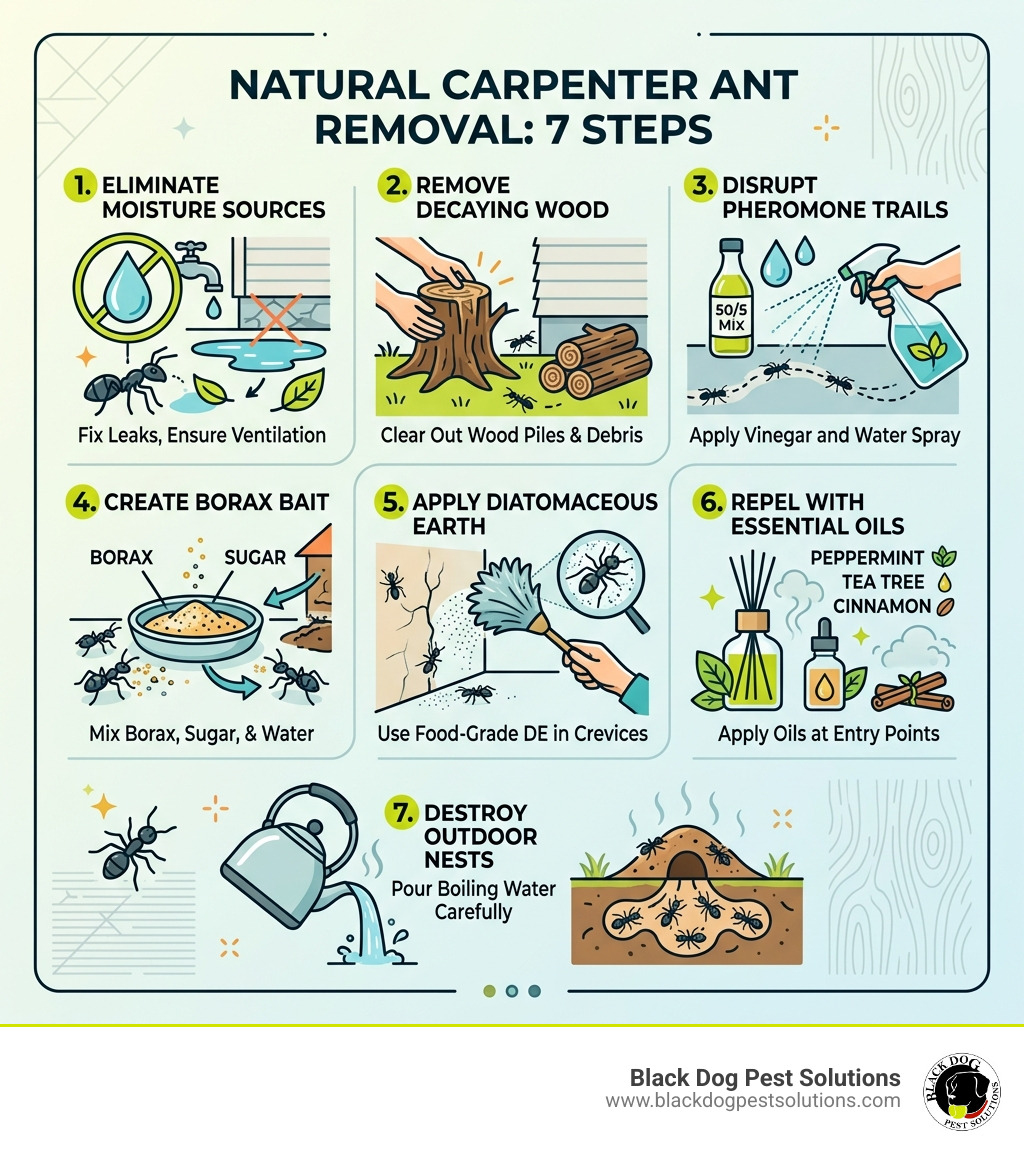
Carpenter ants natural removal is possible — and for mild to moderate infestations, it often works well. Here are the most effective natural methods:
- Borax bait – Mix borax with sugar and warm water; worker ants carry it back to the colony
- Diatomaceous earth (DE) – Sprinkle food-grade DE in cracks, wall voids, and entry points to dehydrate ants
- Vinegar spray – A 50/50 white vinegar and water mix disrupts pheromone trails
- Essential oils – Peppermint, tea tree, and cinnamon oil repel ants and mask scent trails
- Boiling water – Pour directly into outdoor nest entrances to destroy colonies
- Soap and water – A dish soap and water spray kills ants on contact
- Fix moisture and remove decaying wood – This eliminates the root cause
Results take 2–4 weeks for most natural methods. Large or hidden colonies may need professional treatment.
Carpenter ants are not just a nuisance — they tunnel through wood to build nests, silently weakening structural framing over time. In Northern Ohio, where Lake Erie humidity accelerates wood decay, homes are especially vulnerable every spring. This is part of a broader seasonal cycle that includes winter rodents, spring stinging insects, and summer mosquitoes.
Mat Ledyard, owner of Black Dog Pest Solutions in Avon, Ohio, notes that carpenter ants natural removal is a common strategy for homeowners navigating these regional patterns. Understanding the local environment is key to effective pest management.
Identifying the Culprit: Carpenter Ants vs. Termites
Before we dive into carpenter ants natural removal, we have to make sure we’re fighting the right battle. In places like Avon Lake and North Ridgeville, homeowners often panic at the sight of large black ants, fearing they are termites. While both are wood-destroying insects, they are very different creatures.
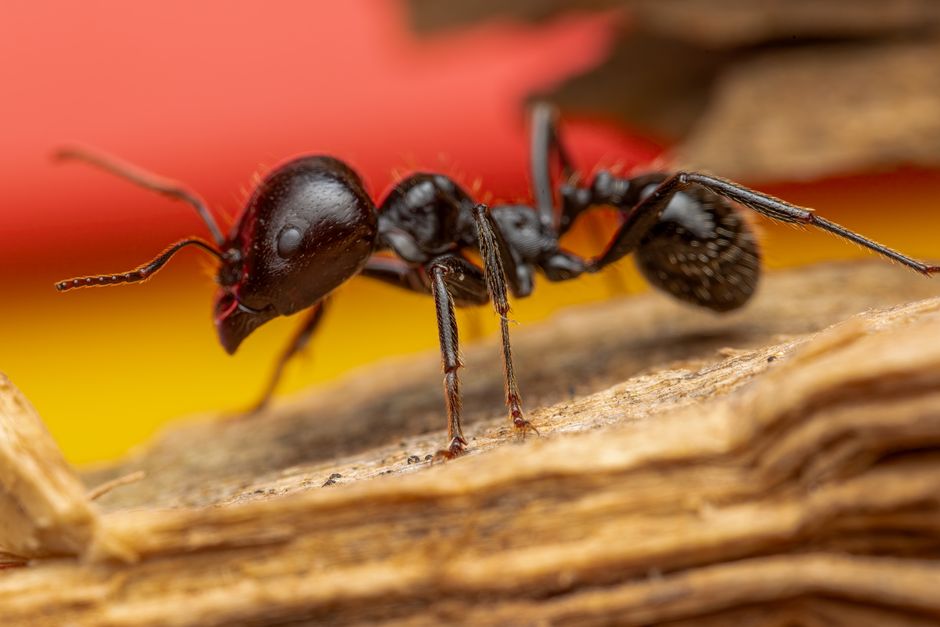
Carpenter ants belong to the genus Camponotus. They are among the largest ants in the United States, with workers ranging from 1/4 to 1/2 inch (7-15 mm) and queens reaching up to 20 mm. Most in Northern Ohio are shiny black, though some species have reddish tones.
The Physical Comparison
If you catch one, look closely (a magnifying glass helps!).
| Feature | Carpenter Ant | Termite |
|---|---|---|
| Antennae | Elbowed (bent) | Straight (like a string of beads) |
| Waist | Narrow, constricted “wasp-waist” | Broad, uniform body |
| Wings | Two pairs, unequal length | Two pairs, equal length |
| Diet | Sweets, proteins (does NOT eat wood) | Cellulose (EATS wood) |
Signs of an Infestation
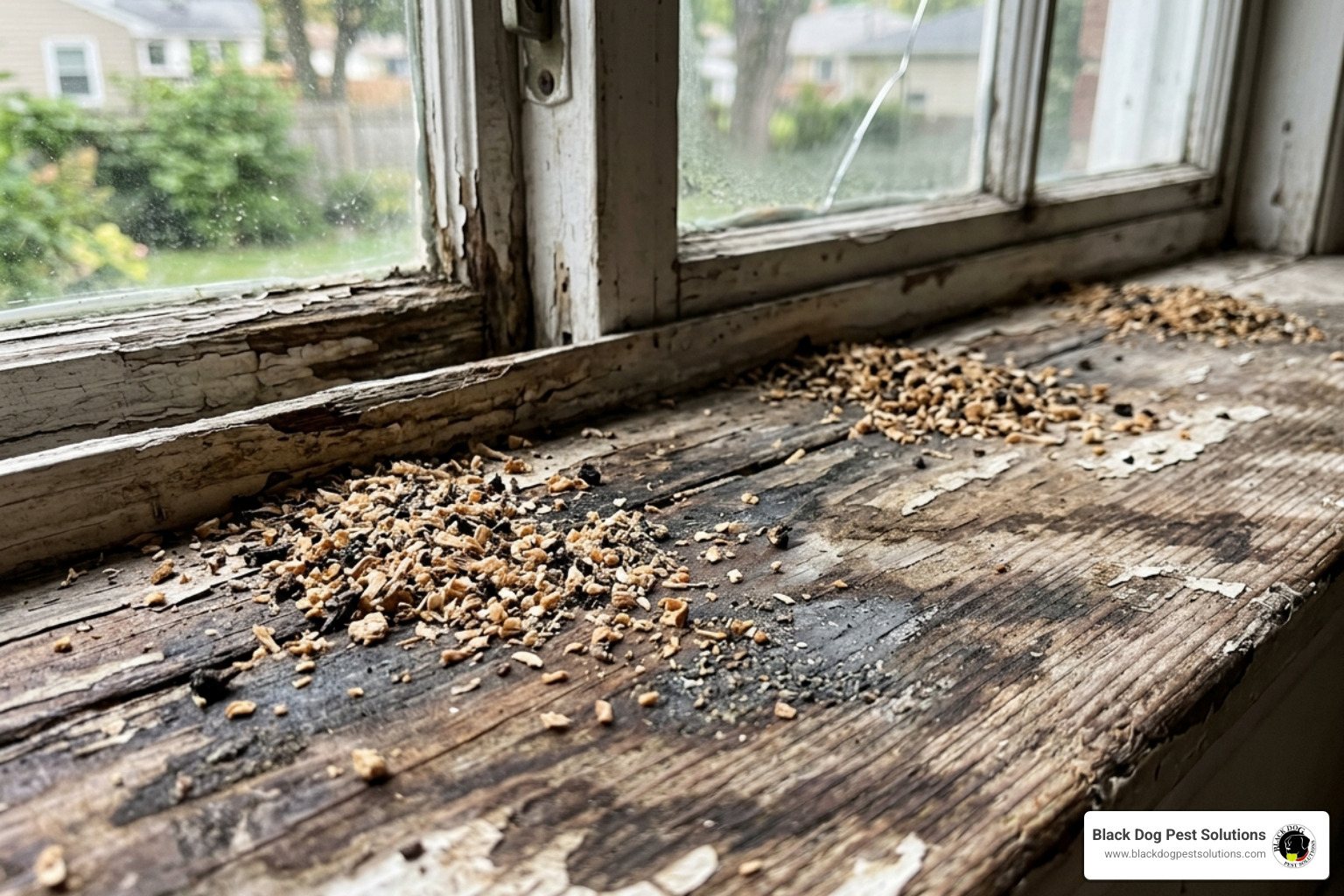
Because carpenter ants are nocturnal, you might not see the workers during the day. Instead, look for “frass.” Unlike the mud tubes termites build, carpenter ants are tidy. They excavate smooth, polished galleries that look like they’ve been sanded. To keep these galleries clean, they push debris out of small “windows,” creating piles of sawdust-like shavings mixed with insect parts. This is a tell-tale sign of an indoor nest.
The humidity from Lake Erie plays a major role here. Moisture leads to wood decay, and softened, damp wood is exactly what these ants seek out to begin their tunnels. Following Integrated Pest Management (IPM) Principles, the first step is always identification and moisture control.
7 Methods for Carpenter Ants Natural Removal
When we talk about carpenter ants natural removal, we aren’t just trying to kill the few ants scouting your kitchen. We need to reach the heart of the colony. Carpenter ants practice trophallaxis—the process of sharing liquid food between members of the colony. This behavior can be utilized by providing slow-acting natural baits that they may carry back to the queen.
Borax and Boric Acid Baits for Carpenter Ants Natural Removal
Borax is a naturally occurring mineral that acts as a slow-acting stomach poison for ants. Because it doesn’t kill them instantly, they have time to share it with the rest of the colony.
- Sweet Bait Recipe: Mix 1/2 cup sugar, 1.5 tablespoons of borax, and 1.5 cups of warm water. Saturate cotton balls in the mixture and place them in shallow dishes near active trails.
- Protein Bait: Sometimes ants prefer protein. Mix a small amount of borax into peanut butter.
- Note: Using an appropriate concentration of borax is important. If the concentration is too high, the ants may die before they reach the nest, or they may detect the substance and avoid it.
Using Diatomaceous Earth for Carpenter Ants Natural Removal
Food-grade Diatomaceous Earth (DE) is a powder made from fossilized algae. To an ant, it feels like walking over broken glass. It cuts through their waxy exoskeleton, causing them to dehydrate and die.
For the best results, use a bulb duster to puff a thin layer of DE into wall voids, behind electrical switch plates, and into cracks where you’ve seen ant activity. It must remain dry to work. In the humid summers of Sheffield Lake or Sandusky, you may need to reapply it if it becomes clumped or damp.
Essential Oils and Household Repellents
While baits and DE are used to eliminate ants, essential oils are sometimes used to repel them or disrupt the “scent trails” ants use to navigate. Similarly, while ultrasonic devices are marketed for pest deterrence, their effectiveness is often debated and results may vary significantly.
- Peppermint and Tea Tree: These oils may act as irritants to ants. Mix 20 drops with two cups of water and spray around window sills and doors.
- Vinegar: A 50/50 mix of white vinegar and water is often used to erase pheromone trails. If an ant cannot detect the path home, it may be unable to lead others to a food source.
- Cinnamon: Sprinkling ground cinnamon or using cinnamon leaf oil at entry points may act as a physical and aromatic barrier.
Note: While these methods are used for managing ants, they rarely eliminate a mature colony of 50,000 individuals on their own. They are best used as part of a multi-step IPM strategy.
Locating and Eliminating the Nest
You can’t achieve permanent carpenter ants natural removal without finding the source. Carpenter ants usually have a “parent nest” outdoors (in a stump, woodpile, or dead tree) and one or more “satellite nests” inside your home.
To find them, grab a flashlight and head out at dusk. This is when the foragers are most active. Watch where they go. Are they trailing from a large oak tree to your roofline?
Inside, listen to your walls. In a quiet room, you can actually hear a large colony; it sounds like a faint rustling or crinkling, similar to cellophane. Check areas with history of moisture issues—under sinks, behind showers, or near chimney flashings. In Avon and Westlake, we often find nests in structural framing that has been softened by leaky gutters or poor attic ventilation.
Long-Term Prevention and Safety in Northern Ohio
Once you’ve cleared the ants, you have to make sure they don’t want to come back. In our region, the seasonal cycle is predictable: ants emerge in the spring looking for moisture and food.
- Moisture Control: Fix leaky pipes and ensure your gutters are clear. Use dehumidifiers in damp basements or crawlspaces.
- Landscaping: Trim tree branches so they don’t touch your siding or roof. These act as “ant highways.”
- Firewood Storage: Keep firewood elevated and at least 20 feet away from your foundation. Never bring wood inside until you’re ready to burn it.
- Seal the Gaps: Use silicone caulk to seal cracks in your foundation and gaps around utility lines.
Safety First
Most of these natural methods are safe for homes with kids and pets. However, even “natural” substances require care. Keep borax baits in areas pets cannot reach. While food-grade DE is non-toxic, you should avoid breathing in the dust during application.
When to Contact Pest Control Companies in Avon, Ohio
DIY methods are excellent for small, accessible problems. However, carpenter ant queens can live for 25 years, and a colony that has been active in a home for years can contain tens of thousands of ants.
You should contact pest control companies in Avon, Ohio like Black Dog Pest Solutions if:
- You see winged “swarmers” indoors (this indicates a mature, established colony).
- You find frass in multiple rooms.
- The ants return every spring despite your best DIY efforts.
- You suspect the nest is deep within a structural support beam.
Professional pest control companies in Avon, Ohio like Black Dog Pest Solutions use specialized tools, like moisture meters and thermal imaging, to help locate hidden nests without unnecessary damage to drywall. For those evaluating professional help, 2026 Ohio average pricing is $100-$300 initial, $100-$175 quarterly, $230-$2,500+ termites, $500-$1,500+ bed bugs, and $200-$600 rodents (noting variance by home size/infestation). Our comprehensive pest management also includes solutions for larger pests like raccoons or squirrels, with release distances for wildlife being variable based on local conditions.
Evaluating Professional Standards
Black Dog Pest Solutions is licensed by the Ohio Department of Agriculture (ODA) and carries proper insurance. As a company based in the region, we understand how Lake Erie’s humidity affects pest cycles.
Professional Integrated Pest Management (IPM)
We follow the four pillars of IPM: Inspect, Identify, Treat, and Monitor. This approach focuses on finding the moisture source that attracted the ants in the first place. Whether it’s a residential home in Lakewood or a commercial kitchen in Rocky River, the goal is long-term protection through environmental management.
Frequently Asked Questions about Carpenter Ant Removal
How long does it take for natural remedies to fully eliminate a colony?
Typically, it takes 2 to 4 weeks. Because you are relying on the ants to transport bait back to the queen, you have to be patient. If you see ants surrounding your bait, don’t kill them! Let them finish their “delivery.”
Are natural methods safe for homes with children and pets?
Generally, yes. Vinegar, essential oils, and food-grade DE are very low-risk. Borax is a mineral, but it should still be kept out of reach of curious toddlers and dogs. If you have concerns, pest control companies in Avon, Ohio like Black Dog Pest Solutions can offer child-and-pet-friendly treatment plans.
Why do carpenter ants keep returning to my home?
If they keep coming back, you likely have a moisture problem you haven’t found yet, or there is a parent nest nearby (within 300 feet) that hasn’t been treated. In Northern Ohio, our high humidity means wood stays damp longer, making our homes a constant target.
Conclusion
Managing pests in Northern Ohio requires consistency and an understanding of seasonal cycles. From winter rodents and spring invaders like carpenter ants, termites, and stinging insects to summer mosquitoes and cockroaches, homes are under constant pressure. The cycle concludes with fall invaders such as stink bugs, earwigs, boxelder bugs, silverfish, and centipedes.
If you’ve tried carpenter ants natural removal and the problem persists, homeowners can rely on pest control companies in Avon, Ohio like Black Dog Pest Solutions. We are licensed, insured, and experienced in the local environment, providing thorough inspection, treatment, and monitoring.