
Tiny Jumpers in Your Houseplant Soil: What You Need to Know
Springtails in potted plants are small, jumping, wingless insects — typically 1–2 mm long — that thrive in moist soil and feed on mold, fungi, and decaying organic matter.
Quick answers:
- What are they? Tiny white or grey arthropods that jump when disturbed
- Are they harmful? Rarely — they don’t bite, don’t eat living roots, and don’t spread disease
- Why are they there? Overwatered soil with decaying matter and fungal growth
- How do you get rid of them? Let the soil dry out between waterings — that’s usually enough
- When should you worry? Only if populations explode or seedlings show stress signs
You lifted a pot or poked at the soil and suddenly dozens of tiny specks launched into the air. It’s alarming — but before you reach for a spray can, it’s worth knowing what you’re actually dealing with.
Springtails are extremely common in houseplant soil, especially in homes where plants get a little too much love (and water). They’re not a sign of a dirty home. They’re a sign of wet soil.
I’m Mat Ledyard, owner of Black Dog Pest Solutions in Avon, Ohio, with nearly two decades in pest control — and springtails in potted plants are one of the most misidentified and over-treated nuisances I come across. Let me walk you through exactly what they are and what — if anything — you need to do about them.
What Are Springtails in Potted Plants?
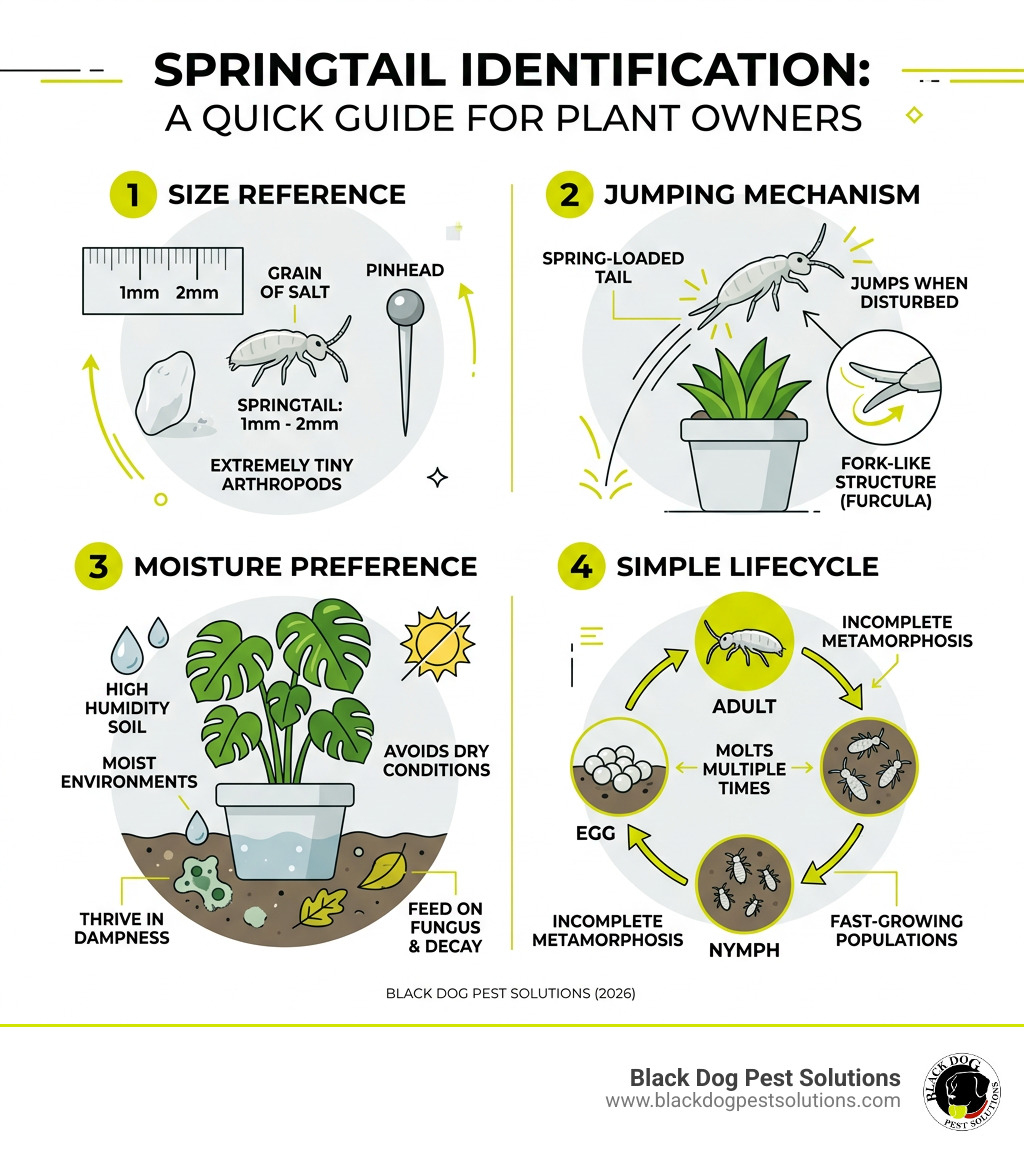
If you have ever peered into the soil of a monstera or a fern and seen tiny, pale specks that seem to “pop” or vanish when you touch them, you have met a springtail. Scientifically known as Collembola, these are not actually true insects, though they are very close relatives. They are wingless arthropods that have been around for millions of years, playing a vital role in the Earth’s ecosystem as decomposers.
In the context of our indoor gardens in Northern Ohio, springtails in potted plants are essentially the “clean-up crew.” They range in length from 0.25 mm to 6 mm, but the ones we usually see in our homes are about 1 mm to 2 mm long—roughly the size of a grain of salt or a pinhead.
The most fascinating thing about them is how they move. They don’t have wings, so they can’t fly. Instead, they have a specialized fork-like structure under their abdomen called a furcula. This structure is held under tension like a spring. When the springtail is startled, it releases the furcula, which strikes the ground and launches the tiny creature up to 100 mm (about 4 inches) into the air. For a creature that is only 1 mm long, that is a massive leap!

Because they are so small and move so fast, they are often mistaken for other pests. To help you get a better look at what they look like under a microscope, you can see additional images in this insect image gallery.
Distinguishing Springtails from Fleas and Gnats
One of the most common reasons people call us at Black Dog Pest Solutions is because they think they have a flea infestation. If you see something jumping near your baseboards or around your plants, it’s a fair guess. However, there are very distinct differences between springtails, fleas, and the other common plant nuisance: fungus gnats.
| Feature | Springtails | Fleas | Fungus Gnats |
|---|---|---|---|
| Body Shape | Rounded or elongated; soft-bodied | Flattened side-to-side; hard-bodied | Like tiny mosquitoes; fragile |
| Movement | Jumps using a “tail” (furcula) | Jumps using powerful legs | Flies in erratic patterns |
| Diet | Fungi, mold, decaying organic matter | Blood (mammals/birds) | Larvae eat fungi/roots; adults don’t eat |
| Crush Test | Easily crushed; soft | Very difficult to crush | Easily crushed |
| Signs | Visible jumping in moist soil | Bites on humans/pets; “flea dirt” | Flying around faces/lights; larvae trails |
Springtails are “moisture indicators.” If they are present, it means the area is damp. Fleas, on the other hand, are looking for a host. Another key difference is that fungus gnat larvae often leave “shiny trails” on the soil surface that look like miniature slug trails—something springtails do not do.
Are Springtails Harmful to Your Houseplants?
The short answer is: No. In fact, for most established plants, having a few springtails around is actually a good thing.
Think of springtails in potted plants as a tiny, unpaid maintenance staff. They spend their days eating the things you don’t want in your soil, such as:
- Mold and Mildew: They graze on fungal spores, preventing mold from taking over the soil surface.
- Algae: They help clean up the green film that sometimes grows on overwatered pots.
- Decaying Matter: They break down dead leaves and roots, recycling those nutrients back into the soil for the plant to use.
Because they focus on decaying material, they generally leave healthy, living plant tissue alone. You can find more scientific research on springtail benefits that explains their ecological role in nutrient cycling.
When Populations Become a Nuisance
While they are technically beneficial, we understand that having thousands of tiny bugs crawling in your living room isn’t exactly the “urban jungle” vibe most people are going for. They become a “nuisance pest” when their numbers explode.
An overpopulation of springtails usually indicates a larger problem: root rot or chronic overwatering. If the soil is constantly saturated, the amount of decaying organic matter increases, providing an all-you-can-eat buffet for springtails. In these extreme cases, if they run out of decaying matter, some species might nibble on the fine root hairs of very young seedlings, which can lead to wilting or stunted growth.
For 99% of houseplants in Avon or Cleveland, the “damage” is purely aesthetic. They don’t bite you, they don’t bite your dog, and they won’t eat your furniture. They just want to stay where it’s wet.
How to Manage Springtails in Potted Plants Safely
If you’ve decided that the “tiny jumping roommates” have overstayed their welcome, the good news is that you don’t need heavy chemicals to get rid of them. Since springtails are fundamentally tied to moisture, the most effective weapon you have is a simple one: dry air.
Springtails breathe through their skin. If the environment dries out, they lose moisture rapidly and die. This is why you often find them in bathrooms, kitchens, or crawlspaces—they are searching for humidity. For more specific details on their biology, you can check our page with more info about springtails.
Cultural Controls for Springtails in Potted Plants
The most effective way to eliminate springtails is to change the environment that allows them to thrive. Here is our recommended “cultural control” checklist:
- The “Dry Out” Method: This is the gold standard. Allow the top two inches of soil to dry out completely before watering again. For many plants, you can even wait until the plant shows the first sign of slight wilting.
- Improve Drainage: Ensure your pots have drainage holes. If a pot is sitting in a saucer full of water, you are essentially running a springtail nursery. Empty those saucers immediately after watering.
- Reduce Peat Moss: Springtails love peat-based soils because they hold moisture for a long time. If you have a recurring problem, consider mixing in more perlite or orchid bark to increase aeration.
- Repot with Fresh Mix: Over time, potting soil compacts and breaks down, becoming “mucky” and holding too much water. If your plant has been in the same soil for three years, it’s time for a change. Wash the roots gently and use a high-quality, well-draining mix.
- Increase Airflow: Use a small fan to circulate air around your plants. This helps the soil surface dry faster and makes the area less hospitable for jumping pests.
Natural and Biological Treatments
If drying the soil isn’t enough, or if you have a plant that requires constant moisture (like a Calathea or a fern), you can use these low-impact methods:
- Diatomaceous Earth (DE): This is a powder made from fossilized algae. To us, it feels like flour; to a springtail, it’s like walking over broken glass. Sprinkle a thin layer on the dry surface of the soil. Note: DE only works when it is dry.
- Neem Oil: A soil drench with a diluted neem oil solution can help disrupt the lifecycle of various soil pests, including springtails and fungus gnats.
- Beneficial Predators: In “bioactive” setups, people actually buy predatory mites (like Hypoaspis miles) to eat springtails. While this is usually for terrariums, it’s a natural way to keep populations in check without chemicals.
If you find that the springtails have moved out of your plants and are congregating in your basement or kitchen, you might need a broader approach. You can find more info about residential services on our main site.
Preventing Springtails in Potted Plants Long-Term
Prevention is always easier than a cure. Most springtails in potted plants enter the home one of two ways: they “hitchhike” on a new plant you bought, or they crawl in through tiny cracks in your foundation during a dry spell in the summer.
Best Practices for Indoor Moisture Control
To keep your home from becoming a springtail magnet, follow these professional tips:
- The Quarantine Protocol: When you bring a new plant home to Avon or North Ridgeville, keep it away from your other plants for two weeks. Check the soil frequently for movement.
- Clean Up Debris: Don’t let dead leaves sit on top of the soil. This is prime springtail real estate.
- Seal the Perimeter: Springtails are tiny enough to fit through window screens and under door sweeps. Ensure your weather-stripping is tight. For a deeper dive into home protection, read the ultimate guide to spring pest management.
- Check Your Mulch: If you have heavy mulch right against your house foundation, you likely have millions of springtails living there. During the hot Ohio summers, they may migrate indoors looking for the moisture in your crawlspace or your potted plants. Keep mulch a few inches away from the actual foundation wall.
For more tips on managing the specific pests we see here in the Greater Cleveland area, check out our guide on how to tackle Northeastern Ohio’s most common spring pests.
Frequently Asked Questions About Soil Pests
Do springtails bite humans or pets?
No. Springtails do not have mouthparts capable of biting humans or pets. They do not sting, and they do not carry diseases. They are purely a “nuisance” because they move in large numbers and jump, which can be startling. If you have itchy red bumps, you are likely dealing with fleas, bed bugs, or mosquitoes—not springtails.
Should I use chemical insecticides for springtails?
We generally do not recommend heavy insecticides for springtails in potted plants. First, they are often ineffective because springtails don’t eat the plant (so systemic pesticides don’t work). Second, unless you fix the moisture issue, the springtails will just come back. If you must use something, a mild insecticidal soap drench is a much safer choice for indoor use.
How long does it take to get rid of springtails?
If you let the soil dry out, you will see a massive drop in population within 2 to 4 days. However, springtail eggs can survive in the soil. It usually takes about two weeks of consistent “dry-wet” watering cycles to ensure the population has completely crashed.
Conclusion
At the end of the day, seeing springtails in potted plants is a message from your plant. It’s saying, “Hey, I’m a little too wet over here!” By listening to that message and adjusting your watering habits, you can usually solve the problem without spending a dime on sprays.
However, we know that sometimes a “nuisance” can feel like an invasion. If you are seeing jumping insects all over your home, or if you aren’t 100% sure if you’re looking at springtails or something more serious like fleas or beetles, give us a call.
At Black Dog Pest Solutions, we pride ourselves on being Northern Ohio’s local experts. Whether you’re in Avon, Westlake, or Sandusky, we can help you identify exactly what’s crawling in your soil and provide a plan to keep your home pest-free. We believe in environmental modification first—fixing the “why” so you don’t have to keep fighting the “what.”
Ready to reclaim your indoor jungle? Contact us for comprehensive pest control services and let us put our 4.9-star expertise to work for you.