Why Business Pest Control Is a Thriving Industry Worth Entering
Business pest control is one of the most recession-resistant service industries you can enter — and the numbers back that up.
Here’s a quick snapshot of what launching a commercial pest control venture looks like:
| Factor | What to Know |
|---|---|
| Revenue potential | Solo operators can gross $175–225k annually; a 4-tech operation can hit $720k/year |
| Startup costs | As low as $5–10k for basic equipment, chemicals, and a vehicle |
| Demand | Businesses are legally required to manage pests — demand never dries up |
| Growth path | Start residential, add commercial contracts, then scale with recurring service plans |
| Key differentiator | Google reviews and a strong local profile drive the majority of new leads |
The commercial side of pest control — serving restaurants, warehouses, healthcare facilities, and offices — is where the real recurring revenue lives. These clients need scheduled, documented, and compliant service, not just a one-time spray. That creates predictable income and long-term contracts.
I’m Mat Ledyard, owner of Black Dog Pest Solutions in Avon, Ohio, and I’ve been working in business pest control since 2005. Over nearly two decades in the field, I’ve seen what separates operators who build sustainable commercial accounts from those who stay stuck chasing one-off jobs.
Similar topics to business pest control:
- commercial and residential pest control
- commercial pest control companies
- commercial pest control companies near me
Understanding the Commercial Landscape and Risks
When you enter business pest control, you aren’t just killing bugs; you are protecting a brand’s reputation and its bottom line. For a local restaurant in Avon or a warehouse in Cleveland, a single pest sighting isn’t just an “ew” moment—it’s a potential PR nightmare and a threat to their health compliance.
Pests can cause devastating property damage, from chewing through expensive wiring to contaminating thousands of dollars worth of food inventory. In the commercial sector, the stakes are exponentially higher than in residential settings. If a homeowner sees a spider, they might be annoyed; if a health inspector sees a roach in a commercial kitchen, that business could be shut down immediately.
Our Commercial Services focus on this proactive protection. We understand that for a business owner, a pest-free environment is a non-negotiable requirement for staying in operation.

Differences Between Residential and Commercial Services
It is a common misconception that business pest control is just “residential service but bigger.” In reality, the two are worlds apart. Residential service is often about peace of mind and comfort for a single family. Commercial service is about strict regulatory compliance, detailed documentation, and high-frequency maintenance.
| Feature | Residential Pest Control | Commercial Pest Control |
|---|---|---|
| Primary Goal | Family comfort and property protection | Regulatory compliance and brand reputation |
| Service Frequency | Quarterly or as needed | Monthly, bi-monthly, or weekly |
| Documentation | Basic service receipt | Detailed trending reports, SDS, and logs |
| Risk Level | Low to moderate | High (fines, closures, lawsuits) |
| Treatment Areas | Living spaces, perimeter, eaves | Kitchens, loading docks, floor drains, HVAC |
While our Residential Services are vital for homeowners in places like North Ridgeville and Westlake, the commercial side requires a much more analytical approach. You aren’t just looking for where the pests are today; you are analyzing data to predict where they will be next month.
High-Risk Industries and Common Pests
Not every business faces the same level of risk. In Northern Ohio, we see specific industries that require “white-glove” attention due to the nature of their work.
- Food Service: Restaurants and cafes are magnets for Roaches and flies. These pests are “tiny terrors” that can spread disease and lead to immediate food spoilage.
- Healthcare: Hospitals and nursing homes in Elyria or Lorain must maintain sterile environments. Here, even the presence of common Ants can be a major health hazard.
- Warehousing and Logistics: Large facilities often struggle with Rodents (Rats) that hitch rides on incoming shipments. These pests can destroy inventory and structural components of the building.
Licensing, Certification, and Regulatory Compliance
Before you can spray your first drop of product in a commercial setting, you must navigate the legal requirements. In Ohio, as in most states, you cannot simply start a business and call yourself an exterminator. You need to be a certified applicator or a licensed technician working under a certified manager.
Every pesticide used must be registered by the U.S. EPA and the state department of agriculture. This isn’t just red tape; it’s about safety. Misusing chemicals in a public space can lead to massive liability. This is why having robust insurance—including general liability and errors and omissions—is essential for any business pest control operation.
For more information on local requirements, you should consult Your state pest control regulatory agency. They provide the framework for what is legal and safe in our industry.
Essential Documentation and Reporting
In the commercial world, “if it wasn’t documented, it didn’t happen.” This is a mantra we live by at Black Dog Pest Solutions. When a health inspector visits a client in Cleveland or Strongsville, they want to see a “Pest Book.”
This book should contain:
- Pesticide Labels: Exactly what was used.
- Application Rates: How much was used and where.
- Safety Data Sheets (SDS): Critical information for emergency responders and employees.
- Trending Reports: Data-driven logs that show pest activity over time.
Modern business pest control often uses electronic monitoring. We log activity via handheld devices to generate reports that help business owners see patterns. For example, if we notice a spike in rodent activity every Tuesday, we might discover that’s when the trash is collected, leading to a simple fix in their waste management protocol. You can find more Information About Pest Control regarding these professional standards through government resource portals.
Implementing Integrated Pest Management in business pest control
The industry has moved away from “spray and pray” tactics. Today, we use Integrated Pest Management (IPM). This is a common-sense, science-based approach that focuses on long-term prevention rather than just killing the bugs you see.
IPM involves four key steps:
- Inspection: A thorough walk-through to find entry points and nesting sites.
- Identification: Knowing exactly which pest you’re dealing with so you don’t use the wrong treatment.
- Monitoring: Using stations to track pest movement.
- Prevention: Sealing cracks, fixing leaks, and managing sanitation.
You can learn more about these strategies from the Integrated Pest Management Programs & Plans for Businesses. It’s about being a consultant to the business owner, not just a technician.
Tailoring business pest control for Food Service and Healthcare
In sensitive environments like hospitals or high-end restaurants in Rocky River, you can’t just blast chemicals. You have to be discreet and safe.
- Food Service: We focus on an “outside-in” approach. By stopping pests at the perimeter, we minimize the need for treatments inside the kitchen. When we do treat inside, we use consumer-safe baits and focus on floor drains where flies and roaches love to hide.
- Healthcare: Patient safety is the priority. We use the “least-amount product” approach, often relying on non-chemical methods like pheromone traps or specialized vacuums. Dealing with Rodents (Mice) in these facilities requires immediate, humane, and quiet intervention to avoid alarming patients.
Pricing Strategies for business pest control Contracts
One of the biggest draws of this industry is the profit margin. A solo operator in Northern Ohio can generate significant revenue by focusing on recurring contracts.
- Quarterly Plans: These are the bread and butter of residential service, but for businesses, we often recommend monthly or even bi-monthly visits.
- Initial Fees: It’s common to charge a higher “initial” fee to get the facility up to standard, followed by a lower monthly maintenance fee.
- Profit Margins: Because the overhead for a well-run solo operation is relatively low, profit margins can be very generous.
Check out our full list of Services to see how we structure our offerings to ensure both value for the client and sustainability for our business.
Operational Logistics and Startup Requirements
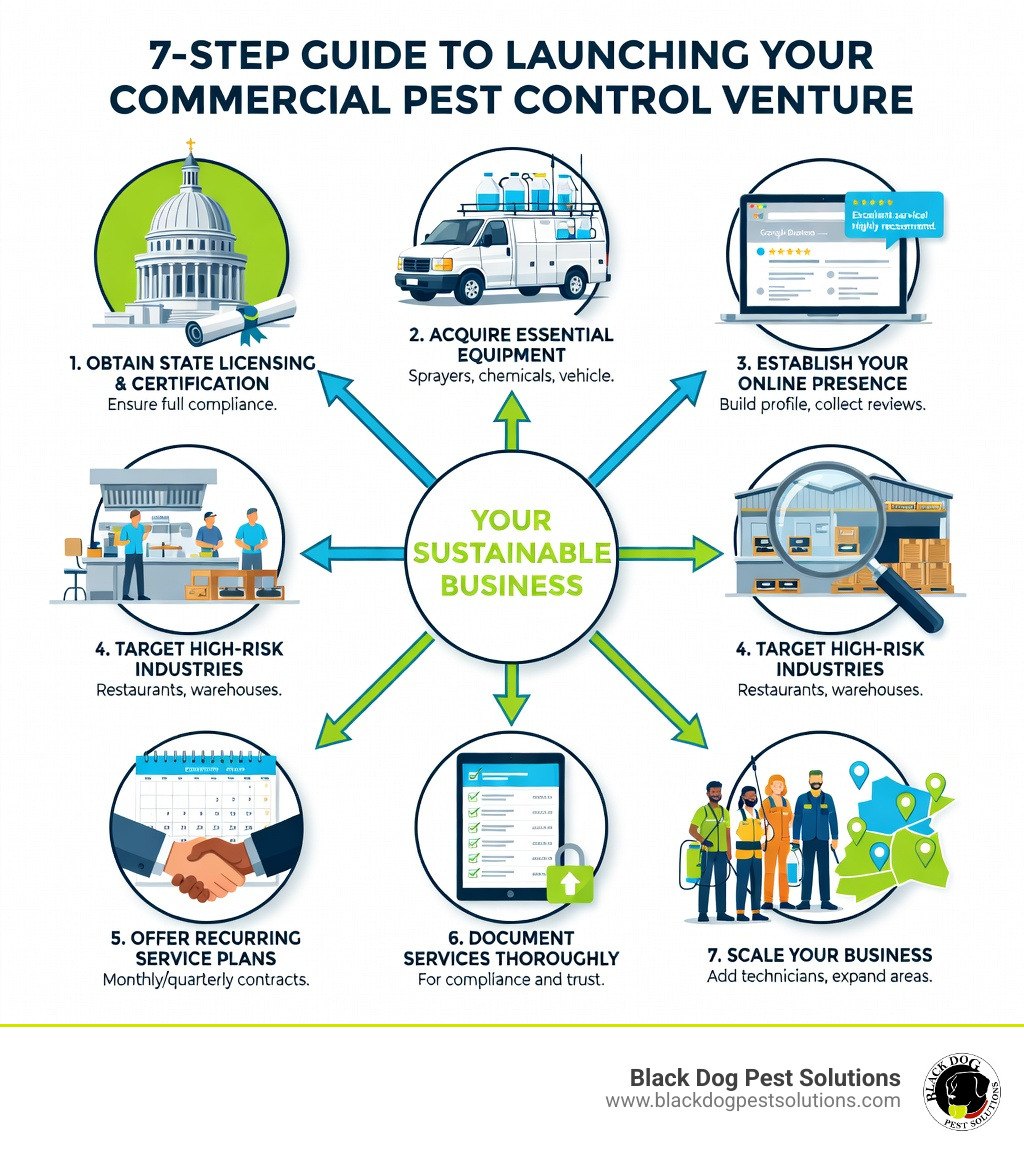
Starting a business pest control venture is surprisingly accessible. You don’t need a massive warehouse or a fleet of trucks to start. Many successful operators, including myself, started with a single reliable vehicle and a few thousand dollars in equipment.
Basic Startup Checklist:
- Vehicle: A clean, professional-looking truck or van.
- Equipment: Handheld sprayers, bait stations, and high-quality flashlights (your most important tool!).
- Chemical Inventory: A focused selection of professional-grade baits, residuals, and dusts.
- Software: A system for scheduling and billing—paper invoices are a thing of the past!
We also offer Seasonal Services that help balance the workload throughout the year, ensuring that our equipment is always earning its keep.
Marketing and Scaling Your Business
90% of Google searches for pest control revolve around the Google Business Profile (GMB) and local reviews. If you want to grow your business in Avon Lake or North Olmsted, you need to be at the top of that map pack.
How to Scale:
- Reviews: Ask every happy customer for a review. Review velocity is a huge ranking factor.
- Networking: Join local real estate investor (REI) groups. Landlords and property managers are gold mines for recurring contracts.
- Niche Down: Become the local expert in a specific pest, like Spiders, to build a reputation quickly.
- Referrals: Word-of-mouth in the restaurant community is powerful. If you save one chef from a roach problem, they will tell five other chefs.
Frequently Asked Questions about Commercial Pest Management
How often should commercial properties schedule inspections?
For most commercial buildings, we recommend inspections at least once every quarter. However, food service establishments like restaurants and cafes should consider monthly or even bi-monthly inspections to stay ahead of high-risk pests and maintain health department standards. You can also reach out to a Cooperative Extension Service office near you for localized advice on pest pressure in Northern Ohio.
What are the red flags when hiring a pest control firm?
Businesses should be wary of door-to-door sales tactics or companies that pressure you into a “secret formula” treatment. A reputable firm will always be transparent about their chemicals, provide a copy of their license, and won’t show up uninvited with “leftover supplies” from a neighbor’s job.
What guarantees should a reputable company offer?
A solid business pest control partner should offer a rapid response guarantee (often responding within 2 hours and being on-site within 24). They should also stand by their work with a satisfaction guarantee—if the pests come back between scheduled visits, the technician should too, at no extra cost.
Conclusion
Building a career in business pest control is about more than just managing insects; it’s about providing a vital service that keeps our local Northern Ohio economy running smoothly. From the hospitals in Cleveland to the small “mom and pop” shops in Vermillion, every business needs a partner they can trust to keep their environment safe and compliant.
At Black Dog Pest Solutions, we pride ourselves on that trust. We combine nearly two decades of expertise with a commitment to the latest IPM techniques and a 4.9-star reputation for excellence. Whether you are a business owner looking for protection or someone looking to enter this rewarding industry, professionalism and consistency are the keys to long-term growth.
Ready to protect your investment? Get started with professional Commercial Services today and let us show you why we are the top-rated choice in Northern Ohio.