
Why Carpenter Ants Are a Serious Threat to Northern Ohio Homes in 2026
Kill carpenter ants before they hollow out the structural wood in your home — that’s the bottom line. These large, wood-destroying pests are among the most common pest problems homeowners face across Northern Ohio every spring and summer.
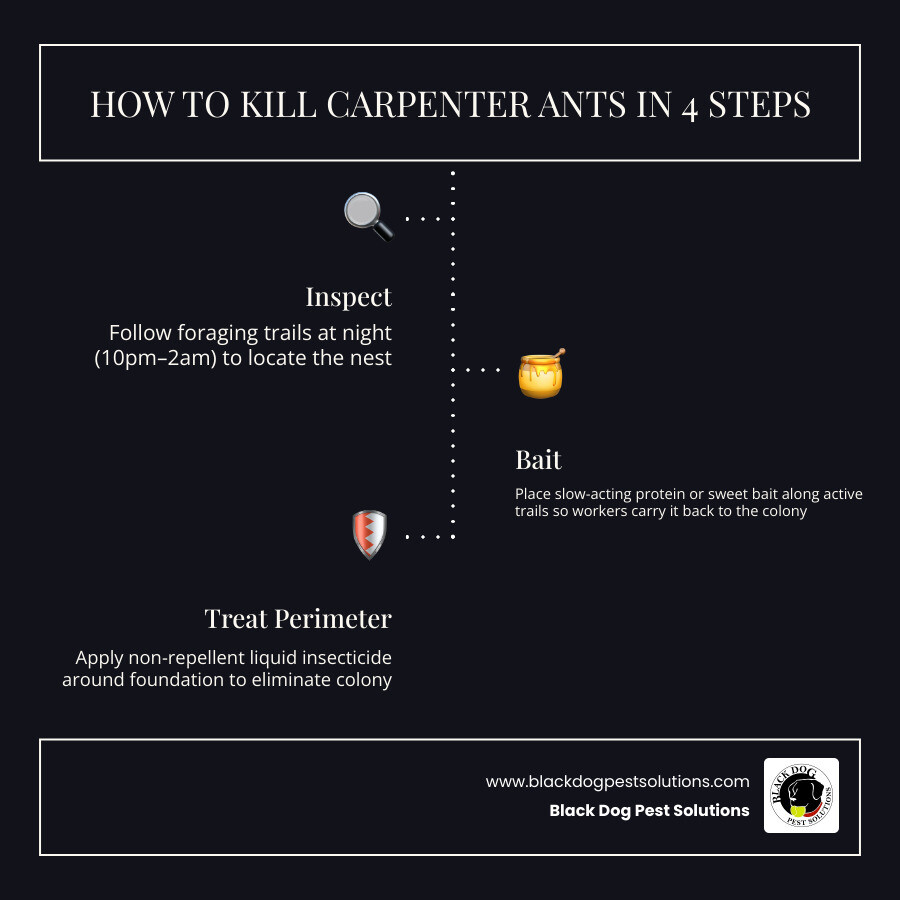
Quick Answer: How to Kill Carpenter Ants in 4 Steps
- Inspect – Follow foraging trails at night (10pm–2am) to locate the nest
- Bait – Place slow-acting protein or sweet bait along active trails so workers carry it back to the colony
- Treat the perimeter – Apply a non-repellent liquid insecticide around the foundation to eliminate the colony
- Prevent – Seal entry points, fix moisture problems, and remove nesting sites near the structure
Carpenter ants don’t eat wood like termites do. Instead, they hollow it out to build nests — and a mature colony can hold up to 10,000 individuals. Most of the time, you’re only seeing 10–15% of those workers. The rest are hidden deep inside wall voids, attics, or a rotting tree stump just outside your home.
In Northern Ohio, colonies become most active between March and October, with peak foraging happening well after dark. By the time you notice a problem, the colony may already be well established.
I’m Mat Ledyard, owner of Black Dog Pest Solutions in Avon, Ohio, and I’ve been helping homeowners kill carpenter ants and protect their properties since 2005. In that time, I’ve inspected hundreds of Northern Ohio homes where what looked like a minor ant problem turned out to be a well-established colony causing real structural damage.
Identifying Carpenter Ants vs. Termites
One of the most common mistakes we see in Greater Cleveland and Avon is homeowners misidentifying their wood-destroying pests. If you want to kill carpenter ants, you first have to be sure you aren’t actually dealing with termites. While both can damage your home, the treatment methods are worlds apart.
Carpenter ants are among the largest ants in the United States. In Ohio, you’ll typically see the Black Carpenter Ant, which ranges from 1/4 inch to 1/2 inch in length. However, size alone isn’t the best indicator. We look for specific physical markers.
| Feature | Carpenter Ants | Termites |
|---|---|---|
| Waist | Pinched, narrow waist | Broad, thick waist |
| Antennae | Elbowed or “jointed” | Straight, like a string of beads |
| Wings (Swarmers) | Front wings longer than back | All four wings equal in length |
| Color | Usually black or dark red | Creamy white or dark brown |
| Thorax | Smooth, evenly rounded | Segmented and rectangular |
Carpenter ants have a single “node” (a small hump) on the narrow waist between the thorax and abdomen. According to Carpenter Ants | Ohioline – The Ohio State University, the smoothly rounded thorax is a key anatomical feature. Knowing these differences helps prevent you from letting your home crumble under carpenter ant damage.
Signs of an Infestation
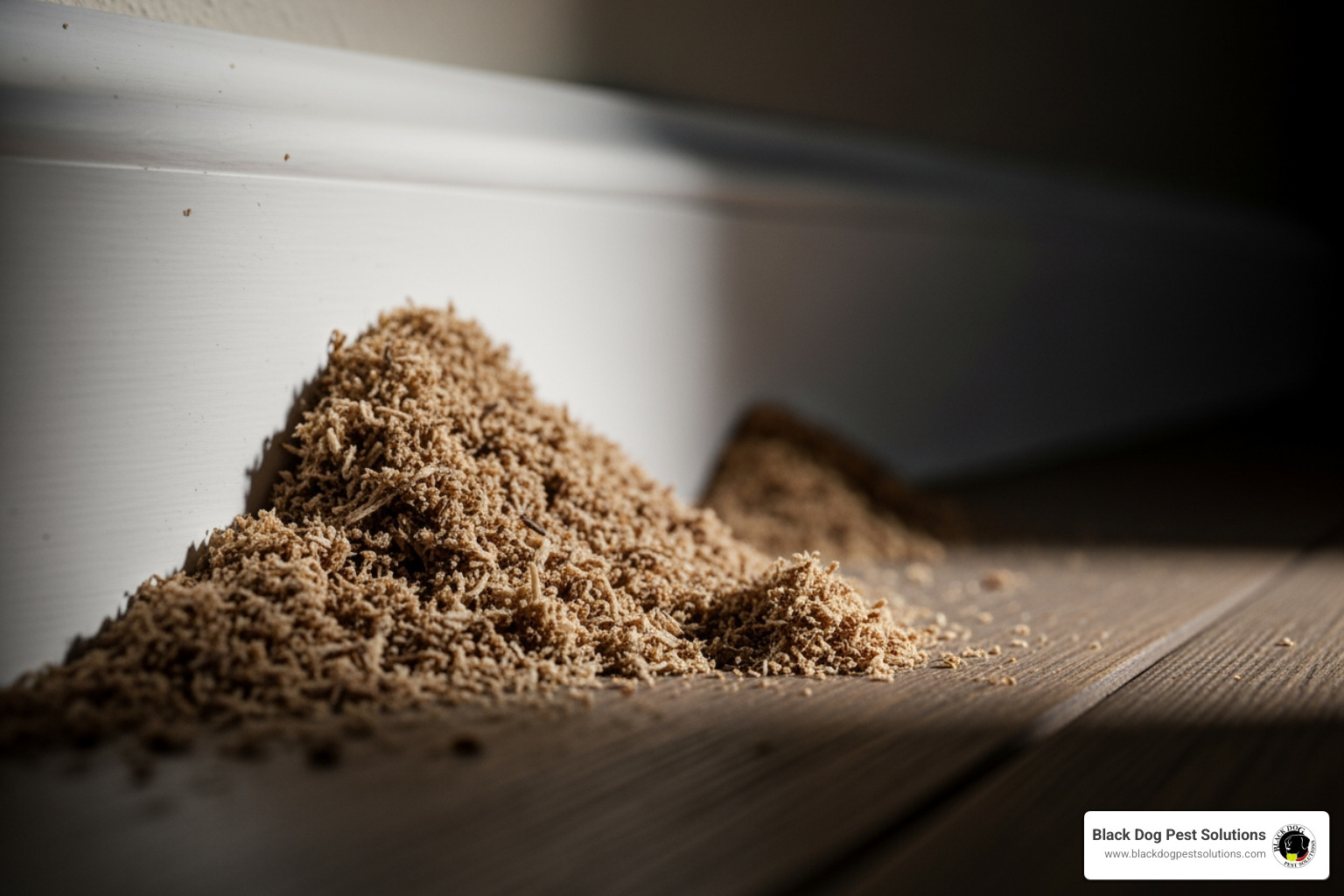
Because these ants are nocturnal and often live inside walls, you might not see the ants themselves right away. Instead, look for “frass.” Unlike termites, which eat wood, carpenter ants simply excavate it. They push the debris out of “kick-out” holes.
Common signs include:
- Frass: Piles of coarse sawdust that often contain insect parts and wood shavings.
- Rustling Sounds: If you press your ear to a wall (or use a stethoscope) at night, you may hear a faint dry rustling or crackling sound—this is the sound of thousands of mandibles clicking.
- Winged Swarmers: Seeing large, winged ants indoors during May 2026 is a major red flag. This usually means a colony is at least 6 to 10 years old and has more than 2,000 workers.
- Smooth Galleries: If you find damaged wood, carpenter ant tunnels will look smooth and sandpapered, unlike the mud-filled tunnels termites leave behind.
You can learn more about general ant behavior on our Ants information page.
Common Nesting Locations
Carpenter ants typically maintain a “parent nest” and several “satellite nests.” The parent nest requires high moisture to keep the eggs and queen healthy, often located in a rotting stump, a woodpile, or a decaying tree within 100 yards of your home.
Satellite nests, however, can be found in drier areas. Indoors, we often find them in:
- Wall cavities and insulation.
- Hollow-core doors.
- Areas around chimneys or skylights where flashing has leaked.
- Voids under bathtubs or behind dishwashers.
- Decks and trees that touch the structure.
Step 1: Inspection and Nest Location
You cannot effectively kill carpenter ants by just spraying the few you see on your kitchen counter. To solve the problem, you must find the colony.
Tracking Foraging Workers
Since only 10-15% of the colony leaves the nest to forage, those workers are your best scouts. Carpenter ants are most active between 10 p.m. and 2 a.m. Grab a flashlight and head out to the perimeter of your home during these hours.
Follow the ants. They follow permanent chemical trails (pheromones) that act like a highway between the food source and the nest. If you can’t find a trail, you can “bait” them into showing you where they live. Place a small amount of honey, sugar water, or even a freshly killed insect near where you’ve seen activity. Once the ants find the “honeydew” or sugar, they will take a direct path back to the nest.
This is the most critical part of evicting carpenter ants from your house. If you find them entering through a gap in the siding or a utility line, you’ve found your target.
Step 2: Effective Mixtures and Baits to Kill Carpenter Ants
Once you’ve identified the trails, it’s time to use their social nature against them. Carpenter ants share food through a process called trophallaxis (mouth-to-mouth transfer). This means if one worker eats a slow-acting bait, they will eventually feed it to the larvae and the queen.
Choosing the Right Bait to Kill Carpenter Ants
Carpenter ants are picky eaters. Their nutritional needs shift throughout the year.
- Spring/Early Summer: They often focus on proteins to help the queen produce more brood. Granular protein baits are highly effective now.
- Late Summer/Fall: They often shift toward carbohydrates (sweets) to fuel the workers. Liquid or gel sugar baits work best during this phase.
Using a combination of both is a strategy often used in professional ant removal services. If you use a spray that kills them instantly, they never make it back to the nest, and the colony survives. Patience is key; baits can take 1 to 3 weeks to fully eliminate a colony.
Using Boric Acid and Dusts to Kill Carpenter Ants
For nests hidden inside wall voids, “desiccating dusts” are incredibly effective. Boric acid is a classic stomach poison that is also abrasive to the ant’s exoskeleton. When ants walk through the dust, it sticks to their legs; they ingest it later while grooming.
You can use a hand duster to inject boric acid or diatomaceous earth into cracks, crevices, or even behind electrical switch plates (be careful around wiring!). This reaches the ants where liquids cannot. For more eco-friendly ideas, check out these natural ways to tell carpenter ants to buzz off.
Step 3: Non-Repellent Perimeter Treatments
If you’ve ever used a standard “bug spray” from a big-box store, you might have noticed the ants just move to a different room. This is because most consumer sprays are repellents. They detect the chemical, panic, and scatter—a process called colony fragmentation that can actually make the infestation worse.
Professional pest control companies in Avon use non-repellent liquid insecticides. These chemicals are undetectable to the ants. They walk through the treated zone, pick up the active ingredient, and spread it to the rest of the colony through contact. This “transfer effect” is a game-changer for large-scale elimination.
Applying these treatments around the foundation, entry points, and where the siding meets the ground provides a residual barrier that continues to work for months. This is a staple of summer ant prevention strategies in Ohio.
Step 4: Long-Term Prevention and Exclusion
Eliminating the current colony is only half the battle. If your home remains attractive to ants, a new queen will move in by next spring.
Sealing Entry Points
Carpenter ants can squeeze through gaps about 1/4 inch or smaller. To keep them out, you need to be meticulous.
- Caulk: Use high-quality silicone caulk to seal gaps around window frames, door frames, and where utility lines (electric, gas, water) enter the house.
- Metal Mesh: For larger gaps or weep holes, use stainless steel wool or metal mesh. These materials are more resistant to chewing than foam or plastic.
- Screens: Ensure all window and attic vent screens are intact.
Landscaping and Sanitation
Our team at Black Dog Pest Solutions often finds that the biggest “ant magnets” are in the yard.
- Moisture Control: Fix leaky outdoor faucets and ensure gutters aren’t clogged. Wet wood is the primary attractant for these ants.
- Vegetation Clearance: Trim tree branches and shrubs so they do not touch the roof or siding. These act as “ant bridges” that allow them to bypass your perimeter treatment.
- Firewood Storage: Store firewood at least 20 feet away from the house and keep it elevated off the ground.
- Stump Removal: Old, decaying stumps are the number one source of parent colonies in Northern Ohio. If you can’t remove them, treat them directly.
By following these steps, you are practicing Integrated Pest Management (IPM), which focuses on long-term prevention rather than just temporary fixes. Many pest control companies in Avon recommend this holistic approach to keep your home safe.
Frequently Asked Questions about Carpenter Ants
Do carpenter ants eat wood?
No. This is a common myth! Carpenter ants do not have the enzymes to digest cellulose. They only excavate wood to create galleries for their young. Their actual diet consists of “honeydew” (a sweet liquid produced by aphids), other insects, and household food like grease, meat, and sweets. However, the excavation process is what causes structural damage over time.
How long does it take to eliminate a colony?
Elimination is rarely overnight. Using a baiting strategy, you will usually see a spike in activity for the first 3 to 5 days as the ants discover the food. You should see a significant reduction within 2 weeks, but full colony elimination—especially for large mature nests—can take 3 to 6 weeks. It is vital to keep the bait fresh and undisturbed during this time.
Can I use vinegar to stop carpenter ants?
Vinegar is a great cleaning agent, but it won’t kill carpenter ants in a way that destroys the colony. Vinegar (and dish soap) works by disrupting the pheromone scent trails the ants use to navigate. While this might stop them from using a specific path for a day or two, they will simply find a new way around unless you address the nest itself.
Conclusion
Successfully managing carpenter ants in Northern Ohio requires more than just a can of spray. It demands a “SMART” approach: inspecting the property, identifying the specific nesting sites, using strategic baiting, and sealing the home against future invaders.
At Black Dog Pest Solutions, we pride ourselves on being the local experts for homes in Avon, Elyria, and the Greater Cleveland area. With a 4.9-star Google rating and years of experience in the local climate, we understand exactly how these pests behave in our corner of Ohio. We prioritize Integrated Pest Management (IPM) to ensure your family and pets are safe while we handle the heavy lifting.
If you’ve seen the signs of an infestation or want to ensure your home is protected for the season, don’t wait for the damage to get worse. Schedule a Carpenter Ant Inspection with us today and let our family-owned team give you the peace of mind you deserve.