
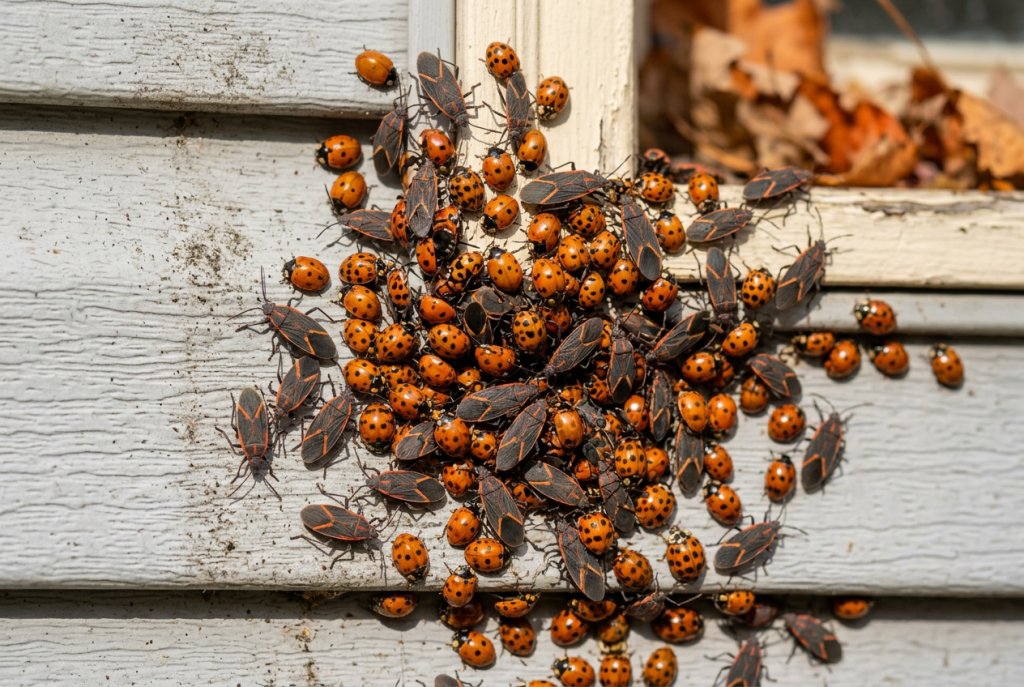
Each fall, one group of insects stops caring about your garden. It starts caring about your walls.
Northern Ohio overwintering pests include four common ones: brown marmorated stink bugs, boxelder bugs, multicolored Asian lady beetles and cluster flies.
All four can seek sheltered spaces in and around buildings in fall. They do not all gather or enter the same way, and the timing and entry points differ by insect.
Four insects, four life stories, one shared season. Here is how each one behaves.
Four Northern Ohio overwintering pests, one shared season
| Insect | Comes from | Moves to buildings | Ends up | Bites or damage? |
| Brown marmorated stink bug | Fruits, seeds, stems and leaves of many plants | Autumn, seeking shelter | Protected voids and sheltered areas, including attics and upper levels; enters near windows, chimneys and AC units | Does not bite; pungent odor when disturbed |
| Boxelder bug | Seed-bearing boxelder and silver maple trees | Warm autumn days | Wall cracks, door and window casings, foundations | Does not bite; may produce an odor when crushed and may leave stains on surfaces |
| Multicolored Asian lady beetle | Aphid-rich plantings | First day over 64°F after a sharp cold drop, usually mid- to late October in Ohio | Cracks and crevices in and around buildings, often in clusters | Does not damage the structure, but may bite or pinch, emit a defensive odor or stain light surfaces |
| Cluster fly | Larvae parasitize earthworms in soil | Late summer and early fall | Wall voids, ceiling voids and attics; may become active on warm days in heated buildings and emerge into rooms | Harmless; no bite, food or fabric damage |
Sources: Brown marmorated stink bug, OSU Extension ENT-90; boxelder bug, OSU Extension 2106; multicolored Asian lady beetle, OSU Extension ENT-44; cluster fly, Michigan State University Extension and Virginia Cooperative Extension.
The trigger is a temperature swing, not a date
The most useful number in fall work comes from Ohio research on multicolored Asian lady beetles.
This trigger applies to that beetle, not to stink bugs, boxelder bugs or cluster flies.
Lady beetle adults start hunting for overwintering sites on the first day above 64°F that follows a sharp drop in temperature, often to near freezing. In Ohio, those conditions usually show up in mid- to late October (OSU Extension ENT-44).
That is a weather pattern, not a date on a calendar.
Local Northern Ohio weather patterns can shift the timing of fall insect activity from year to year. National Weather Service normals for 1991–2020 put Cleveland’s average first frost on October 14 and its average first freeze on October 28. Akron-Canton runs earlier, on October 8 and October 19 (NWS Cleveland).
Similar weather conditions may occur more than once during fall. Across Northern Ohio, those conditions can appear from late September into early November.
Boxelder bugs run the same logic in reverse during winter. On warm winter and early spring days, they come out onto light-colored surfaces on the south and west sides of houses to sit in the sun (OSU Extension 2106).
Lady beetles add another clue. Research shows they are drawn to surfaces with strong contrasting vertical patterns (OSU Extension ENT-44).
Why some Northern Ohio homes get hit every single year
Cluster flies are a soil story, not a sanitation story.
The maggots are internal parasites of earthworms. Adults are among the first insects active in spring, and they lay eggs in cracks in the soil (MSU Extension).
Read that again and the pattern clicks. Cluster fly pressure tracks the ground around a home. A spotless house on a damp, worm-rich lot can still get them every single year. No amount of kitchen cleaning changes that.
Lady beetles work differently. They follow aphids through summer, then gather. The key difference from our native lady beetles: this one seeks hibernation sites in and around buildings, while native species usually overwinter in sheltered outdoor spots (OSU Extension ENT-44).
Ohio’s history with the beetle also explains why the problem seems to come and go. It was recognized here in October 1993, when residents reported thousands massing on homes. Numbers stayed high through the 1990s and early 2000s. They fell mid-decade, and by 2007 the beetles were seldom a problem. Then they rebounded in 2013, with many local reports of large numbers entering homes (OSU Extension ENT-44).
A few quiet years is not proof that a house is sealed.
Why spraying indoors fails on overwintering pests
This is the part homeowners in Avon, Bay Village and North Ridgeville learn the hard way, year after year.
Once cluster flies settle into wall voids, ceiling voids and attics, it is practically impossible to kill enough of them to make a meaningful difference. Aggressive treatments may cut indoor numbers temporarily because nearly every hidden harborage cannot be reached. New flies may continue emerging from inaccessible wall or attic voids (MSU Extension).
There is a second twist. In heated buildings, cluster flies may become active on warm days and emerge into rooms from hiding spots (MSU Extension).
That is why people can find a dozen slow-moving flies at a sunny window in January.
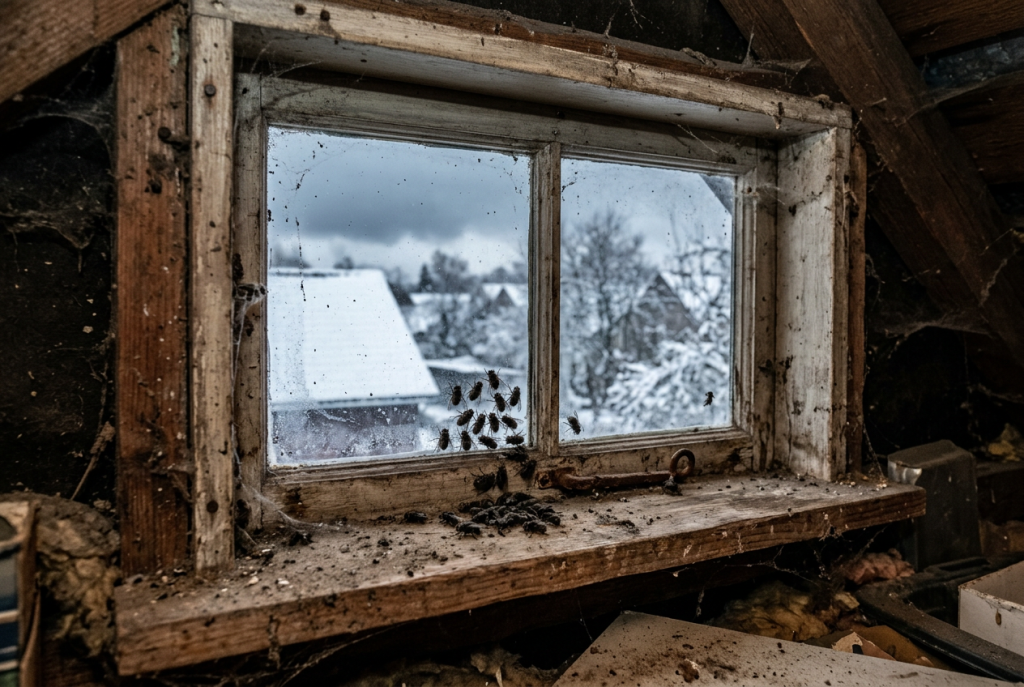
Stink bugs behave much the same way. They get in through small exterior openings, especially around windows, chimneys and air conditioner units. They shelter in protected voids and areas such as attics and upper levels. In extreme cases, hundreds can invade one home (OSU Extension ENT-90).
Where the real leverage is: outside, before the trigger
Every source above points toward the same long-term strategy: identify and seal exterior entry points before large numbers of insects enter.
That is true for all four of these overwintering pests across Northern Ohio.
- Seal exterior gaps. Caulking cracks and holes outside, especially on south- and west-facing walls, can reduce how many cluster flies get in (MSU Extension).
- Seal interior gaps second. Sealing around outlet boxes, switches, light fixtures, window and baseboard molding can limit how many insects already inside voids reach living spaces (MSU Extension).
- Clear harborage at the foundation. For boxelder bugs, remove piles of boards, rocks, leaves, grass and debris near the house (OSU Extension 2106).
- Close the common openings. Repair torn screens, add door sweeps, screen attic and foundation vents, and seal gaps around utility-line entries, trim, window frames and siding transitions (EPA).
- Know the host trees. Boxelder bugs feed on seed-bearing female boxelder and silver maple trees. They do not feed on male trees (OSU Extension 2106).
Sequence matters more than product choice for overwintering pests. Exterior work completed before the insects enter can reduce the number that reach wall voids and attics. Late-season sealing may not remove insects already inside those spaces, but it can still address entry points for future activity.
Seeing insects gathering on your siding?
Black Dog Pest Solutions can assess and help manage common overwintering-pest issues across its Northeast Ohio service area.
Learn more about our boxelder bug services, stink bug services and fly control services.
Frequently asked questions
What triggers stink bugs and lady beetles to come to my house in fall?
Ohio research found multicolored Asian lady beetle adults begin looking for overwintering sites on the first day above 64°F after a sharp temperature drop, usually in mid- to late October (OSU Extension).
That specific temperature trigger applies to multicolored Asian lady beetles. Stink bugs move toward buildings in autumn to find shelter (OSU Extension).
Do stink bugs bite or damage a house?
They do not bite people or pets, and they do not damage the structure. They can give off a pungent odor when disturbed and may arrive in large numbers (OSU Extension).
Why do cluster flies keep showing up indoors in winter?
In heated buildings, cluster flies may become active on warm days and emerge into rooms from wall, ceiling and attic voids (MSU Extension).
Can I just spray inside to get rid of cluster flies?
Indoor treatments may provide only short-term relief once cluster flies are established in inaccessible voids. New flies may continue emerging from hidden areas that cannot be reached (MSU Extension).
Why are boxelder bugs on the same side of my house each year?
On warm winter and early spring days, boxelder bugs gather on light-colored surfaces on the south and west sides of buildings to sit in the sun (OSU Extension).
Are these Northern Ohio overwintering pests dangerous to pets or food?
Cluster flies are harmless. They do not bite, are not known to spread disease and do not infest stored food (MSU Extension).
Boxelder bugs are not known to bite people or animals (OSU Extension).
Prepare your home before fall pest activity increases
If stink bugs, boxelder bugs, lady beetles or cluster flies are gathering around your home, addressing exterior entry points before they move into protected spaces can make a difference.
Contact Black Dog Pest Solutions to schedule a fall exterior inspection for your Northern Ohio property.