Where to Find Commercial Pest Control Supplies
If you’re looking for commercial pest control supplies near you, here’s a quick overview of what’s available and where to find them:
- Local pest control distributors – Wholesale suppliers (like Target Specialty Products with 46+ locations across North America) carry professional-grade insecticides, rodenticides, baits, dusts, and equipment
- Online professional suppliers – Sites like pestcontrolsupplies.com and pestmanagementsupply.com ship concentrates, aerosols, IGRs, and traps directly to businesses
- Local pest control companies – Many licensed operators (including pest control companies in Avon) can source or recommend products and provide expert application services
- Janitorial and facility supply distributors – Some carry commercial-grade pest control products alongside cleaning and safety supplies
Note: Ohio requires a pesticide business license for anyone applying pesticides for hire. General-use professional products are more widely available for business owners to apply on their own property, though some professional-grade products are restricted-use.
Pests are one of the most common — and most disruptive — problems businesses face. Restaurants, warehouses, offices, and healthcare facilities all deal with them. And when a pest problem shows up, the pressure to act fast is real.
The good news? You have options. Between hiring a licensed pest management professional and sourcing commercial-grade supplies directly, there’s a wide range of tools available to protect your facility, stay compliant, and keep pests out for the long term.
This guide covers everything from equipment and product categories to licensing, safety, and where to buy locally in Northern Ohio.
I’m Mat Ledyard, owner of Black Dog Pest Solutions in Avon, Ohio, with nearly two decades in the pest control industry — and I’ve sourced and used commercial pest control supplies across dozens of facility types, from restaurants to light industrial spaces. That hands-on experience shapes everything in this guide, so you can make smarter decisions for your business.
Quick look at commercial pest control supplies:
- commercial exterminator near me
- commercial pest control companies near me
- commercial pest control companies
Understanding Commercial Pest Control Supplies
When searching for the right tools to protect your business, it is essential to understand how commercial products differ from what you find on standard retail shelves. Commercial-grade pest control supplies are formulated for high-efficiency, durability, and targeted action. While a standard residential spray might offer a quick, temporary fix, professional-grade products are designed to address the root of an infestation and help prevent future occurrences.
The primary difference lies in chemical concentration and residual efficacy. Commercial concentrates are mixed on-site and applied using specialized equipment. These products are strictly regulated by the Environmental Protection Agency (EPA) to ensure they do not pose unnecessary risks to the public or the environment when used correctly.
When evaluating commercial pest control supplies near you, local businesses often consult with established pest control companies in Avon to understand which active ingredients are most appropriate for their specific industry. Furthermore, it is important to note that Ohio requires a pesticide business license for anyone applying pesticides for hire. If you are managing your own commercial facility, you can purchase and apply general-use professional products, but any hired application must be done by a licensed professional.
Essential Equipment Found at Commercial Pest Control Supplies Near You
To apply professional-grade products safely and effectively, you need the right tools. Standard household spray bottles will not cut it when treating a large warehouse or a commercial kitchen.
Here is the essential equipment typically stocked by local commercial suppliers:
- Pump-Up and Backpack Sprayers: These are the workhorses of commercial pest management. They allow for precise application of liquid insecticides along baseboards, perimeters, and cracks. For reliable sprayers, professionals often turn to trusted brands, such as those found at Chapin Products – Pump-up Sprayers – Professional Pest Control – KECSupplies.com .
- ULV (Ultra-Low Volume) Foggers: These machines break down liquid insecticides into tiny droplets, creating a fine mist that penetrates deep into hard-to-reach voids, drop ceilings, and large open spaces.
- Bait Stations: Secure, tamper-resistant bait stations are critical for both rodent and insect control. They protect the bait from weather conditions and prevent non-target animals or unauthorized individuals from accessing the rodenticides.
- Exclusion Materials: Preventing pests from entering in the first place is the most effective long-term strategy. This includes heavy-duty door sweeps, silicone-based sealants, and copper or stainless steel mesh. When sealing entry points, keep in mind that mice can squeeze through gaps about 1/4 inch or smaller. Using metal mesh is highly recommended because metal materials are more resistant to chewing than expanding foam or plastic.
Regulatory Compliance and Licensing for Commercial Pest Control Supplies Near You
Using professional pest control supplies in a business setting comes with significant regulatory responsibilities. Unlike residential use, commercial pesticide application is subject to strict oversight by local health departments, OSHA, and the Ohio Department of Agriculture.
First, you must distinguish between general-use and restricted-use pesticides. General-use professional products can be purchased online or from local distributors and applied by business owners on their own property.
Second, maintaining proper documentation is mandatory. Businesses must keep Safety Data Sheets (SDS) for every chemical stored or used on-site. These sheets outline safety protocols, first-aid measures, and environmental hazards. Keeping detailed records of what was applied, where, and when is also crucial for passing health inspections, particularly in food service and healthcare environments.
Integrated Pest Management (IPM) and Sector-Specific Solutions
Every industry faces unique pest challenges. A restaurant deals with grease-loving pests like German cockroaches and fruit flies, while a logistics warehouse is more likely to struggle with rodents chewing through inventory. To handle these varied threats, professional pest control relies on Integrated Pest Management (IPM).
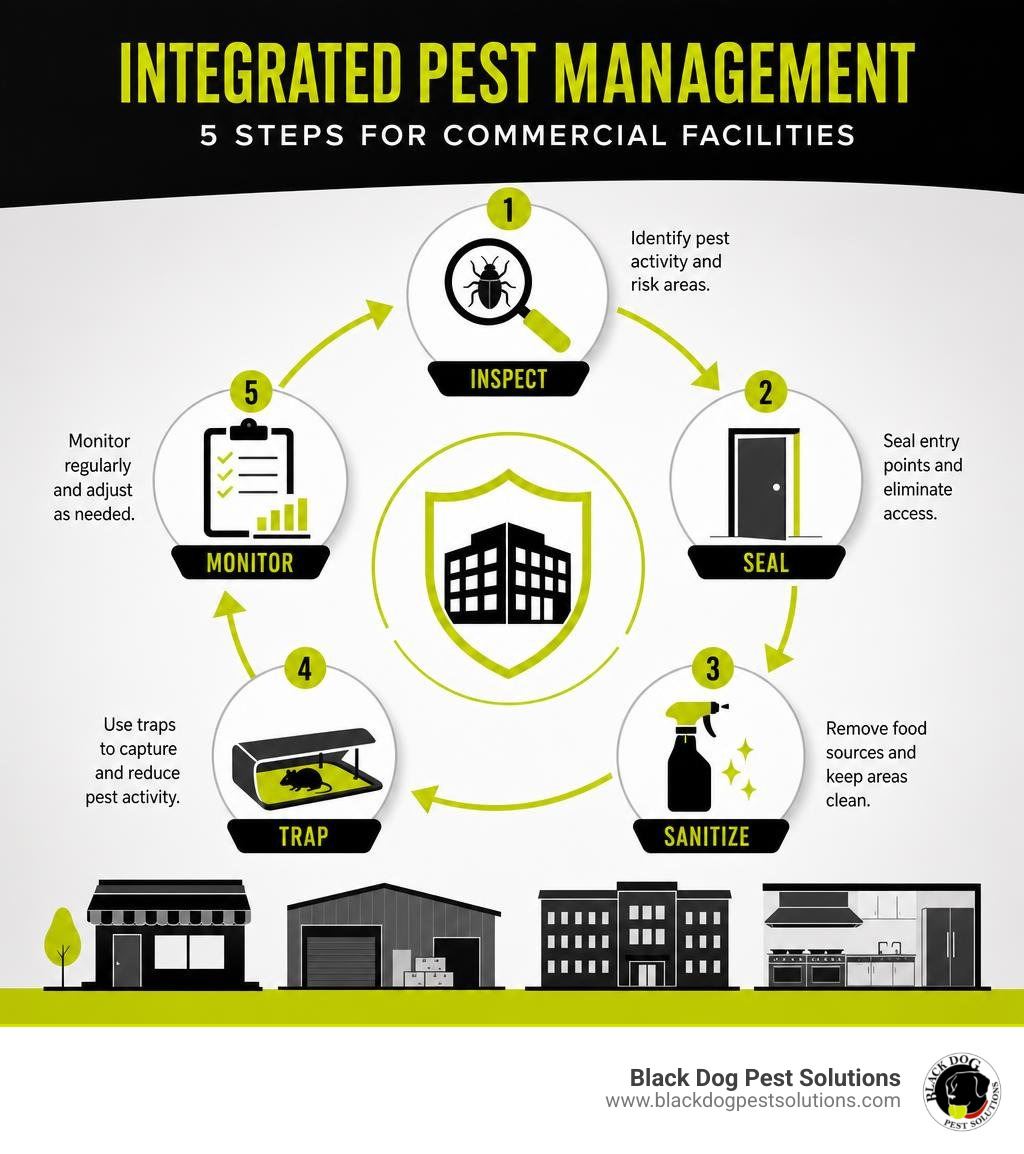
IPM is a science-backed, holistic approach that prioritizes long-term prevention. Instead of relying solely on chemical sprays, IPM focuses on a continuous cycle: inspect, seal, sanitize, trap if needed, and monitor. By focusing on sanitation and exclusion first, you reduce the need for heavy chemical applications, creating a safer environment for your employees and customers.
For businesses in the food industry, managing flying insects is a constant battle. Implementing a structured program is key to keeping your dining areas clean and compliant. You can learn more about managing these specific pests in our guides on How to Implement a Commercial Fly Control Program That Works and How to Effectively Eliminate Fruit Flies in Commercial Settings. Ensuring a high standard of sanitation is the foundation of any successful Dining Without Pests: Top Restaurant Pest Control Services program.
Humane Rodent Control and Exclusion Strategies
Rodent control in commercial spaces requires a careful balance of effectiveness and ethics. Businesses increasingly prefer humane mouse control methods that focus on minimizing stress and suffering while ensuring the property remains rodent-free.
Prevention is always the best long-term approach. To keep mice out, you must conduct a thorough inspection of your building’s exterior. Look for any gaps, cracks, or utility penetrations. Mice reproduce quickly, and a small family can rapidly grow into a major problem if left unchecked.
- Seal the Gaps: Focus on any openings that are about 1/4 inch or smaller.
- Choose the Right Materials: Fill these gaps with stainless steel or copper mesh, and seal them with a high-grade silicone caulk. Metal materials are far more resistant to chewing than standard foam.
- Consider Live-Catch Traps: Where appropriate, live-catch traps can be used to capture mice without harming them. If you choose this route, you must check the traps frequently per instructions to prevent the animals from suffering from dehydration or stress.
- Variable Release Guidance: If you plan to release captured rodents, release guidance can vary by location and situation. Always consult local wildlife guidelines before releasing animals back into the wild.
Local weather and building conditions can make homes and commercial properties more attractive to mice, especially during seasonal transitions when rodents seek warmth and food sources indoors.
Moisture Control and Springtail Management
Springtails are tiny, wingless insects that thrive in high-moisture environments. While indoor or pool springtails are completely harmless to humans and structures, they can gather in massive numbers, making them an annoying nuisance for businesses and customers alike.
When dealing with springtails, moisture control is the primary fix. Chemical treatments should always be considered secondary to moisture control and exclusion. If you do not resolve the underlying dampness, these pests will continue to return.
To manage springtails and keep them away from your facility, follow these practical steps:
- Manage Mulch: Keep organic mulch at least 12 to 18 inches back from your building’s foundation. Use gravel, river rock, or stone near the home or commercial structure instead.
- Fix Drainage Issues: Ensure the ground slopes away from your foundation so water does not pool against the walls.
- Extend Downspouts: Direct water from your roof gutters several feet away from the building.
- Avoid Overwatering: Adjust automatic sprinkler systems so they do not oversaturate the soil near the structure.
- Trim Vegetation: Cut back low-hanging branches and thick shrubs to improve airflow and allow sunlight to dry the soil.
- Seal Entry Points: Use weather stripping and caulk to seal low-level gaps around doors and basement windows.
If springtails find their way indoors or into outdoor pools, they can easily be vacuumed up or skimmed off the water surface. However, if the moisture issues are resolved but the problem persists, calling a licensed pest professional is the best way to identify hidden water leaks or damp areas. Reputable pest control companies in Avon can help you locate the source of the moisture and establish a long-term barrier.
Professional Services vs. DIY Commercial Pest Control
Many business owners wonder whether they should purchase commercial-grade supplies to handle pest control in-house or hire a professional service provider. Sourcing your own supplies from reputable distributors like DIY Pest Control: Pest Control | Shop Pest Control Supplies & Lawn … can offer flexibility, but it also comes with added labor and regulatory risks.
| Feature | DIY Commercial Pest Control | Professional Pest Control Services |
|---|---|---|
| Upfront Cost | Lower; you only pay for supplies and basic tools. | Higher; includes labor, expertise, and service guarantees. |
| Time Commitment | High; requires staff training, application time, and monitoring. | Low; technicians handle everything during scheduled visits. |
| Regulatory Compliance | Business owner assumes all liability for chemical storage and SDS logs. | Service provider manages documentation, licensing, and compliance. |
| Equipment Maintenance | You must clean, repair, and store sprayers and safety gear. | Professionals bring their own state-of-the-art, calibrated equipment. |
| Efficacy & Expertise | Relies on staff knowledge; potential for incorrect application. | Trained technicians target pests at their source using IPM. |
While purchasing supplies directly can offer cost savings, partnering with professional pest control companies in Avon ensures your facility stays in compliance with local health codes. For businesses in the food service sector, understanding the financial side of pest management is crucial. You can explore our detailed breakdown in Budgeting for a Bug-Free Business: Restaurant Pest Control Pricing Explained. If you decide to delegate this responsibility, learning How to Select the Right Pest Control Partner for Your Restaurant will help you choose a reliable, long-term ally.
Frequently Asked Questions about Commercial Pest Control Supplies
Do I need a license to purchase professional-grade pest control products in Ohio?
In Ohio, you do not need a license to purchase general-use professional pest control products for use on your own business property. These are widely available from professional pest control distributors and online suppliers. However, Ohio requires a pesticide business license for anyone applying pesticides for hire. Additionally, restricted-use pesticides, which carry higher environmental risks, always require a certified applicator license to purchase and apply.
How can businesses safely store and document commercial pest control chemicals?
Commercial chemicals must be stored in a dedicated, locked storage area that is cool, dry, and well-ventilated. The storage area should be clearly labeled with warning signs and kept out of reach of customers and unauthorized staff. You must keep a printed copy of the Safety Data Sheet (SDS) for every chemical on-site to remain compliant with OSHA standards. Accurate application records—detailing the product name, EPA registration number, volume used, and application date—must also be maintained for compliance inspections.
What are the best exclusion materials to prevent rodent entry?
The best exclusion materials are those that pests cannot easily chew through or degrade over time. Heavy-duty stainless steel or copper mesh is highly effective for filling voids, as metal materials are much more resistant to chewing than expanding foam. Pair these meshes with high-quality exterior silicone sealants to block airflow and odors. Focus on sealing any opening that is about 1/4 inch or smaller, paying close attention to utility line entry points, foundation cracks, and gaps beneath exterior doors.
Conclusion
Maintaining a pest-free commercial facility is essential for protecting your reputation, satisfying health inspectors, and ensuring the safety of your employees and customers. Whether you choose to manage minor issues in-house using professional-grade supplies or establish an Integrated Pest Management program, taking a proactive approach is the key to long-term prevention.
When you want to ensure your business remains compliant and pest-free, relying on trusted pest control companies in Avon like Black Dog Pest Solutions is the safest way forward. As a licensed, family-owned business founded by Mat Ledyard, we have proudly served Northern Ohio since 2014. With a 4.9/5-star Google rating and full BBB accreditation, we combine industry-leading expertise with the personalized care of a local partner.
We can help you implement a tailored IPM program that addresses your facility’s unique vulnerabilities, allowing you to focus on running your business with peace of mind.
Ready to secure your business against pests? Explore our comprehensive Commercial Services or reach out to our team today to schedule a professional consultation!