
When mice are in your walls, they usually announce themselves with a sound before you ever see one. You’re lying in bed, the house is quiet, and something scratches or scurries behind the drywall. Across Northern Ohio that sound tends to start in October, and there’s a reason for the timing. University of California IPM notes that house mice frequently enter homes in autumn when nighttime temperatures become colder, and the Internet Center for Wildlife Damage Management says mice are most likely to invade structures as temperatures cool in the fall.
This post covers how to tell whether you’re hearing mice, what the other signs look like, why a few traps from the hardware store often miss a wall problem, and when it makes sense to bring in help. If you want the full exclusion checklist, our September guide to rodent proofing in Northern Ohio walks through every gap to seal.
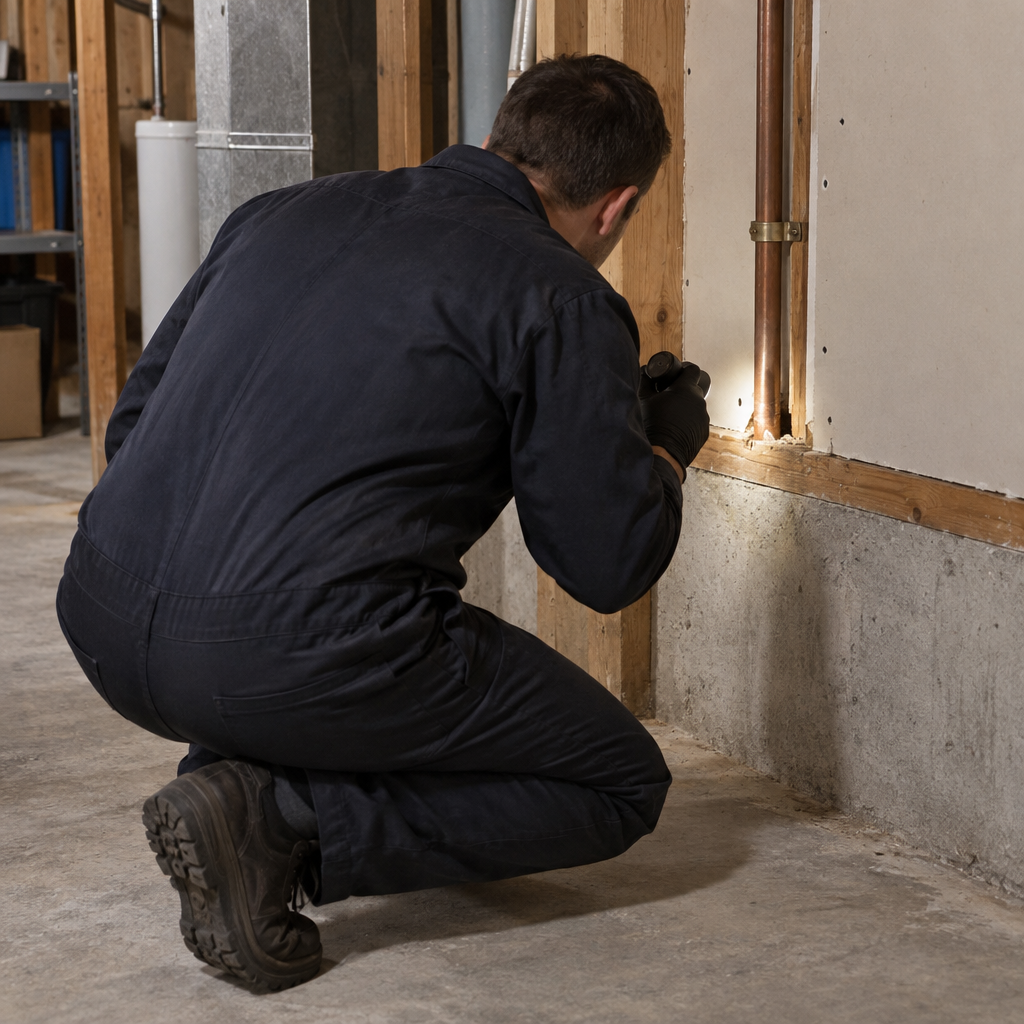
How to tell if you have mice in your walls
Sound is the first clue for most people, and the time of day matters. House mice are active mostly at night, according to UC IPM, though they can show up in daylight when food is available. So scratching, light scurrying, or a faint rustle that picks up after the house goes quiet fits the pattern for mice. Mice are also strong climbers. They can run up any rough vertical surface, the same pest note says, which is how they reach upper floors and ceiling spaces through the wall cavity.
Sound alone can’t confirm the animal. Attic and ceiling noise can come from other wildlife too, and the openings and methods differ by species. That’s why the physical signs below matter more than what you hear.
Droppings

Droppings are the easiest sign to find and the most useful. They sit on the UC IPM list of evidence, along with fresh gnaw marks and tracks, that shows where mice are active. Check along the base of walls, under the kitchen sink, behind the stove and refrigerator, and inside lower cabinets. Fresh droppings in a spot you cleaned last week tell you the activity is current.
Gnaw marks and damage
Mice gnaw on food packaging, cardboard, and soft building materials. The ICWDM damage guide says mice can cause extensive damage to insulation inside walls and attics, and that damage happens in homes and apartments as well as farm buildings. Wiring is the bigger worry. UC IPM notes mice can chew on appliance cords and wires in walls, and that many fires of unknown origin are believed to be caused by rodents gnawing on wires.
Nesting material and odor
House mouse nests are made from finely shredded paper or other fibrous material, according to UC IPM. ICWDM adds that nests usually run 4 to 6 inches across and that mice prefer to nest next to heat sources such as compressors, pilot lights, and water heaters. A musky odor is also common in large or long-term infestations, so a smell near a wall or closet is worth a closer look.
How mice move through a house
A mouse in your wall doesn’t wander the whole house. It works a small area over and over, which changes how you should look for it and how traps need to be placed.
| Mouse behavior | The figure | What it means for a wall problem |
| Gap it can use | Under gaps 1/4 inch tall. Through openings 3/8 inch wide. | A small gap at a sill or pipe is enough to reach the wall void. |
| Range from the nest | Seldom more than 30 feet. | The nest is usually close to where you hear or find signs. |
| Trap spacing | No more than about 10 feet apart. | One trap in the middle of the room won’t cover the runway. |
| Jumping | Up to 12 inches onto a flat surface. | Counters and shelves are within reach. |
| Detecting movement | At least 15 feet away. | They notice you long before you notice them. |
Source: University of California Statewide IPM Program, Pest Notes: House Mouse.
ICWDM gives a similar picture from another angle. One mouse travels an area that averages 10 to 30 feet in diameter during daily activity and may leave and return to its nest up to 40 times a day. Mice learn and memorize their pathways, food, and shelter. Once they’ve settled into a wall, they keep using the same routes.
Where mice get into the wall
The wall void is rarely the entry point. Mice usually get in lower down and move up through the cavity. ICWDM tells inspectors to examine outside and inside sill plates, foundations, door thresholds, and utility lines, and to seal openings larger than 1/4 inch. University of Kentucky Extension puts that 1/4 inch gap at about the diameter of a pencil and calls out the bottom corners of doors as a common spot where rodents and insects enter.
Material matters when those gaps get sealed. The UC IPM note warns that plastic screening, rubber, vinyl, expanding foam, and wood are ineffective for plugging holes used by house mice. ICWDM says expanding foam can reduce heat loss but won’t stop mice. Metal, concrete, and hardware cloth hold up.
Why store-bought traps often miss a wall problem
Traps work. The same source calls trapping a good first step and the preferred method in homes where only a few mice are present. The trouble with a wall problem is placement. Traps catch mice that cross them, and a mouse living in a wall void may travel inside the cavity and come out only at one or two openings you haven’t found yet.
The placement rules in the UC IPM note show how precise this has to be. Set traps close to walls so mice pass directly over the trigger. Put them behind objects, in dark corners, and where you’ve found droppings. Space them no more than about 10 feet apart where mice are active, and use enough traps to make the effort short. Keep traps where children, pets, and other animals can’t reach them.
A few common products don’t help much:
- Ultrasonic plug-ins. UC IPM says there’s little evidence that sound, magnetic, or vibrating devices drive established mice from buildings. ICWDM notes ultrasound doesn’t travel around corners or through walls well.
- Expanding foam alone. It fills the hole but mice chew through it, as noted above.
- Glue boards as the main tool. ICWDM says glue boards have a lower capture rate than other traps and shouldn’t be the primary method.
The problem with bait inside walls
Poison bait can create a new problem when mice live inside a wall. House mice tend to stay within about 30 feet of their nest, UC IPM points out, so mice that eat rodenticide often die inside the structure being treated. If a dead mouse in a wall would cause an odor or sanitation problem, UC IPM says trapping may be the best approach. Timing adds to the risk. EPA notes that most rodenticides are anticoagulants and that death typically happens four days to two weeks after rodents begin feeding, which gives a mouse plenty of time to crawl back into a cavity.
Bait still has a place in some situations, handled by someone who knows the label and where the bait can safely go. An active wall infestation is a reason to think about placement first.
When to call for help
Some signs point to more than one or two mice. ICWDM says mice may have 5 to 10 litters a year, with litters of 5 or 6 young, so a small problem can grow over one winter. Consider a professional inspection if you notice any of these:
- Scratching in more than one wall or on more than one floor.
- Fresh droppings coming back after you’ve cleaned and trapped.
- Chewed wiring, insulation, or stored belongings.
- You can’t find how they’re getting in.
Black Dog Pest Solutions handles mice and other rodents in homes across Northern Ohio. Rodent service includes identifying entry points, removing rodents, and putting preventive measures in place.
FAQ
Why do I only hear the scratching at night?
House mice are active mostly at night, according to UC IPM. They can be active in daylight when food is available, but nighttime noise in a quiet house is the most common sign.
How do I know it’s mice and not something bigger?
Sound alone can’t tell you. Look for droppings, fresh gnaw marks, tracks, and shredded nesting material near the noise. Other wildlife can also make noise in attics and ceilings, and the right fix depends on the species.
Can mice damage the wiring in my walls?
Yes, they can. UC IPM says mice can chew wires in walls and that many fires of unknown origin are believed to be caused by rodents gnawing on wires.
Will the mice leave on their own in spring?
You shouldn’t count on it. Mice are active year-round, and ICWDM says they may breed year-round. Once they’ve learned the routes and food sources in your home, they tend to keep using them.
Should I use poison bait?
Be careful. UC IPM notes that mice that eat bait often die inside the structure, which can leave an odor in the wall. For small numbers indoors, UC IPM calls trapping the preferred method.
Does expanding foam keep mice out?
Not on its own. UC IPM lists expanding foam among materials that are ineffective for plugging mouse holes. Metal, concrete, and 1/4 inch hardware cloth hold up better.